Having trouble reading in English? Then translate it!

Popular Posts

Showing posts with label mayfair. Show all posts

Monday, 15 November 2021

COSTLY COFFEE, GEORGE FRIDERIC HANDEL, AND JIMI HENDRIX


Coffee, the blues, and baroque in London's Mayfair


THERE ARE TWO entrances to Lancashire Court from Mayfair’s Brook Street. One of them, the closest to New Bond Street, is a cobbled lane leading down to a courtyard occupied by the back entrance of the Victoria’s Secret store and the outdoor tables of a restaurant called Hush Mayfair. The tables under delightfully decorated canopies looked enticing, and as we felt the need for some coffee, we sat down to enjoy small macchiatos (maybe more correctly, ‘macchiati’). The coffees were enjoyable but not exceptional. However, the bill that arrived after we had drunk our tiny coffees was far from unexceptional. We were charged just under £13 (US $17.46, INR 1300, or EUROS 15.25) for our two hot drinks. Just in case you are not familiar with the London café scene, today, November 2021, two macchiatos usually cost between £4 and £6.


Hush, Mayfair

Lancashire Court is a network of lanes and courtyards located behind the buildings on the southwest corner of the intersection of New Bond Street and Brook Street. It was once a part of London, the Conduit Mead Estate (www.ianvisits.co.uk/blog/2021/07/05/londons-alleys-lancashire-court-w1/, an informative web page), that followed the course of an old water conduit that ran through the area in a north/south direction (for a map of the district, see: www.bl.uk/onlinegallery/onlineex/crace/t/largeimage88092.html). From the 1730s until the 1970s, the buildings in Lancashire Court included many workshops, warehouses, and builder’s yards. In 1987, there was a plan to demolish the network of alleys and replace it with a new shopping complex, but this never materialised. Now, the old businesses have been replaced by ‘chic’ establishments including the place where we enjoyed our exorbitantly priced coffees.


Returning to Brook Street, the short section lying between the two entrances to Lancashire Court has two neighbouring houses, numbers 23 and 25, which have importance in the history of music in London. The composer of well-known works such as “The Messiah” and “The Water Music”, George Frideric Handel (1685-1759), moved into what is now number 23 in the summer of 1723, and lived there until his death (https://handelhendrix.org/plan-your-visit/whats-here/handel-house/). In Handel’s time, Brook Street was known as ‘Lower Brook Street’. Handel’s home included a Music Room in which as many as 40 people would be accommodated to perform and listen to Handel’s latest creations.

23 and 25 Brook Street


In 1968, 209 years after Handel died, another musician moved into number 25, the house next door to number 23 Brook Street. Like Handel, the occupant of number 25 was a musical innovator. His name was Jimi Hendrix (1942-1970). According to a useful website (https://handelhendrix.org/plan-your-visit/whats-here/hendrix-flat/):

“The flat on the upper floors of 23 Brook Street was found by Jimi’s girlfriend Kathy Etchingham from an advert in one of the London evening newspapers in June 1968 while he was in New York. He moved in briefly in July before returning to the United States for an extensive tour. He spent some time decorating the flat to his own taste, including purchasing curtains and cushions from the nearby John Lewis department store, as well as ornaments and knickknacks from Portobello Road market and elsewhere. He told Kathy that this was ‘my first real home of my own’.

He returned to Brook Street in January 1969 and almost immediately launched into an exhaustive series of press and media interviews and photo shoots in the flat. On 4 January he made his infamous appearance on the BBC Happening for Lulu TV show, and gave his two Royal Albert Hall concerts in February. In March he was back in New York again and although Kathy remained at Brook Street for a while longer Jimi did not live there again.”


Handel mural in Lancashire Court

After Hendrix’s girlfriend left the flat, it was used as office space. In 2000, it was taken over by the Handel House Trust. By 2016, both Handel’s House and Hendrix’s flat became open to the public as a museum, which I have yet to visit. Sadly, since the onset of the covid19, the museum, now known as ‘Handel and Hendrix in London’ is only open occasionally and will open fully in March 2023.


Lancashire Court is marked in red

The westernmost of the two Brook Street entrances to Lancashire Court is lined with an attractive mural made from ceramic tiles. Created in 2001 by Michael Czerwiǹski (with Ray Howell), it celebrates Handel’s residence in Brook Street. Amongst the many works he composed whilst living there, here is a very small selection of them: the opera “Rodelinda”; “The Messiah” and “Semele”; and “Music for the Royal Fireworks”.


Each of the two musicians of Brook Street did much to change the course of musical history. I wonder what each would have thought of the other, and which of them has the most listeners today. Whatever the answers, their names will live on in people’s minds far longer than that of both the place where we had costly coffee and the currently trendy Victoria Secret high-end but low-cut lingerie store.


Friday, 12 November 2021

ART DECO AND PIANOS IN MAYFAIR


THE CORNER OF BROOK Street and Haunch of Venison Yard (in London’s Mayfair) is adorned with a fine building with a white Portland stone façade. It is built in the art deco style. The building, Greybrook House (28 Brook Street), was constructed in 1929 and designed by Sir John Burnet and Partners (https://historicengland.org.uk/listing/the-list/list-entry/1392996). 
Burnet, born in Scotland, lived from 1857 to 1938.


Greybrook House was built to house the showrooms of the piano company, Bechstein, founded in 1853 by Friedrich Wilhelm Carl Bechstein (1826-1900). In 1901, the firm opened a concert hall, Bechstein Hall, on Wigmore Street. In 1917, the hall was renamed the Wigmore Hall and is still used today. The hall was next to Bechstein’s showrooms, which were closed in 1916 because of its German connection. In 1928, Bechstein’s, which had been closed during and after WW1, re-established itself in the UK, and commissioned the building of Greybrook House to be used for their new showrooms. In addition to showrooms, the new building included practice rooms and office space.


I am not sure when Bechstein left its Brook Street premises. However, I noticed that beside the entrance to the flats there is a beautifully carved calligraphic inscription that reads “Allied Ironfounders Ltd”. This company had its showroom in Greybrook House in the 1950s. Judging by a photograph I have seen on the Internet (www.ribapix.com/allied-ironfounders-showrooms-28-brook-street-mayfair-london-the-showrooms-entrance-with-the-brick-mural-men-of-iron-designed-by-trevor-tennant_riba25422#), it must have been quite exciting visually.


Currently, the ground floor of Greybrook House is occupied by Joseph, an upmarket clothing retailer. The upper floors have been converted into luxury flats by Fenton Whelan and Vanbrugh Prime Property. This was done recently.


The lovely art deco façade of Greybrook House remains unaltered. By chance, or who knows, maybe deliberately, Bechstein’s Brook Street showrooms were almost opposite the house where the composer George Frideric Handel (1685-1759) lived from 1723 until his death. Finally, the company that had its piano showrooms in Greybrook House is currently constructing a new set of showrooms and a small 100 seat concert hall back in Wigmore Street where their first London premises were located (www.rhinegold.co.uk/international_piano/c-bechstein-returns-to-londons-wigmore-street/).


Wednesday, 10 November 2021

Oscar Wilde, a bishop, and an art gallery


DOVER STREET RUNS north from Piccadilly, not far from The Royal Academy. It is a thoroughfare we often visit because it contains several commercial art galleries that frequently put on interesting exhibitions. One of these is the London gallery of Thaddeus Ropac. Not only does this international art dealer have good exhibitions, but the house in which the works of art are displayed, 37 Dover Street, is an artwork itsef, an architectural treasure.


The architectural historian, Nikolaus Pevsner (1908-1983), whose writing I enjoy greatly, is a little dismissive of the buildings in Dover Street with one exception. In his “London Volume 1”, which was co-authored by Bridget Cherry, he wrote of this street:

“The only house which needs special attention is Ely House (No. 37)”

This is the building that is now home to Thaddeus Ropac. Ely House was built in the 1770s by the then Bishop of Ely, Edmund Keene (1714-1781), who was appointed to that post in January 1771. According to The Dictionary of National Biography (1885-1900 edition), Keene:

“… obtained in 1772 an act of parliament for alienating from the see, in consideration of the payment of 6,500l. [i.e., £6,500] and an annuity of 200l., the ancient palace in Holborn, and for purchasing, at a cost of 5,800l., the freehold of a house in Dover Street, Piccadilly, London. The present house on that site was built by him about 1776.”

Clearly, the bishop was not short of cash; he was married to Mary (née Andrews), daughter and sole heiress of Andrews of Edmonton, once a successful linen draper in Cheapside.


The architect of Ely House was Sir Robert Taylor (1714-1788). The building remained the London residence of the Bishops of Ely until the beginning of the 20th century. In 1909, the interior of Ely House was greatly modified by the Arts & Crafts architectural firm Smith and Brewer (https://ropac.net/news/245-galerie-thaddaeus-ropac-ely-house-london/), and it became the home of The Albermarle Club. This private members’ club, founded in 1874, was open to both men and women, and was first housed at 13 Albermarle Street. Known for its liberal views on women’s rights, it was in 1895 the site of an incident that led to the first trial of one of its members, the writer Oscar Wilde (www.back2stonewall.com/2021/02/gay-lgbt-history-feb-18-oscar-wilde-accused-sodomite.html). Because of the club’s connection with proceedings that led to Wilde’s downfall, it moved to 37 Dover Street to distance itself from Albermarle Street where these unfortunate events had occurred.

Bottle rack by Marcel Duchamp


During WW2, Ely House became used by The American Red Cross Interstate Club. Later, it housed a private bank. When Pevsner and Cherry published their book in 1973, the house was being used by Oxford University Press. In Spring 2017, Thaddeus Ropac announced that they would open their London gallery in Ely House.


The exterior of Ely House might not have changed much since it was constructed. A medallion on the façade depicts a bishop’s mitre. The magnificent wrought iron railings topped with several models of lions was a 19th century addition based on the lions designed for The British Museum by the sculptor Alfred Stevens (1817-1875). The interior of Ely House would now be unrecognisable to Bishop Edmund Keene apart from a few decorative features that have been preserved. Furthermore, the artworks that are so beautifully displayed in the lovely, whitewashed rooms of the former Ely House would have seemed totally alien to the long-since departed bishop. Rarely, if ever, do the artworks displayed superbly in the gallery lack in visual interest and originality. What drew us to the gallery on the 9th of November 2021 was a small, intriguing collection of creations by Marcel Duchamp (1887-1968) in one room, and several rooms containing disturbingly lifelike, but not always life-sized, sculptures by Ron Mueck, an artist born in Australia in 1958, son of German-born toymakers.


Part of a sculpture by Ron Mueck

Dover Street is part of a network of Mayfair thoroughfares containing commercial art galleries. Amongst them Thaddeus Ropac has the most beautiful premises and is worth seeing not only for its artworks but also as a fine example of London’s architectural heritage.


Tuesday, 9 November 2021

GIN AND TONIC BEHIND THE PULPIT AND CHICKEN IN THE CHURCH


NAPOLEON BONAPARTE DIED in captivity on the tiny island of St Helena in the south Atlantic. While he was imprisoned on the island, Lieutenant General Sir Hudson Lowe (1769-1844) was the Governor of St Helena. He was buried at St Mark’s Church in North Audley Street in London’s Mayfair, where a commemorative plaque can be found by the main entrance. St Mark’s was built in the Greek Revival Style in 1825-28, designed by John Peter Gandy (1787-1850). In 1878, the church architect Arthur Blomfield (1829-1899) made considerable alterations to its interior including adding a timber vaulted ceiling over the nave.


During the 1950s and 1960s, the size of St Mark’s congregation diminished significantly. In 1974, the church was made redundant, and this is how it remained until 1994, when the church was used by The Commonwealth Christian Fellowship. It continued to serve this group until 2008. After that, it was used as a venue for occasional events. In about 2019 after a 5 million Pound restoration programme, the church underwent a surprising reincarnation.


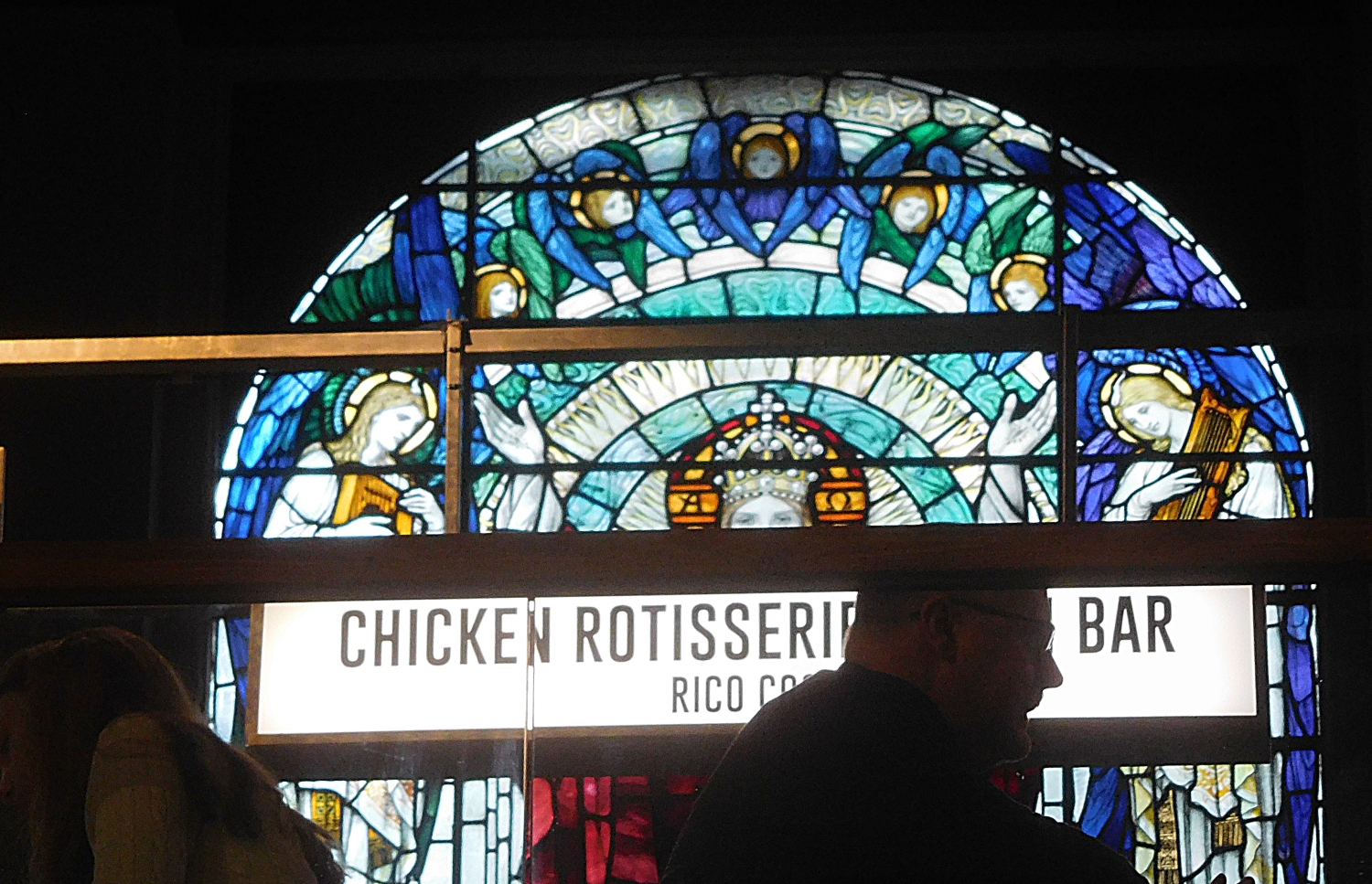
After passing beneath the grand portico supported by two columns topped with ionic capitals, one enters the church’s large vestibule. Since 2019, this has become a marketplace selling upmarket Italian delicatessen goods. Entering the body of the church is rather like taking part in a Fellini film. The floor of the nave is filled with tables and chairs and people drinking and dining. The side aisles, north and south, contain several kitchens, preparing and serving a wide variety of foods, from Turkish to Thai. On the north side of the chancel, just behind the neo-gothic stone pulpit, there is a gin bar, and facing it on the south side of the chancel, there is another bar providing alcoholic refreshments. Look upwards and you can admire the splendid timber roof supports. The wide gallery surrounding the nave at the first-floor level is home to more food stalls, each offering tempting looking fare at not unreasonable prices, especially by local Mayfair standards.


In 2019, the church became home to a branch of Mercato Metropolitano, whose first venture was converting a 150,000 square foot disused railway station in Milan during the 2015 World Expo in that Italian city. The idea of the company was:

“The development of the first Mercato Metropolitano was carefully planned to retain the site’s original appearance, which nurtured the local community’s affection for a special part of their urban history.”

 (https://www.mercatometropolitano.com/mmarketplace/#the-mercato-story).


And this is what has been done at the former St Mark’s in Mayfair. Many of the church’s fittings (for example, the tiled floors, the stained glass, the monuments, the pulpit, and the sacred paintings at the east end of the chancel) have been preserved. Entering the church is like entering the scene of a lively gargantuan feast. Seeing the large number of customers on a weekday lunchtime demonstrates that Mercato Metropolitano have successfully created a great place to meet, eat, and drink. It is highly original and exciting, both visually and gastronomically.


In Chapter 21 (verses 12-13) of the Gospel according to Matthew, we learn that:

“…Jesus went into the temple of God, and cast out all them that sold and bought in the temple, and overthrew the tables of the money changers, and the seats of them that sold doves, And said unto them, It is written, My house shall be called the house of prayer; but ye have made it a den of thieves.”

I just cannot help wondering, as many of you might also be doing, what The Good Lord would have made of what can now be seen inside the Church of St Mark’s in Mayfair.