Having trouble reading in English? Then translate it!

Popular Posts

Showing posts with label Essex. Show all posts

Monday, 15 November 2021

THE CONNECTICUT CONNECTION AND A LESSER KNOWN CATHEDRAL


THE CITY OF CHELMSFORD is the county town of the English county of Essex. 


It is a place that until November 2021 we felt. without any reason, was not worthy of a visit and have tended to avoid, skirting it on its by-pass. It was only recently that we realised that the place is home to a cathedral. Being nearby on a recent tour in Essex and curious about its cathedral, we paid a visit to Chelmsford and were pleasantly surprised by what we found.


The cathedral, which I will discuss later, is housed in what used to be the parish church of St Mary. The edifice is in the centre of a pleasant grassy open space. One of the buildings on the south side of this green bears a plaque commemorating Thomas Hooker (1586-1647), who was the curate and ‘Town Lecturer’ (a position established by the Puritans) of Chelmsford between 1626 and 1629.


Hooker was born in Markfield, a village in Leicestershire (www.britannica.com/biography/Thomas-Hooker) and studied at the University of Cambridge (https://connecticuthistory.org/thomas-hooker-connecticuts-founding-father/). At Cambridge, he underwent a moving religious experience that made him decide to become a preacher of the Puritan persuasion. He became a well-loved preacher, first serving the congregation of a church in Esher (Surrey) before moving to preach at St Mary’s in Chelmsford in 1626. A preacher in a neighbouring parish denounced Hooker to Archbishop Laud (1573-1645), a vehement opponent of Puritanism, and was ordered to leave his church and to denounce Puritanism, which he was unwilling to do. In 1630, Hooker was ordered to appear before The Court of High Commission. Soon, he forfeited the bond he had paid to the court and, fearing for his life, fled to The Netherlands.


In 1633, Hooker immigrated to The Massachusetts Bay Colony, where he became the pastor of a group of Puritans at New Towne (now Cambridge, Mass.). To escape the powerful influence of another Protestant leader, John Cotton (1585-1652), Hooker led a group of his followers, along with their cattle, goats, and pigs, to what was to become Hartford in what is now the State of Connecticut. They arrived there in 1636.


When Hooker and his followers reached the Connecticut Valley, it was still being governed by eight magistrates appointed by the Massachusetts General Court. In 1638, Hooker preached a sermon which argued that the people of Connecticut had the right to choose who governed them. This sermon led to the drawing up of a document called “The Fundamental Orders of Connecticut”, which served as the legal basis for the Connecticut Colony until 1662, when King Charles II granted The Connecticut Charter that established Connecticut’s legislative independence from Massachusetts. Hooker’s importance in this process has led him to be remembered as “the father of Connecticut.”


In 1914, the church of St Mary in Chelmsford, was elevated to the status of ‘cathedral’. The reason for this is slightly complex but is explained in a well-illustrated guidebook to the cathedral written by Tony Tuckwell, Peter Judd, and James Davy. In the mid-19th century, London expanded, and the size of its population grew enormously. Many previously rustic parishes that became urbanised were absorbed from the Diocese of Rochester into the Diocese of London. This resulted in a denudation of the Diocese of Rochester. To compensate for this, Rochester was given parishes in Hertfordshire and Essex. The Archbishop of Rochester lived in Danbury, Essex, which was closer to the majority of his ‘flock’ than anywhere in Kent. In 1877, the county of Essex was transferred into the new Diocese of St Albans in Hertfordshire. However, by 1907, 75% of the population of this new diocese were living in Essex. A further reorganisation led to the creation of two new dioceses, one in Suffolk and the other in Essex. After some acrimonious competition between the towns of Barking, Chelmsford, Colchester, Thaxted, Waltham Forest, West Ham, and Woodford, it was decided that Chelmsford should become the cathedral seat of the new Diocese of Essex. St Mary’s, where Hooker of Connecticut once preached in Chelmsford, became the new cathedral. In 1954, the cathedral’s dedication was extended to include St Mary the Virgin, St Peter, and St Cedd, whose simple Saxon chapel can be seen near Bradwell-on-Sea.


The cathedral, of whose existence we only became aware this year, is a wonderful place to see. Its spacious interior with beautiful painted ceilings contains not only items that date back several centuries but also a wealth of visually fascinating art works of religious significance created in both the 20th and 21st centuries. To list them all would be too lengthy for this short essay, so I will encourage you to visit the church to discover them yourself.


Having just visited Chelmsford, its cathedral, and its tasteful riverside developments, my irrational prejudice against entering the city and preferring to avoid it by using its bypass has been demolished. Although Chelmsford might not  have the charm of cathedral cities such as Ely, Canterbury, Winchester, and Salisbury, it is worth making a detour to explore it if you happen to be travelling through East Anglia.


As a last word, it is curious that although there are places named Chelmsford in Massachusetts, Ontario, and New Brunswick, there does not appear to be one in Connecticut; at least I cannot find one.


Monday, 8 November 2021

SINGING AND SOCIALISM IN ESSEX

THAXTED IS A PICTURESQUE small town in Essex, about six and a half miles northeast of Stansted Airport. Apart from its numerous quaint old buildings, the town has three notable landmarks: an old windmill, a 15th century guildhall, and a large parish church, which was built between 1340 and 1510 during the time when Thaxted was an important centre for the manufacturing cutlery. Also, Thaxted is home to an annual music festival, whose existence derives from the discovery of the town by a composer, Gustav Holst (1874-1934), creator of “The Planets” and many other musical compositions, who was on a walking tour in Essex during the winter of 1913.


Holst, who was born in Cheltenham, was living in London by 1913 and teaching music at St Pauls School for Girls in Hammersmith, James Allen’s Girls School in Dulwich, and Morley College for adults in Lambeth. At the same time, he was busy composing.


Holst had come to study at The Royal College of Music in London in 1893. Soon after arriving in London, he became acquainted with William Morris (1834-1896) and attended meetings at the latter’s house in Hammersmith, where he would have heard lectures on socialism given by George Bernard Shaw (1856-1950) and others. Holst joined the Hammersmith Socialist Society (‘HSS’), which was led by Morris. Many of the socialists he met including Shaw were vegetarians, as was the composer Wagner, whom Holst greatly admired. As a student and a regular attender of meetings of the HSS, he became a vegetarian and at the same time developed a great interest in Hinduism (www.ivu.org/people/music/holst.html). He began studying Sanskrit at The School of Oriental and African Studies (https://www.bl.uk/20th-century-music/articles/holst-and-india) and several of his compositions bear Indian-sounding titles, such as “Savitri” and another opera called “Sita”, and songs based on the Rig Veda.


According to Nalini Ghuman:

“In contrast to the vague musical orientalism in vogue during the height of the British Empire, Holst’s hymns, with their bona fide Indian texts, subjects, and musical elements, have often seemed decidedly ‘un-Indian’ to the uninformed ear: ‘Sound firm impressions of the East from a sane Western perspective’ declared The Musical Times; ‘They do not suggest a point further East than Leicester-square’ (Daily Telegraph); after all, explained the Manchester Guardian ‘many real Eastern musical ideas are frankly ugly and uninteresting’. Their Indian musical roots have long been denied by the composer’s biographers.” (https://www.bl.uk/20th-century-music/articles/holst-and-india).

However, Ghuman points out in her article that Holst did incorporate elements of Indian music, including emulating Vedic chanting and a South Indian mode, the namanarayani. You would need to be a serious musician with specialist interest in Indian music to be aware of these features whilst listening to Holst’s Indian inspired compositions.


Returning to his political leanings, major biographies of Holst tend not to focus much on his connections with socialism, but an informative article, “Gustav HoIst, William Morris and the Socialist Movement” by Andrew Heywood (Journal of the William Morris Society, vol 11, no. 4: 1996), shows that his involvement was far from inconsiderable. In addition to attending meetings of the HSS, Holst conducted its socialist choir, played the harmonium on the ‘official socialist’ cart, and was involved in the administration of the society. Heywood wrote that:

“In the light of his clear commitment to the socialist movement through 1896 it would seem likely that his involvement with the musical activity of the society did not stem from a lack of political commitment; rather it was an opportunity to serve the movement in a way which utilised his musical talents and interest.”

It was through the HSS that Gustav met his wife Isobel, who not only sang in the socialist choir but also, according to Heywood, was politically active in the society.


So, it was with a background of involvement with socialism that Holst walked into Thaxted in late 1913 and took such a great liking to the place that he rented a 17th century cottage there (actually, in Monk Street, 1 ½ miles from Thaxted) from its owner, the Jewish author Samuel Levy Bensusan (1872-1958). Thus began Holst’s several year’s association with the town. It was not long before he made the acquaintance of Thaxted’s vicar, Conrad le Despenser Roden Noel (1869-1942). After the cottage in Monk Street burnt down, Holst and his family lived in a house, The Manse (formerly known as ‘The Steps’), in the centre of Thaxted. Today, this is marked by a commemorative plaque.


Noel was not a run-of-the-mill country cleric. He was a Christian Socialist and a member of Social Democratic Federation, a founder member of the British Socialist Party, and for some time the Chairman of the Anti-Imperialist League, supporting the struggle for independence both in Ireland and India. Deeply committed to Christian socialism, social justice, and egalitarianism, Noel made sure that what went on in his parish church promoted these ideals. Noel’s biographer, Reg Groves, wrote that Conrad:

“…emphasised always that there was much more to making a new society than the acquisition of political power and the transfer of some property from the rich to the state, from one set of rulers to another. In this as in so many things, he was at one with the wisest of English socialists, William Morris, and much of what Morris said in prose and poetry and in the work of his hand, Noel tried to say in the group life he had developed at Thaxted”.

Noel and Holst shared socialist sympathies and more.


During Holst’s sojourn’s in Thaxted in between his heavy teaching and other musical commitments, he attended services led by Noel. It was after one of these held at Whitsun in 1915, that Holst, having heard the great potential of singers in the church, approached Noel and offered to give the choir the benefit of his professional skills as a trainer of vocalists. Noel, recognizing the splendid opportunity, soon had Holst become his church’s ‘master of music.’


Heywood explains that Holst’s:

“…first job was to train the choir for the church. Its members were drawn from the local population, and they achieved high standards with Holst. One member, Lily Harvey from the local sweet factory, was sent to London for professional training because of her exceptional vocal talents. In addition to his activities with the choir and playing the organ, Holst organised three major music festivals in Thaxted between 1916 and 1918.”

Lily was not the only person sent to London for musical training. The then young curate Jack Putterill, who was politically turbulent and played the organ, became one of Holst’s students at Morley College. Jack, who married Noel’s daughter, succeeded Noel as Vicar in 1942.


The festivals organised by Holst involved not only performers from Thaxted but also some of his students from Morley College and St Pauls as well as other musicians from outside the town. Each festival lasted several days, on each of which there were many hours of music making, both rehearsed concert pieces and much spontaneous music.


Holst not only helped make music in Thaxted but also composed there. The plaque on the The Manse, where he lived, is positioned on the outside of the wall of the room in which he composed. While living at Monk Street, he composed much of what was to become the well-known piece, “The Planets”. The “Jupiter” section of “The Planets” contains a tune or theme that Holst named “Thaxted” (you can listen to this familiar tune here: https://youtu.be/GdTpBSg7_8E). In 1921, “Thaxted” was used as the tune for the patriotic song “I vow to Thee, My Country”, whose words were written by the British diplomat Cecil Spring Rice (1859-1918). Holst also composed pieces specially for Thaxted and its people. These works include a special version of Byrd’s “Mass for Three Voices”, “Three Hymns for Thaxted” (later known as “Three Festival Choruses”), and a setting of the Cornish carol “Tomorrow shall be My Dancing Day” (hear it on https://youtu.be/Cz_0j__FDuc).


Although the last festival in Thaxted with which Holst was intimately involved was in 1918, he never lost touch with music making in the town, even after he moved from it to nearby Little Easton in 1925. Holst’s pupil Jack Putterill, an accomplished musician who was Thaxted’s assistant curate from 1925 to 1937 and its vicar from 1942 until 1973, helped keep the town’s musical life alive and vibrant. In the 1950s and 1960s, concerts with great orchestras such as The London Philharmonic and audiences in excess of 1000 were held in the parish church. In 1974, the hundredth anniversary of Holst’s birth, the first of what was eventually to become an annual music festival was held in Thaxted. By the 1980s, the Thaxted Festival had become a regular and respected part of the British musical calendar (www.thaxtedfestival.co.uk/).


Apart from the Festival and the house with the plaque in Thaxted, most souvenirs of Holst’s time in the town can be found within the cathedral-like parish church, which, incidentally, was once a candidate for becoming Essex’s cathedral (this honour was granted to the parish church in the centre of much larger Chelmsford). The church in Thaxted contains a photograph of Holst with singers and musicians at the Whitsuntide Festival held in 1916. Near this, there is some calligraphy with the words of “Tomorrow shall be My Dancing Day”. The church’s Lincoln organ built in 1821 by Henry Cephas Lincoln (who worked between c1810 and c1855) was played by Gustav Holst and has been recently restored. Not far from the organ is a cloth banner, sewn by Conrad Noel’s wife, which was used in the 1917 Whitsuntide Festival. It bears the words “The aim of music is the glory of God and pleasant recreation”. These words were written by the composer JS Bach (1685-1750) and were chosen for use on the banner by Holst. Near this banner, there is a bust of Holst’s friend and collaborator, Conrad Noel.


Both Holst and his student Putterill fell in love with Thaxted at first sight and were so strongly drawn to it that the town came to occupy important places in their hearts and minds. We first visited Thaxted in the early summer of 2020 soon after covid19 restrictions began to be relaxed sufficiently to permit travelling out of one’s immediate neighbourhood. Like Holst and Putterill, Thaxted made a special impression on us, so much so that we have visited it at least twice since our first encounter with it. Next year, we hope to be able to attend concert(s) at the Thaxted Festival inside a church that we have grown to love.       


Saturday, 21 October 2017

A SURPRISING VILLAGE IN ESSEX


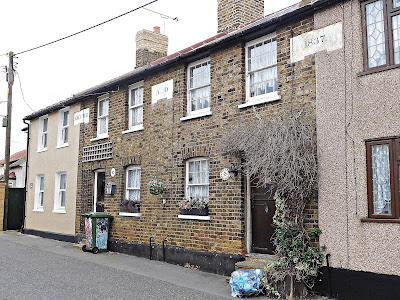
James Thorne wrote (in his “Handbook to the Environs of London”) in 1876: “East Tilbury is curiously out-of-the-way and old world like…”. It retains its feeling of being out-of-the-way, but no longer looks old world. Apart from the church, its rectory, and the fort, there are four cottages dated 1837. The rest of the buildings are much newer. The same goes for the village’s only pub, The Ship, which was rebuilt in 1957 when it looked the same as it does today. There has been an inn on its site since the 18th century, and maybe earlier. I had a mediocre lunch in the pub. I thought that was nowhere else to eat in the small village, but later discovered that the Fort (see below) has a café.
The flint and rubble gothic church of St Catherine contains much fabric dating back to mediaeval times, back to the 12th century. When viewed from the north or east, the church does not appear to have a tower. The reason is that the tower and part of the south aisle were destroyed by naval artillery in a battle between the British and the Dutch at Tilbury Hope in 1667. According to contemporaneous church records, by 1667 the tower was already in a poor state. Some say that it might have collapsed without the help of military intervention.

From the south side of the church, you can see an ugly square-based stone addition to the old church. This stump is all that was built of a replacement tower begun in the First World War by men of a garrison of the Coalhouse Fort (see below). It was to have commemorated those fallen in WW1. However, the authorities stopped the building works because the builders were not following correct procedures. Across the road from the church, stands the Rectory, an elegant brick building with large windows. It was built in the early 1830s to replace an earlier one which had been badly damaged in the battle mentioned above.


The village’s only thoroughfare continues downhill, almost to the north bank of the Thames. It ends at the car park for visitors to the Coalhouse Fort. During the early 15th century following an infiltration of the Thames by the French, King Henry IV allowed the inhabitants of East Tilbury, at that time classed as a ‘town’, to build defensive ramparts. In 1540, King Henry VIII ordered that a ‘blockhouse, be constructed at Coalhouse Point. This point on a curve in the Thames is so-named because by well before the 18th century coal was being unloaded from craft at this ferry point close to the village. The coal was transported westwards towards Grays and Chadwell along an ancient track known as the ‘Coal Road’.


In 1799, when it was feared that the French led by Napoleon Bonaparte would try to invade via the Thames, a new gun battery was built at East Tilbury.  In the 1860s, when another French invasion was feared, a series of forts were built along the shores of the estuary of the Thames. One of these was the Coalhouse Fort at East Tilbury. Thus, the by then somewhat insignificant village became part of London’s defences.

The Fort was built between 1861 and ’74. Surrounded by a semi-circular moat and raised on a mound, the Fort is not particularly attractive. However, it is set in beautifully maintained parkland. From the slopes of the mound, there are great views of the Thames, which sweeps around the point, and its rural southern shore. The moat is separated into two sections by a short sharp-ridged stone wall, which was likely to have been built when the Fort began to be constructed. When I looked for the Fort on old detailed (25 inch to the mile) Ordnance Survey Maps (pre-1939), the moat is marked, but the Fort is not (probably, in the
interests of security). A ‘Coalhouse Battery’, which ran more-or-less parallel to the village’s only street was marked as “dismantled” on a 1938 map, but not the Coalhouse Fort.


The outer walls of the Fort have had all manner of later structures built on them: gun-emplacements, searchlight emplacements, and other shelters, whose functions were not obvious to me. There is a large concrete bunker outside the Fort, between it and the moat. Its shape might be described as three intersecting concrete blocks.  This is marked on the tourist map as a ‘minefield control tower’. I believe that was it used to control electrically-fired mines in the estuary. Nearby and closer to the river, there is a smaller concrete bunker. The Fort’s interior was closed when I visited it, but I was able to get a peek through its main gates, which were open. Tramway tracks lead into the Fort. Old maps show that these led from the Fort to a small landing stage at Coalhouse Point, which is a short distance southwest of the Fort. The Fort ceased to be used after 1957.

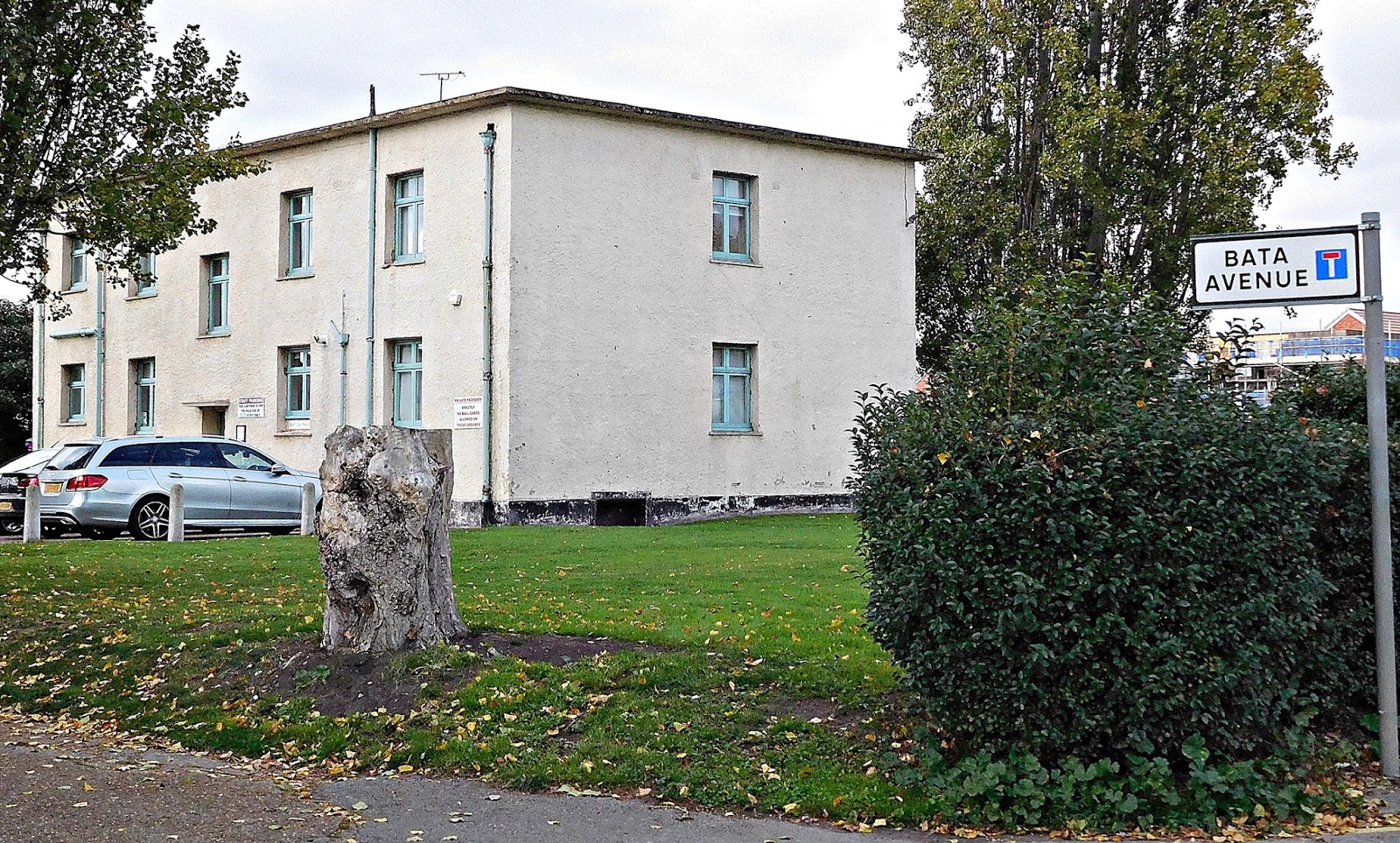
Just over a mile north-west of the Fort, the road to East Tilbury Station passes through a most fascinating place. One of the first things you will see along the road from the Fort is a vast factory, which closed in 2005. Made of concrete and glass, but in a poor state of decoration, its flat roof carries a high water-tower labelled ‘Bata’. This was part of the factory complex that the Bata Company began building in 1932.

The Czech Thomas Bata (1876-1932) was born in the Moravian town of Zlin. He became the founder of Bata Shoes in 1894 in Zlin. He modernised shoe-making by moving it from a craftsman’s process to and mechanised, industrialised one. Bata’s company also revolutionised the way industrial enterprises were run, introducing a profit-sharing system that involved all of its workers, and provided a good reason for them to work enthusiastically. During the period between the two World Wars, the forward-thinking Bata opened factories and individual companies in countries including: Poland, Yugoslavia, India, France, Holland, Denmark, the United Kingdom and the USA. The company in India is still very active, almost every small town or village having at least one Bata retailing outlet. I have bought many pairs of comfortable Bata-manufactured shoes from Bata stores in India.

In anticipation of WW2, Bata’s son, the prudent Thomas J Bata (1914-1980), and one hundred other Czech families firm moved to Ontario (Canada) to form a Canadian Bata company. After WW2, the Communist regimes in Czechoslovakia and other ‘iron-curtain’ countries nationalised their local Bata firms. Meanwhile, Thomas J continued to develop the Bata firms in Canada and the UK, and opened up new Bata companies and factories in Asia, Africa, the Middle East, and Latin America.
Bata senior was keen on the ‘Garden City Movement’.  He was concerned that his workers lived (close to his factories) and worked in a pleasant environment, and lacked for nothing. A pioneer of this in the UK was Titus Salt, who built his gigantic mill in the 1860s near Bradford in West Yorkshire. He created a new town, Saltaire, around his textile factory. This consisted of better than average homes for all of his workers (and their families) from the humblest to the most senior. In addition, he built schools, a hospital, open-spaces, recreation halls, a church, and other requisite of Victorian life.  In Zlin, Bata created something similar, a fully-equipped town for his workers in park-like surroundings around his factory in the 1920s. The homes he built for the workers are still considered desirable today.

The factory at East Tilbury, was another example of a town built specially for its workers. One lady with whom I spoke there told me that she had worked for Bata’s for twenty-seven years. She told me that in its heyday the Bata ‘town’ was self-sufficient. It had workers’ homes, shopping facilities (including a supermarket and a Bata shoe store), a restaurant, a hotel, a cinema, a school, a library, farms, and playing fields.
The factory buildings at the East Tilbury site, some of which have been adopted by other businesses, were built using a construction system devised (employing reinforced concrete frames that allowed for great flexibility of design) by the Czechs Frantisek Lydie Gahura (1891-1958), Jan Kotera(1871-1923), and Vladimir Karfic(1901-1996). The site bought by Bata in Essex in late 1931 was ideally placed in level open country near to both the railway and the river.  His intention was to build a vast garden city around his factories, which was to produce boots and shoes in East Tilbury.
Mr Bata senior was killed in an air-crash in 1932 near Zlin, and so never saw the completion of his creation in Essex, whose construction only began in early 1933. Construction of the factory buildings and the workers’ housing went on simultaneously.  By 1934, twenty semi-detached houses of the same design as those in Zlin were built by local builders, and equipped with Czech fittings. The houses look just like many houses built in Central Europe. As Steve Rose wrote in The Guardian newspaper (19th June 2006):
“East Tilbury doesn’t look like it belongs in Britain, let alone Essex, and in a sense it doesn’t. It’s a little slice of 1930s Czechoslovakia, and the most Modern town in Britain.”
Later, more homes were built, but designed like many British suburban houses.

There is a huge building across the main road opposite the factory buildings. Part of its ground floor is now home to a Co-op supermarket. The whole building, which has now been converted to flats, was the ‘Bata Hotel’. Until recently, the Co-op was still named the Bata supermarket. One man, who has lived in the Bata Estate for many years, told me that he recalled seeing swarms of workmen in white protective clothing crossing the road from the factory and then entering the hotel during their lunch-break. He told me that the first floor of the hotel was a ‘restaurant’ for the factory workers. 


I met this man in what is now called ‘East Tilbury Village Hall’. This was formerly the Bata cinema.Looking somewhat Central European in design, the former cinema was undergoing much-needed electrical re-fitting. In a way, I was lucky because the workers had left the door open to a building that is often locked closed these days. I entered the foyer, which was being used to store the stock of the local public library. An office to the left of the foyer used to serve as the cinema’s ticket office. A couple of old-fashioned film posters have been put on the foyer’s walls to recreate what it used to be like.

A man, who oversaw the hall’s maintenance, showed me the auditorium. It had a new wooden floor marked out for indoor sports. He explained that the floor had been ‘sprung’ when it was laid originally. This was so that it could be used as a dance-floor. The banked chairs for the audience were originally designed in an ingenious way, only lately beginning to be employed in other much newer buildings, so that they could be folded away when the hall was needed for, for example, a dance. There was a proper theatre stage at the far end of the hall. This still has the original stage lights that were fitted when the hall was built. The old-fashioned control panel for this lighting was still in place.

My guide then told me that beneath the stage, there was a reinforced bunker for use during air-raids. He took me through a door at the back of the stage, and then down some concrete steps. At the bottom, there was a heavy metal sliding-door painted grey. He slid this open to reveal the large reinforced concrete bunker beneath the stage. Its walls were thick. It is now used as a storage area.
After seeing the old cinema, I entered the large grassy area to the south of it. In the centre of it, raised on a stepped plinth, there is a war memorial. The memorial bears the words: “… to the memory of those of the British Bata Shoe Company who gave their lives for freedom 1939-1945”. To the south of the memorial park, there is a large field, now used for agricultural purposes, that was once a Bata playing field.

Across the road from the war memorial in the grounds of the factory, there is a statue of Thomas Bata senior, who died in 1932. When I visited it many years ago (in the late 1980s), it stood in a small green area, a little park. During my recent visit (October 2017) it was surrounded by tall piles of sand being used by building contractors.
Some of the Bata factory buildings have already been modernised and are being used for industrial or commercial operations. The main large derelict building, which is surmounted by a water tank, might be destined for conversion into ‘loft apartments’ for residential use. One building, a small tall construction near the main road, remains derelict at present. It might, one informant suggested, have been used for milling activities.
During the early 1980s, British Bata began greatly reducing its production activity at East Tilbury. The Bata industrial estate finally closed in 2005. With the closing of the British Bata firm, Bata shoe-retailers, which were common in British high streets, have disappeared. The nearest Bata shoe store to the UK is now in Best (just north of Eindhoven) in the Netherlands.

From having been one of the bastions defending London from naval attack along the River Thames, East Tilbury became home for an exciting and successful industrial enterprise. Now, the extensive vestiges of this are being restored and re-used in an attempt, which looks like being successful, to keep the area alive and prosperous.


READ FASCINATING BOOKS BY ADAM YAMEY

DISCOVER MORE HERE: