Having trouble reading in English? Then translate it!

Popular Posts

Showing posts with label karnataka. Show all posts

Friday, 24 November 2017

EXPLORING INDIA WITH A BABY


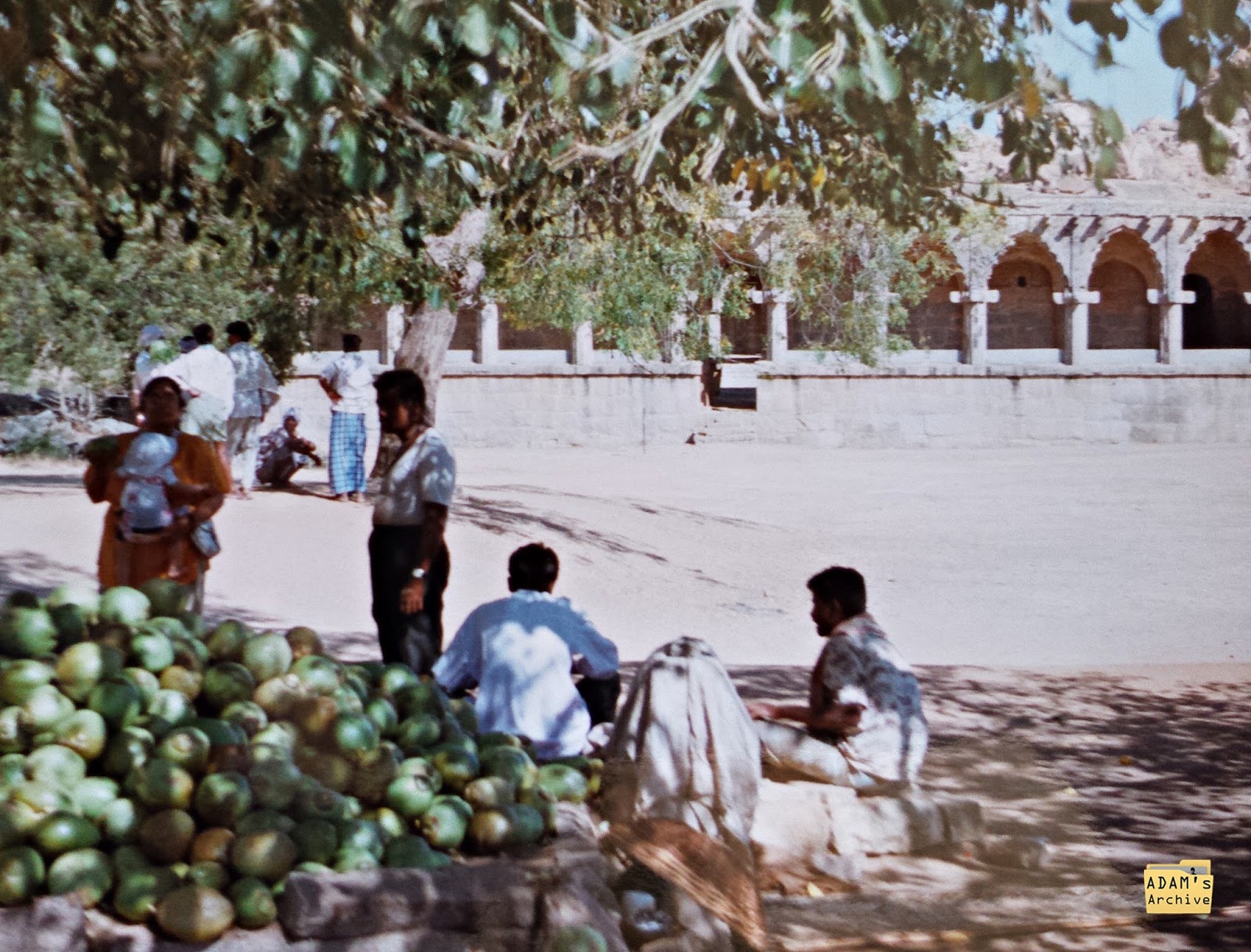
It was early in 1996. We never intended taking our nine-month old daughter to visit Hampi in the Indian state of Karnataka to see the ruins of the once great city Vijayanagara, which had in its heyday rivalled Rome in its splendour. We had hoped that her grandparents in Bangalore were going to baby-sit for us, but just before my wife and I were about to depart they felt unable to oblige. So, with little preparation, we boarded the sleeper from Bangalore to Hospet, the nearest town to Hampi. My wife clutched our little one on a narrow, hard, swaying railway bunk bed, desperately trying to prevent her from falling off.

At Hospet, our hosts, officials at a local mining company, greeted us with banners which they had made for us. They drove us to a comfortable hotel, whose rooms lacked air-conditioning and fridges. The ambient temperature never dropped below thirty Celsius, even at night. When our daughter needed a bottle of milk, we prepared it, and had to use, and then dispose, of it in less than 45 minutes because in that heat the artificial milk deteriorated rapidly.

Hospet in 1996 was less sophisticated that it was, say, a decade later. We ate in simple restaurants, often outdoors under shades. Our daughter took a shine to the South Indian food that we were usually served. She took this from our plates and, also, to our horror, off the not too clean floor. Years later, I can report that unlike many of her school friends she has never suffered from allergies. I am sure that her foraging in Hospet is to some extent to be thanked for that.


Occasionally, I felt like eating North Indian food. We found places, which bore the notice “NIDS”, which meant ‘North Indian dishes served”. I should have known better than to order a ‘NID’ in a very provincial South Indian area, but I did, and was usually disappointed by the curious concoctions that appeared on my plate. On one occasion, I ordered a ‘Peshawari naan’, something that I love. What arrived was surreal. It looked like a circular pizza base that had been painted bright green, and it was covered by bits of dried fruit and fresh banana. It was almost, as they say in the USA: ‘close, but no cigar’.

Optimistically, we had taken a folding ‘buggy’ to Hospet. This never got used, as there was hardly a square metre of ground smooth enough to roll it. Luckily, our hosts drove us around the vast archaeological site in a large four-wheel drive. Our daughter, sat happily perched on or other of our laps as we bounced across the rough ground between the various attractions.

In 1996, the ruins at Hampi were in a far better condition than they are now. For example, the Vittala Temple with its musical pillars was in fine condition. Now, it is a sad shadow of what it was in 1996. It has been vandalised by evil-doers as well as by the authorities, who have tried to save it from collapsing by adding hideous concrete supports.  Back in ’96, it was possible to wander from one attraction to another through a landscape romantically dotted with fragments of earlier civilisations, both Hindu and Islamic. In contrast, today the major attractions are walled off, and attract entry fees. Although I consider Hampi still to be a most exciting archaeological area, it has lost some of the charm that it had when we visited with our baby. She has not only visited Hampi thrice since and is planning another trip soon, but has also grown up to become a professional art-historian. I like to think that her early exposure to mediaeval Indian art has played a role in the evolution of her professional interests.

Our baby had no difficulty with the high temperatures and discomforts during our visit to Hampi and Hospet. She seemed to have enjoyed it immensely. Not only that, but so did the locals. Wherever we went, and this was true of most other places that we visited in India in 1996, she was adored by everyone including total strangers. We had thought that I, a ‘gora’ (a fair-skinned non-Indian), would have attracted attention during our trip from Bangalore, but this was not the case. I was ignored, but our little child was mobbed by well-meaning passers-by, especially little boys who patted her affectionately and told us how sweet she was.


Some short while after our trip to India, we visited Italy, a country famed for spoiling children with affection. At the end of our visit, we concluded that the Indians are far more ‘soppy’ about little children that even the Italians.


Enjoy books written by the author-dentist, ADAM YAMEY.

Sunday, 9 November 2014

BEEF IN BENGALURU (Bangalore)


BEEF IN BANGALORE (BENGALURU)


When I tell my friends and others in the UK that one of the very best places to eat beef is in the  land of the 'Sacred Cow' - India - they raise their eyebrows in surprise. I assure them that I am not pulling their legs.

Just before ending my very first visit to Bangalore in early 1994, my wife suggested that we ate a good biryani at a place which she considered to be good at making this kind of dish. We headed for Shezan's, which was located in an old-fashioned bungalow in Lavelle Road. The bungalow no longer exists, but the restaurant does, having relocated to another place in the same road. I looked at the menu and noticed that a large chateaubriand steak with trimmings was available for about 2 pounds (GB). I said that I would have that as the same thing would cost many times that in the UK, and that getting good biryanis was not difficult in London. The steak was outstandingly good. This was my introduction to eating beef in Bangalore.

We have visited Shezan's may times since, and always enjoy eating there. Some years after my 'discovery' of Shezan's, which also calls itseft 'The Other Place', I was taken to Only Place ('OP'). This restaurant was originally started by Haroon in a location on Brigade Road. Later, it shifted to Museum Road. Haroon and his son Shoaib served some of the best beef steaks that I have ever eaten.


The late Haroon of OP


Haroon died about 2 years ago. Shoaib and one of his relatives inherited the restaurant in Museum Road, and ran it as a partnership. About a year ago, Shoaib and his partner chose to split up. Shoaib left Museum Road, and his former partner continued to run it. We visited the restaurant once or twice after Shoiab had left it, but were not nearly as satisfied with it as when Shoaib had been involved.


After some time, Shoaib opened his OP at a new location: 311, 6th Main, 2nd Stage, Off 80 Feet Road, Indiranagar . This place in Indiranagar is in no way related to, or connected with, the OP in Museum Road. Shoaib's OP in Indiranagar is yet another reincarnation of the place that Haroon first created many decades ago in Brigade Road. The quality of the food and service at the 'true' OP in Indiranagar has not suffered in the slightest from the shift from Museum Road to Indiranagar. Shoaib's OP still serves some of the world's best beefsteak. You will spurn Aberdeen Angus, Charolais or Wagyu beef after eating what Shoaib and his team prepare with beef bred in Karnataka!  Shoaib's beef is so good that major embassies in New Delhi order it from him.


The Indiranagar OP, which should really be regarded as the ONE and  ONLY 'Only Place' is located in a tree-lined street opposite an open space belonging to Defence Colony Cricket Ground. Some of its tables are outside in the shade of the leafy branches of huge trees. Other tables are indoors in a simply decorated dining room. Apart from being a place to enjoy superb beef as well as seafood (try the king fish [seer fish] steaks and the jumbo prawns), this is a pleasant place to linger and to escape from the hustle and bustle of Bangalore. Whatever you choose from Shoaib's extensive menu that  contains mostly European (rather than Indian) dishes, you should leave space for a portion of  Shoaib's deliciously fruity apple pie. Shoaib's OP is not only renowned for its deservedly highly praised beef, but also for the aforementioned apple pie. So, even if you are a vegetarian, there is at least one reason for you to visit Shoaib's OP in Indiranagar. I have never tried the vegetarian dishes at OP as I am a true carnivore!


Finally, please do not confuse Shoaib's 'original' OP in Indiranagar with that establishment that is now running in Museum Road. The latter will disappoint you; the former - in Indiranagar - will delight you.


To read more by Adam Yamey,

click HERE

Thursday, 11 July 2013

RUSSIAN IN BANGALORE


Luminous streaks of clouds traverse the eerily lit, crisp outlines of the Himalayan Mountains. I have never seen these lofty peaks at the roof of the world in real life. So, these images that I have are only second-hand. They derive from seeing the magnificent series of paintings by the Russian-born artist Nicholas Roerich (1874-1947). These hang in the art gallery of the Karnataka Chitrakala Parisath ('CP'), a prestigious art college in Bangalore.


The CP is  located near the end  of Kumara Krupa Road furthest away from the Windsor Manor Hotel. It is set amongst extensive grounds. A large vestibule, open to the elements, gives access to a number of rooms on the ground floor. These include a ticket office, which doubles up as a bookshop, and some larger rooms that are used to house occasional exhibitions of hanficrafts. When I visited recently, one room contained a display of flower arrangements and another a sale of handicrafts made in Rajasthan.


The permanent exhibition of artworks is housed in rooms on the labyrinthine first floor. The first of these rooms that one reaches after ascending the staircase contains the series of pictures of the Himalayas to which I have already referred. Nicholas Roerich, who was already an accomplished painter in Russia, his native land, had already left Russia when he began traveling in Asia in the mid 1920s. By 1928, he and his family had settled in India where he lived out the rest of his life. His son Svetoslav (1904-1993) was also a prolfic painter. A couple of galleries in the CP are dedicated to displaying his highly colourful works, which in my opinion are not as fine as his father's but good nevertheless. He married the Indian film star Devika Rani, and painted her portrait frequently. He died in Bangalore.


Although I consider the collection of Himalayan pictures painted by Nicholas Roerich to be the highlight of the CP, there are many other delights to be discovered in its ill-lit, dingy rooms. One of these contains paintings mainly by Bengali artists. The earliest of these is a collection of paintings by artists of the Kalighat school who worked in 19th century Calcutta. Paintings by members of the Tagore family including Rabindranath and Abinandranath can be seen in this room as well as some political cartoons by another relative Gaganendranath. These reminded me of the somewhat grotesquely sinister works of the German artist Georg Grosz. The works of other artists hanging in this room show the influence of European artists who were breaking the mould in the 1920s, 30s, and 40s.


Moving on, we reached some rooms containing a wide selection of paintings and sculptures from artists who were/are working in more recent times. Although many of these works were created during the last 20 years or so, they are so badly conserved that they seem as if they were made many years earlier. The lighting in these galleries was poor even after it had been switched on. This is a great shame as many of the works on display are of the highest quality.

As one moves deeper into the building, one enters rooms containing everything from the sublime to the ridiculous. I will not dwell on the latter too long, but it includes sculptures that are, in my humble opinion,  unworthy of public display. Two of the many rooms are worthy of a visit. Although difficult to find, the search is worth the effort.


One room contains a collection of beautiful Karnatakan leather puppets. They resemble other oriental marionettes such as those used in the Javanese shadow plays. However, they look fragile and are badly displayed, often being attached to their backing displays by ageing pieces of adhesive tape.


Another room, deep inside the gallery contains a collection of Mysore paintings that date back to the 14th century. Many of the paintings on display at the CP were painted far more recently than this. One of them, which particularly intrigued me, was a genealogy of the Mysore Royal family (see above). Another picture in the collection showed the influence of the Company Style of painting, popular with British patrons stationed in India during the 18th and 19th centuries (see below).


The grounds of the CP contain a newly opened café, a branch of the Kamat chain; the college's library and sculpture studios; various other out-houses; a Hindu shrine; and a multi-leveled garden studded with sculptures. Occasionally, these grounds host 'Dastakar', a fair filled with stalls selling folkloric crafts from all over India.


Until a few years ago, the CP became the nucleus of one of the most wonderful art events in Bangalore, Chitra Santhe.  This event used to be held on the last Sunday of each year. The whole of Kumara Krupa Road was closed off to vehicular traffic. Artists lined the road with stalls from which they sold their works of art. Some were professional, many were students. We bought many beautifully painted watercolours from them over the years. Sadly, this event is no longer held. I do hope that it will be re-instated as soon as possible! The picture below was taken at one of these events.


The collection of art exhibited at the CP is of a far greater quality than that at the National Gallery of Modern Art in Bangalore ('NGMA'), which I wrote about earlier (see: http://yameyamey.blogspot.co.uk/2013/07/best-in-bangalore.html ). However, the care given to displaying the works at CP is far inferior to that at the NGMA. Also, the latter is very fortunate in that it is housed in a heritage building of great beauty. This said, any art lover visiting Bangalore would be well-advised not to miss devoting some time to exploring the superb collection housed in the CP.


FOR MORE INFORMATION ABOUT

ADAM YAMEY's WRITING

PLEASE VISIT:


AND


Sunday, 7 July 2013

BEST IN BANGALORE


Rome has its St Peters Basilica and Colisseum, Paris its Eiffel Tower and Notre Dame, and London its Trafalgar Square and British Museum. One could go on endlessly about the tourist attractions of these three cities and those of  of many others, but I wish to concentrate on Bangalore, the capital of the State of Karnataka in Southern India.

Until recently, the tourist sites of Bangalore were few and far between, and none of them are as memorable as those which I have listed above. Given the extremely unlikely chance of the city's roads being clear of the normally highly congested traffic, it would not take long to 'do' all of the tourist sites of Bangalore. Traffic permitting, a few hours would suffice to visit and enjoy Tipu's Palace, Lalbagh Gardens, Cubbon Park, Vidhana Soudha, the Iskon Temple, The Bull Temple, and Bangalore Palace. Of course, there is much more to see than these commonly listed 'attractions'. I would add to these, amongst other places, the colourful City Market, The Chowdeiah Memorial Hall, Malleswaram, and the crowded streets of the old City Area. However, none of these undoubtedly fascinating places could honestly be described as being 'world class' tourist attractions. Recently, in February 2009, the situation changed: the National Gallery of Modern Art Bengaluru ('NGMA') opened its doors. Bangalore now possesses a site worthy of a great detour.


The NGMA stands near a petrol station on Palace Road between the Bangalore Golf Club and Mount Carmel College. Its collections are housed in a beautifully restored old palace, which used to be a government office for the so-called 'Backwards Castes', and also in a tastefully designed modern annex attached to it. An expanse of water separates the old building from another new building that houses the Gallery's shop, ticket hall, offices, and cafeteria. 


A shady garden filled with modern sculptures, all properly labelled, separates the NGMA from the hooting of the autorickshaws and other vehicles speeding along the  busy Palace Road. I always enjoy looking at sculptures in the open air.


Usually, the old building houses the NGMA's permanent collection. This consists mainly of paintings, mostly of Indian subjects, dating from the late 18th century up to modern times. The works of a wide range of artists are displayed including many by Bengali artists including members of the illustrious Tagore family from Calcutta. The presence of one particular painting always surprises me. It is by the British Pre-Raphaelite Alma-Tadema, and appears to have little to do with India. Why it's hanging in Bangalore, no one has been able to tell me.


The recently built annex contains contemporary works and is often used to house temporary exhibitions. A year or so ago, we saw an exhibition of the paintings of Rumale Chennabasavia (1910-1988). His vividly coloured paintings of Bangalore and other places in Karnataka certainly make his reputation as the "Van Gogh of Bangalore" well-deserved.


While I am writing these words, both parts of the NGMA, the old palace and its annex, are housing temporary exhibitions.  The permanent collection of art in the old part has been displaced to make room for a travelling exhibition called 'Homelands'. Organised by the British Council, this showcases some pieces by contemporary British artists. The name of the exhibition alludes to its theme of multi-culturalism in the UK. It is a sort of immigrants' home thoughts from abroad. It is a tribute to the ever present theme of 'political correctness' that pervades life in contemporary Britain.


The new annex houses another exhibition. It is a collection of paintings by Bengal's cultural genius Rabindranath Tagore. This splendid display of paintings shows how Tagore's painting developed from decorative doodles on his literary manuscripts to sophisticated artworks that could be hung without hesitation next to works of his better known contemporaries, such as Picasso and Matisse.


Whether you see these two exhibitions, or others, or even just the permanent collection, the NGMA will not disappoint.  Its architectural excellence - both historical and modern - and the superb skill with which the artworks are displayed makes the NGMA a tourist atrraction that can be truly described as being 'world class'. 


Sadly, the NGMA is poorly publicised. Many Bangaloreans do not know of its existence. This is also the case for the city's numerous foreign visitors and its huge ex-pat community. It is a great shame that the NGMA cannot find the funds to give it the publicity that it truly deserves. In any case, I hope that this short article will help to put the NGMA onto every tourist's itinerary in southern India. 


For more information about Adam Yamey's writing
please visit :


& 


 \