Having trouble reading in English? Then translate it!

Popular Posts

Showing posts with label church. Show all posts

Wednesday, 24 November 2021

BLACK ABOLITIONISTS IN A WESTMINSTER CHURCH


WESTMINSTER ABBEY IS costly for tourists to enter. Currently (November 2021) the entrance ticket ranges in price from £10 for a child to £24 for a full-price adult ticket. Without doubt, the Abbey is well worth a visit, but if you do not feel like spending so much money, its neighbour, the St Margaret’s Church is also full of interest but charges no entry fee.


Because the present Abbey was once the church attached to a monastery, St Margaret’s was built in the 11th and 12th centuries to provide a place of worship for the (non-ecclesiastical) residents of Westminster. When the residential population of the area declined, it became what it is now, the parish church for The House of Commons. The first church on the site was built in the Romanesque style, but when this deteriorated in the 14th century, it was replaced by the present structure built in the Perpendicular (gothic) style. Since then, like many old churches it has undergone various modifications over the centuries.


Amongst the many fascinating things within the church, which are described in an excellent booklet by Tony Willoughby and James Wilkinson, several things particularly attracted my attention. First of all, several of the windows in the south wall of the church contain superb modern stained glass designed by the painter John Piper (1903-1992) and created by Patrick Reyntiens (1925-2021). The were installed in 1966 to replace Victorian windows that were destroyed during WW2. Piper’s windows alone are a good reason to visit the church.


Another thing that caught my eye is a pair of doors on the north side of the church. These are covered with red leather, each one embossed in gold with a portcullis, surmounted by a crown, the symbol of Parliament. Some of the prayer kneelers are also decorated with this symbol.


Amongst the many tombs and funerary memorials within the church, there is one to the artist Wenceslaus Hollar (1607-1677). Born in Prague, he left the city when the Emperor Ferdinand the Second ordered Bohemian nobility to convert to Roman Catholicism or leave the country. A highly prolific and much-admired artist, creator of many works including detailed views of London, he died a poor man in Westminster. His monument is on the north wall.


Amongst the many memorials on the south wall there is an oval plaque commemorating the fact that in 1759, Olaudo Equiano (aka Gustavus Vassa) was baptised in the church when he was a slave owned by a sea captain, Michael Henry Pascal. Equiano (c1745-1797) was a black African slave, who gained (purchased) his freedom in 1766. After numerous adventures, which he related in his autobiographical work “The Interesting Narrative of the Life of Olaudah Equiano”, published in 1789 in London, he became active in the nascent movement to abolish the slave trade. In addition to his book, he wrote a great number of pamphlets and letters to the press.


Whereas I was able to spot the plaque for Equiano with no difficulty, I was unable to see the grave of another abolitionist, also a former slave, Ignatius Sancho (c1729-1780), who was born on a slave ship and is buried in the churchyard of St Margaret. He married a West Indian woman, Anne Osborne, in St Margaret’s, ran a grocery shop in Westminster, acted, composed music, and wrote against slavery using the pseudonym “Africanus”. He was the first black Briton to vote in a parliamentary election. He cast his vote both in 1774 and 1780.


In addition to these two black abolitionists, the church contains memorials to two men who tried to alleviate the suffering of slaves in the Americas, Richard Burn (c1744-1822) and Thomas Southerne (1660-1746). The latter was one of the first writers in English to denounce slavery.


I hope that what I have written above will help to distract you from the idea of visiting only Westminster Abbey and to encourage you to make plenty of time to explore St Margaret’s.  


Tuesday, 9 November 2021

GIN AND TONIC BEHIND THE PULPIT AND CHICKEN IN THE CHURCH


NAPOLEON BONAPARTE DIED in captivity on the tiny island of St Helena in the south Atlantic. While he was imprisoned on the island, Lieutenant General Sir Hudson Lowe (1769-1844) was the Governor of St Helena. He was buried at St Mark’s Church in North Audley Street in London’s Mayfair, where a commemorative plaque can be found by the main entrance. St Mark’s was built in the Greek Revival Style in 1825-28, designed by John Peter Gandy (1787-1850). In 1878, the church architect Arthur Blomfield (1829-1899) made considerable alterations to its interior including adding a timber vaulted ceiling over the nave.


During the 1950s and 1960s, the size of St Mark’s congregation diminished significantly. In 1974, the church was made redundant, and this is how it remained until 1994, when the church was used by The Commonwealth Christian Fellowship. It continued to serve this group until 2008. After that, it was used as a venue for occasional events. In about 2019 after a 5 million Pound restoration programme, the church underwent a surprising reincarnation.


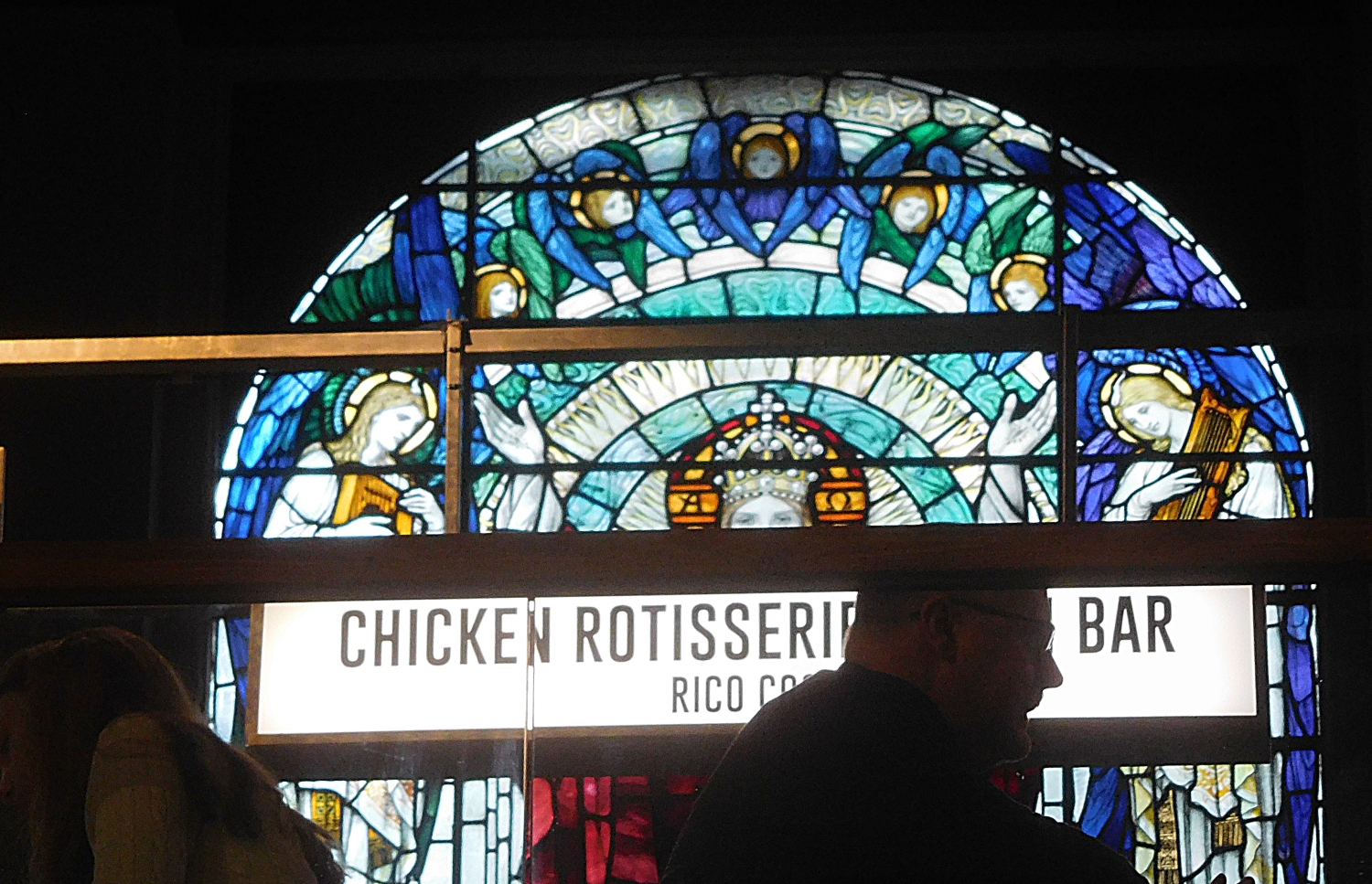
After passing beneath the grand portico supported by two columns topped with ionic capitals, one enters the church’s large vestibule. Since 2019, this has become a marketplace selling upmarket Italian delicatessen goods. Entering the body of the church is rather like taking part in a Fellini film. The floor of the nave is filled with tables and chairs and people drinking and dining. The side aisles, north and south, contain several kitchens, preparing and serving a wide variety of foods, from Turkish to Thai. On the north side of the chancel, just behind the neo-gothic stone pulpit, there is a gin bar, and facing it on the south side of the chancel, there is another bar providing alcoholic refreshments. Look upwards and you can admire the splendid timber roof supports. The wide gallery surrounding the nave at the first-floor level is home to more food stalls, each offering tempting looking fare at not unreasonable prices, especially by local Mayfair standards.


In 2019, the church became home to a branch of Mercato Metropolitano, whose first venture was converting a 150,000 square foot disused railway station in Milan during the 2015 World Expo in that Italian city. The idea of the company was:

“The development of the first Mercato Metropolitano was carefully planned to retain the site’s original appearance, which nurtured the local community’s affection for a special part of their urban history.”

 (https://www.mercatometropolitano.com/mmarketplace/#the-mercato-story).


And this is what has been done at the former St Mark’s in Mayfair. Many of the church’s fittings (for example, the tiled floors, the stained glass, the monuments, the pulpit, and the sacred paintings at the east end of the chancel) have been preserved. Entering the church is like entering the scene of a lively gargantuan feast. Seeing the large number of customers on a weekday lunchtime demonstrates that Mercato Metropolitano have successfully created a great place to meet, eat, and drink. It is highly original and exciting, both visually and gastronomically.


In Chapter 21 (verses 12-13) of the Gospel according to Matthew, we learn that:

“…Jesus went into the temple of God, and cast out all them that sold and bought in the temple, and overthrew the tables of the money changers, and the seats of them that sold doves, And said unto them, It is written, My house shall be called the house of prayer; but ye have made it a den of thieves.”

I just cannot help wondering, as many of you might also be doing, what The Good Lord would have made of what can now be seen inside the Church of St Mark’s in Mayfair.