Having trouble reading in English? Then translate it!

Popular Posts

Showing posts with label indian. Show all posts

Friday, 10 August 2018

GUJARAT - a new link


GUJARAT has been an important trading area since time immemorial and a place where diverse peoples have mingled. It offers the visitor a rich cultural tapestry: history, tradition, architecture, and much more. Its people are welcoming. 

Good accomodation is available, and transportation is not a problem.


Find out more about GUJARAT at this exciting new website:

Friday, 24 November 2017

EXPLORING INDIA WITH A BABY


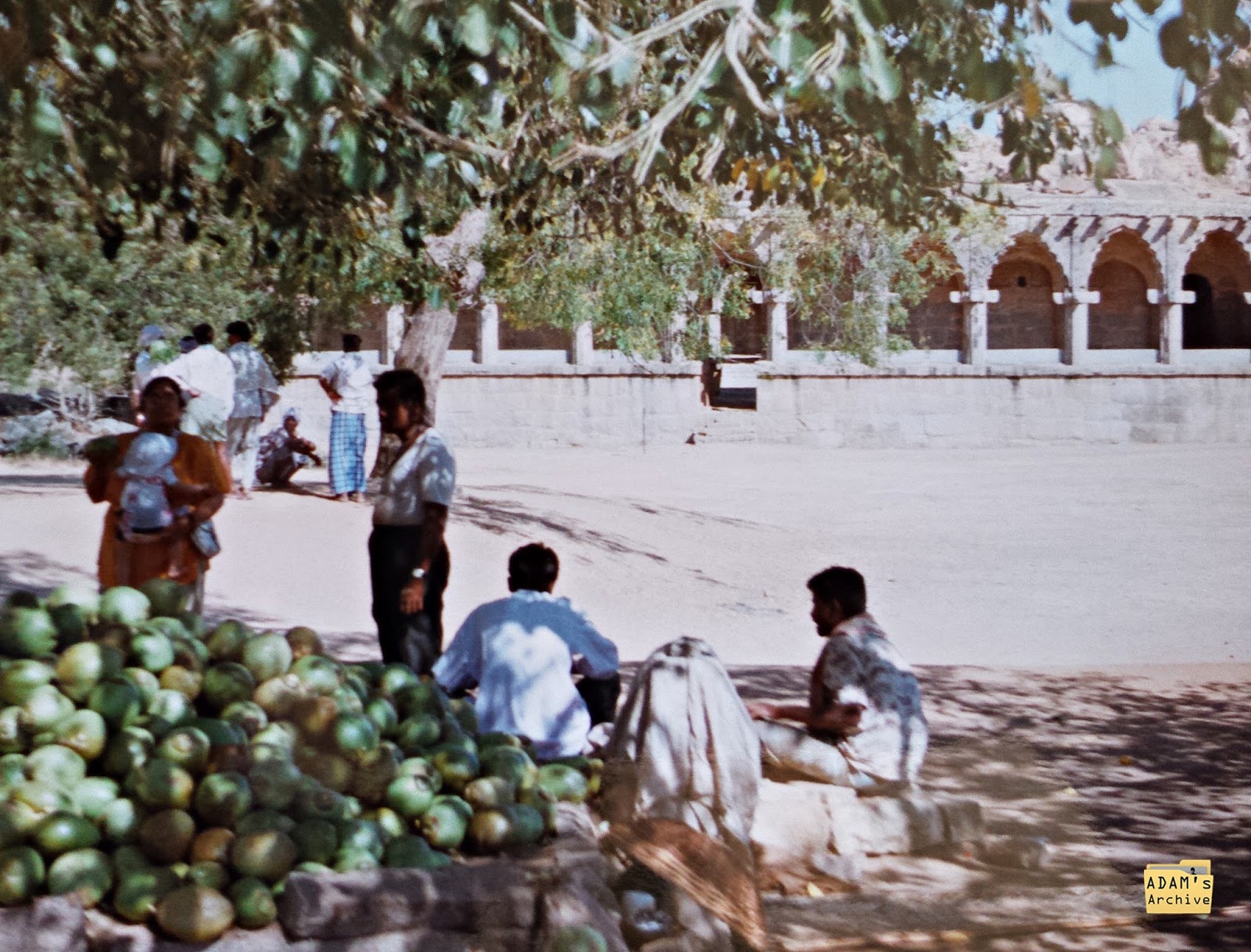
It was early in 1996. We never intended taking our nine-month old daughter to visit Hampi in the Indian state of Karnataka to see the ruins of the once great city Vijayanagara, which had in its heyday rivalled Rome in its splendour. We had hoped that her grandparents in Bangalore were going to baby-sit for us, but just before my wife and I were about to depart they felt unable to oblige. So, with little preparation, we boarded the sleeper from Bangalore to Hospet, the nearest town to Hampi. My wife clutched our little one on a narrow, hard, swaying railway bunk bed, desperately trying to prevent her from falling off.

At Hospet, our hosts, officials at a local mining company, greeted us with banners which they had made for us. They drove us to a comfortable hotel, whose rooms lacked air-conditioning and fridges. The ambient temperature never dropped below thirty Celsius, even at night. When our daughter needed a bottle of milk, we prepared it, and had to use, and then dispose, of it in less than 45 minutes because in that heat the artificial milk deteriorated rapidly.

Hospet in 1996 was less sophisticated that it was, say, a decade later. We ate in simple restaurants, often outdoors under shades. Our daughter took a shine to the South Indian food that we were usually served. She took this from our plates and, also, to our horror, off the not too clean floor. Years later, I can report that unlike many of her school friends she has never suffered from allergies. I am sure that her foraging in Hospet is to some extent to be thanked for that.


Occasionally, I felt like eating North Indian food. We found places, which bore the notice “NIDS”, which meant ‘North Indian dishes served”. I should have known better than to order a ‘NID’ in a very provincial South Indian area, but I did, and was usually disappointed by the curious concoctions that appeared on my plate. On one occasion, I ordered a ‘Peshawari naan’, something that I love. What arrived was surreal. It looked like a circular pizza base that had been painted bright green, and it was covered by bits of dried fruit and fresh banana. It was almost, as they say in the USA: ‘close, but no cigar’.

Optimistically, we had taken a folding ‘buggy’ to Hospet. This never got used, as there was hardly a square metre of ground smooth enough to roll it. Luckily, our hosts drove us around the vast archaeological site in a large four-wheel drive. Our daughter, sat happily perched on or other of our laps as we bounced across the rough ground between the various attractions.

In 1996, the ruins at Hampi were in a far better condition than they are now. For example, the Vittala Temple with its musical pillars was in fine condition. Now, it is a sad shadow of what it was in 1996. It has been vandalised by evil-doers as well as by the authorities, who have tried to save it from collapsing by adding hideous concrete supports.  Back in ’96, it was possible to wander from one attraction to another through a landscape romantically dotted with fragments of earlier civilisations, both Hindu and Islamic. In contrast, today the major attractions are walled off, and attract entry fees. Although I consider Hampi still to be a most exciting archaeological area, it has lost some of the charm that it had when we visited with our baby. She has not only visited Hampi thrice since and is planning another trip soon, but has also grown up to become a professional art-historian. I like to think that her early exposure to mediaeval Indian art has played a role in the evolution of her professional interests.

Our baby had no difficulty with the high temperatures and discomforts during our visit to Hampi and Hospet. She seemed to have enjoyed it immensely. Not only that, but so did the locals. Wherever we went, and this was true of most other places that we visited in India in 1996, she was adored by everyone including total strangers. We had thought that I, a ‘gora’ (a fair-skinned non-Indian), would have attracted attention during our trip from Bangalore, but this was not the case. I was ignored, but our little child was mobbed by well-meaning passers-by, especially little boys who patted her affectionately and told us how sweet she was.


Some short while after our trip to India, we visited Italy, a country famed for spoiling children with affection. At the end of our visit, we concluded that the Indians are far more ‘soppy’ about little children that even the Italians.


Enjoy books written by the author-dentist, ADAM YAMEY.

Saturday, 11 February 2017

VISITING VYPIN ISLAND - a lovely excursion from Cochin


Chinese fishing nets, Fort Cochin


Goat on a boat: on the ferry from Vypin to Fort Cochin


Like Venice and Istanbul, Cochin is a city where water plays an important role both functionally and aesthetically. The Cochin ‘metropolitan’ area that includes Fort Cochin, Mattancherry, the modern city of Ernakulam, Willingdon Island, and other islands is infiltrated with waterways that flow past them and out into the Arabian Sea. These watery channels are alive with shipping, lined with fishermen, flanked by warehouses, and swarming with waterfowl. The sun reflects off the waters, producing a rare quality of light that heightens the beauty of the area.

The historic city of Fort Cochin with its many historic buildings, its Chinese fishing nets, and its colourful shoreline, makes for a wonderful place for tourists to linger. I have visited the place three times in two years, and Cochin’s attraction simply continues to grow for me.

The elongated island of Vypin (aka ‘Vypeen’) runs in a north-south direction, its southernmost tip being across the estuary from Fort Cochin. Two ferries connect Vypin with Fort Cochin. One carries foot passengers only, and the other carries both vehicles and foot passengers.

Ticket office for ferry at Vypin


The first time that I crossed to Vypin on the foot passenger only ferry, I noticed that a section of the boat was reserved for ladies only. Indeed, the queues for the ticket boot were segregated by gender. Lately (2017), I did not notice any separation of male and female passengers.

Leaving Fort Cochin, the ferry passenger gets a good view of the Chinese fishing nets on one side, and of the waterfronts of the Brunton Boat House and its neighbours (such as the old Aspinwall warehouse complex).

The ferry captains have to navigate carefully, so as to avoid colliding with all manner of craft: everything from ocean going liners and enormous dredgers to tourist pleasure boats and smaller craft used by the local fishermen.

Boats moored at Vypin


As the Fort Cochin shore begins to recede and mingle with the heat haze, the Chinese fishing nets of Vypin get nearer. Behind them, it is not difficult to see a couple of huge cylindrical structures, which are part of an oil refining site near to the Arabian Sea shore.

Belts in a small shop in Vypin


Both ferries dock at the aged, rather shabby Vypin ferry terminal, which until recently contained an even shabbier café, The Sealand, now closed. Passing through the terminal, we reach a line of small shops that face a parking area where multi-coloured busses and auto-rickshaws park. These busses carry passengers to a variety of places including Ernakulam and beaches at the northern tip of the island.

Detail on a private house in Vypin


The southern shore of Vypin is a peaceful contrast to the relatively busy shore of Fort Cochin, which faces it across the water. A good paved footpath follows the shoreline, passing several Chinese fishing net set-ups, upon whose ropes and wooden structural elements sea birds roost. On a recent visit, most the avian population consisted of white egrets. Landward of the path but partly hidden by the dense foliage of luxuriant gardens, you can just about spot low dwellings.


Taking one of the paths that lead away from the sea, one enters a series of narrow lanes lined with domestic residences surrounded by lush gardens. Wandering around these lanes reminded me of the lesser visited parts of Venice. There was hardly anyone around, little or no traffic, and a lovely calm silence.


The village of Vypin is built around The Church of Our Lady of Hope, (aka "Nossa Senhora Da Esperança"), which was built during the Portuguese occupation in 1605 AD (see picture above). Along with many other Roman Catholic buildings in the Cochin  district, it was badly damaged by the Dutch in 1663, but has been restored lovingly since then. Usually this is closed except for early morning masses. My wife managed to persuade a passing nun to get the sacristan to open up the church for us. While its interior (see picture below) is not as grand as some of the churches we saw in Goa, it is nevertheless worth seeing. A great anchor hangs from the northern wall of the chancel. A highly-revered effigy stands in a glass-fronted cabinet covered with a curtain near the southern wall of the church.


A short walk through more narrow lanes brings one back to the ferry station. Whereas the passenger only boat is quite comfortable for passengers, the boat that carries vehicles is less so. Passengers congregate at the covered foremost part (the bow) of the boat. Cars and vans are tightly loaded onto the ferry, and then the two wheelers motor bikes and scooters) squeeze their way into the remaining spaces including at the bow of the ship where foot passengers congregate, trying to avoid being knocked by mirrors or getting their feet run over by wheels.


Disembarking, one realises how peaceful Vypin is in comparison with Fort Cochin. This is not to say that Fort Cochin is not particularly unrestful (as is the city of Ernakulam); it is just far busier than that  peaceful haven Vypin.

The vehicular ferry at Fort Cochin


Now WATCH a short video showing a crossing from Fort Cochin to Vypin by CLICKING HERE

Church hall on Vypin Island next to Church of Our Lady of Hope 

DISCOVER ADAM YAMEY's BOOKS by clicking:


Friday, 31 January 2014

HITLER WITHOUT THE HOLOCAUST?


I found this book about Hitler, which was published in 2007 (ISBN: 9788131002520) and is part of a series called “Biographies of Great Personalities” aimed at younger Indian readers, in Gangaram’s Bookshop in Bangalore (India). The garishly covered book caught my eye in that large bookshop in Bangalore. When I flicked through it, I noticed that it was illustrated with line drawings, many of which showed Adolf Hitler in Indian settings with palm trees. At 40 Rupees (less than half a Pound Sterling), I could not resist buying the 93 page book.


Young Adolf with his mother


The author, Igen B, is a prolific writer. He has published well over 70 short books including biographies of personalities as diverse as Jesus Christ, Bhagat Singh, Mother Teresa, Ashoka the Great, Chhatrapati Shivaji, Shakuntala, and Netaji Chandra Bose. As well as these he has written versions of great Indian classics such as the Vedas, the incarnations of Lord Vishnu, and the Mahabharata. That these books are probably aimed at children is evident from the format and appearance of the books and also the fact that one of his titles is “Illustrated Model Book of School Essay etc.” Therefore, his potential audience is the innocent and impressionable younger mind. This should be remembered whilst paging through his children’s biography of Adolf Hitler.


Hitler at his mother's death-bed


More than half of the text is dedicated to Hitler’s childhood, about which not much is known in detail, his career as an artist, and his rise to power. The author of this book, Igen B, blames a disturbed childhood in a dysfunctional family for much of what Hitler was to become.  The future dictator’s disillusionment with the lack of German national pride and his disappointment with the country’s leadership during WW1 were according to this book, also important formative factors. As, are also the Jews: unquestioningly, Igen B repeats the kind of dangerous nonsense about the Jews that Hitler and many Germans believed. 


Hitler discusses world problems and anti-Semitism at a café in Vienna


Having gained power, we learn of Hitler’s campaign to relieve the Jews of any role in public life, and his hatred of the communists. We also learn of his desire to tear up the Treaty of Versailles, and how he went about doing so. So far, the reader is presented with something that faintly resembles what is now common knowledge about the history of Germany just before and during the brief, but long enough, era of Nazi rule. The penultimate 4 pages of the book describe some aspects of WW2. The last page of text is dedicated the last days of Hitler and his new bride Eva Braun.


Hitler, the artist, at work on a painting


Nowhere in the book are the mass murders perpetrated by the Nazis even hinted at, let alone mentioned. This worries me greatly considering that the book is sold in bookshops in India, and most of these also sell often more than one edition of Hitler’s pernicious ‘autobiography’ “Mein Kampf”.


Adolf Hitler meets the common people  (of Germany).


Igen B’s book is aimed at an Indian audience. It is appropriate in a way that the illustrations are drawn with an Indian flavour, as many readers are unlikely to have visited Europe or are ever likely to do so. The spelling of many German words and names is peculiar. For example we read of ‘Hebzburg’ (Habsburg), ‘Strum Abtiling’ (Sturmabteilung), ‘fonn’ (von), ‘Versai’ (Versailles), and ‘Hoffbraha’ (Hofbrauhaus). Whilst these original spellings are used more than once and are thus unlikely to be typographic errors, they may also be purposeful. It is possible that the author, realising that most of his readers are likely to be unfamiliar with German pronunciation, has transliterated them so as to make them pronounceable by readers of English.


Eva Braun comforts Hiler after he has learnt of the defeat 
of his armies by the Soviet Russians.


I picked up this book as a curio, and read it. The author appears to have done some research, but his or her interpretation and presentation of the facts is somewhat unusual. His lack of emphasis of Hitler’s evil influences and deeds in a book aimed at impressionable youngsters is worrying to say the least.  The impression I had after reading it was that Hitler was portrayed as an unfortunate child, who grew up with the aim of making Germany a great nation. I was not given the impression that he was even a fraction of the monster that he was in reality. I had rather the same impression after watching the end of the film Downfall made in 2004. Hitler’s final moments during that film were almost heart-rending; the power of film and literature cannot be underrated. This is why Igen B’s book on Hitler might well be considered malevolent, even if the author’s intention was otherwise, to be purely informative.


Adolf Hitler and Eva Braun on their wedding day.
(Note the somewhat oriental background)


Read about the books written by the author of this blog by clicking on: http://www.adamyamey.com