Having trouble reading in English? Then translate it!

Popular Posts

Showing posts with label Sicily. Show all posts

Tuesday, 28 August 2018

LOOKING THROUGH STONE IN GUJARAT


Baroda

Before setting out on our recent extended travels through Gujarat, I booked accommodation via a well-known travel website. The hotel I chose for Ahmedabad was the aptly named ‘Hotel Goodnight’. Its address, ‘Opp. Sidi Saiyed’s Jali, near Electricity House…’, intrigued me. What is a ‘Jali’, I wondered, apart from being an anagram of ‘jail’.

Ahmedabad


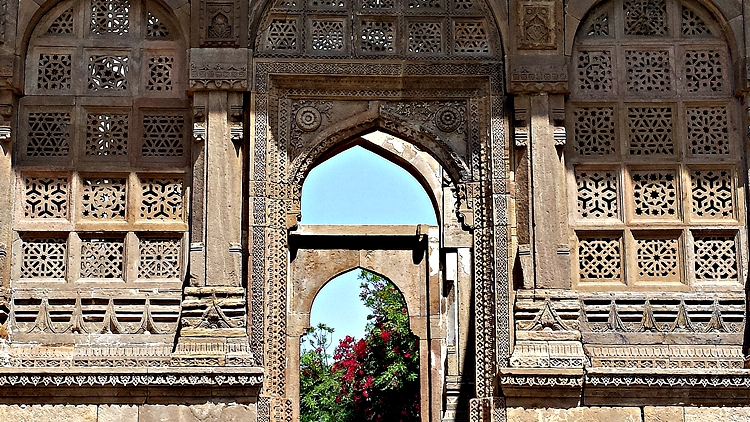
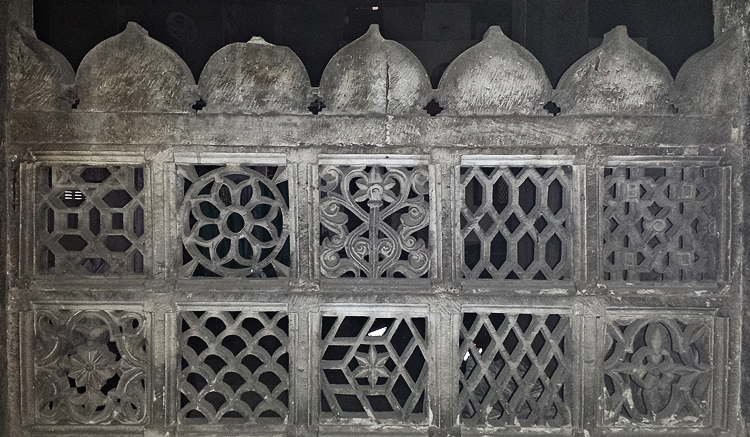
The word ‘jali’ (or ‘jaali’) means ‘net’ in Hindustani. As an architectural term, it refers to stone grille window screens. These screens are carefully and usually intricately carved in stone (usually). A flat stone is carefully perforated to produce an often elaborate pattern of spaces surrounded by the remaining strands of stone. In India, they are found in temples (Hindu and Jain), mosques, and secular buildings. They are usually very attractive. These carved stone window coverings, that simultaneously provide shade and the passage of light, can be seen outside India. There is at least one church in Palermo (Sicily), which contains jali work. In this case, it was created by Moorish craftsmen who remained in Sicily after it was conquered by the Normans.


Palermo (Sicily)


Jali work can be found not only in buildings constructed many centuries ago, but also in more recently built structures, such as the Arts Faculty Building in Baroda and the Vijay Vilas Palace in Kutch Mandvi.


Baroda Faculty of Arts (19th century)


Vijay Vilas (Kutch Mandvi)


The best places in Gujarat for seeing jali, which we visited, were Ahmedabad and Baroda. If you don’t wish to travel so far afield, The Victoria and Albert Museum in London has some very fine examples in its South Asian galleries.


In Victoria and Albert Museum


Returning to Sidi Saiyed’s Jali in Ahmedabad, here is an excerpt from my new book:

Opposite our hotel and across the busy Relief Road, which one should not cross without first saying a prayer, is one of the city’s many architectural treasures. It is the Sidi Saiyed Mosque (aka: ‘Sidi Saiyed’s Jali’), which was built in 1573 during the last year of the Gujarat Sultanate. It was constructed by Sidi Saiyed, an Abyssinian general in the army of Sultan Shams-ud-Din Muzaffar Shah III. A learned man with a great library, he had served with Rumi Khan, a son of Khwajar Safar, who died at Diu. The Sidi’s grave lies in a wire mesh enclosure near the north east corner of the mosque. His much-revered gravestone is usually covered with beautiful coloured silk cloths.

This mosque is a long rectangular open-fronted pavilion. It is entered through any of five wide arches with pointed tops. The mosque’s domed ceiling is supported by four rows of pillars each supporting arches, which together form an arcade. The stonework is decorated in places with floral motifs that are not especially Islamic. The lower part of the rear wall facing the entry arches is plain stonework apart from a centrally placed mihrab.  The upper third of this wall has five almost hemi-circular stone arches. The central one is solid stonework. It is flanked on either side by pairs of exquisite, intricately perforated stone lattice screens, exceptional examples of jali work. They allow light to filter into the mosque from the west.  The screen at the south end of the mosque is carved to represent a Tree of Life with swirling, tangled branches…


Champaner

READ MORE ABOUT GUJARAT IN ADAM YAMEY's
LATEST BOOK

AVAILABLE in PAPERBACK by clicking HERE

DOWNLOAD on to your KINDLE by clicking HERE


Monday, 8 September 2014

OUT FROM ALBANIA


There are many towns within a roughly 20 mile radius of Sicily's capital, Palermo. No doubt, each of them is unique in its own way, but the most special of all of these has to be Piana degli Albanesi. The majority of the 6000 or so inhabitants of this town, which perches on the slopes of Mount Pizzuta, speak -as their mother tongue - a form of the Albanian language known as "Arbëreshë". Distinct from Albanian spoken in Albania itself, the language spoken in Piana is closer to Tosk than Gheg. 


Many of the inhabitants who live in Piana degli Albanesi are descendants Albanians who fled from the Balkans in the 15th century when the Ottoman Turks invaded their homes. More than 500 years later, the Arbëreshë people in Piana not only use the language of their forefathers but also preserve much of their traditions, culture, and religious practices. Many of the decendants of the Albanians living in Piana degli Albanesi and the 4 other surviving communities set up by the Albanians seeking refuge from the Ottomans (Contessa Entellina, Mezzojuso, Palazzo Adriano, and S Cristina Gela) worship in churches following the Eastern Orthodox rites, but regard their 'Greco-Byzantine' or 'Eastern Catholic' church as being within the folds of the Vatican; they regard the Pope as their religious leader.


Adam Yamey recently stayed in Piana degli Albanesi, and explored the history and culture of the Arbëreshë people. By meeting and discussing matters with a number of informative and extremely hospitable people in Piana and elsewhere, he was able to amass a great deal of information about the Albanians who adopted Sicily as their new home and their descendants. They told him about their origins, their religion, their culture, and their tragic involvement with the Mafia. 


Adam's recently published personal travelogue, in which he describes all 5 of the Arbëreshë towns in Sicily, is full of illustrations and maps, and is called: From Albania to Sicily


Adam Yamey in Viale Scanderbeg in S Cristina Gela


Read From Albania to Sicily and learn about the importance of the Arbëreshë in Garibaldi's conquest of Sicily that led to the liberation of Sicily as well as what happened to the Mafia after Mussolini visited Don Ciccio, the one-time Mafia mayor of Piana degli Albanesi. Discover the secrets of making the best cannoli in Italy and why the town of Palazzo Adriano was a star in the movie Nuovo Cinema Paradiso. Learn about the inner meanings of icons and what happens on Ascension Day in Piana. These and many more fascinating topics, including the tragic events that occurred on the 1st May 1947 at Portella della Ginestra, fill the pages of Adam's book.


BUY  YOUR COPY OF

FROM ALBANIA TO SICILY 

NOW

Kindle: click  H E R E

Paperback: click   H E R E

Visit and 'like' the book's special

Facebook Page:


Saturday, 28 June 2014

PAINTING ALBANIANS IN SICILY


Most tourists visit the small town of Palazzo Adriano to see its perfectly preserved old piazza with its unusual fountain, where the delightful movie Cinema Paradiso was filmed in 1988. We visited it for another unrelated reason. The picture below, a copy of a photograph in one of the town's museums, shows a scene from the film. The fountain is on the right side


Detail of the fountain as it is today


Palazzo Adriano is one of the 5 places in Sicily that were settled in the 15th century by Albanians fleeing from the Ottoman invaders of their homes in the Balkans. The first Albanians to arrive there were soldiers and their families, who left the Balkans before the death of their great leader Skanderbeg in 1468. More of them arrived later, bringing with them the traditions and practices of the Eastern Orthodox (Byzantine) Church. The plaque shown below, which is on the side of the town's largest Byzantine rite church, reminds us that the Albanians who came to Palazzo helped defend western Christianity from the ravages of the Ottomans.


The largest of the 5 places settled by the Albanians in Sicily is Piana degli Albanesi, someway north of Palazzo. In Piana, more than 95% of the inhabitants speak Arberesh, which is a dialect of Albanian. In Palazzo, no one speaks it anymore, but many people worship according to the Byzantine rite. We learnt this when we asked some old men who were spending time in the town's small 'Circolo Skanderbeg'. This place was filled with items relating to the town's Albanian connection. Even the lace curtain over its window was embroidered with the two-headed eagle of Albania:


The town boasts a museum of Albanian culture, the MUSEO DELLA CULTURA ARBERËSHE. It is housed in part of the castle, which overlooks the town. This grandly named institution displays only a few exhibits. Amongst these, there are a few traditional costumes that, we were told, were copied from paintings of the Arberesh made by the French artist Jean-Pierre-Louis-Laurent Houël (1735-1813). 


Portrait of Houel by François André Vincent 
(Source: http://mbarouen.fr/en/oeuvres/portrait-of-the-painter-jean-pierre-houel-1735-1813)


Best known for his painting of the siege of the Bastille, he visited Sicily between 1776 and 1779. During his travels there, he painted and drew many pictures of what he saw. Many of these were bought by Russian royalty, and are now to be found in the Hermitage Gallery in St Petersburg (Leningrad).  The museum in Palazzo has copies of two of these pictures, both depicting Arberesh women in traditional dress. They are illustrated below:


The marks with the crown in the lower right corners of these copies shows that they are also part of the Hermitage collection. The lower of the two pictures shown above shows what Palazzo Adriano looked like when Houël visited it. The picture below shows a part of the piazza as it is today:


We visited Palazzo Adriano hoping to find evidence of its Albanian past, and did. Even if you have no interest in the Arberesh or Albania, this well-preserved little town in the heart of western Sicily deserves a visit.


TO DISCOVER MORE
WRITING
BY 
ADAM YAMEY,

Click H E R E