Having trouble reading in English? Then translate it!

Popular Posts

Showing posts with label stained-glass. Show all posts

Wednesday, 24 November 2021

BLACK ABOLITIONISTS IN A WESTMINSTER CHURCH


WESTMINSTER ABBEY IS costly for tourists to enter. Currently (November 2021) the entrance ticket ranges in price from £10 for a child to £24 for a full-price adult ticket. Without doubt, the Abbey is well worth a visit, but if you do not feel like spending so much money, its neighbour, the St Margaret’s Church is also full of interest but charges no entry fee.


Because the present Abbey was once the church attached to a monastery, St Margaret’s was built in the 11th and 12th centuries to provide a place of worship for the (non-ecclesiastical) residents of Westminster. When the residential population of the area declined, it became what it is now, the parish church for The House of Commons. The first church on the site was built in the Romanesque style, but when this deteriorated in the 14th century, it was replaced by the present structure built in the Perpendicular (gothic) style. Since then, like many old churches it has undergone various modifications over the centuries.


Amongst the many fascinating things within the church, which are described in an excellent booklet by Tony Willoughby and James Wilkinson, several things particularly attracted my attention. First of all, several of the windows in the south wall of the church contain superb modern stained glass designed by the painter John Piper (1903-1992) and created by Patrick Reyntiens (1925-2021). The were installed in 1966 to replace Victorian windows that were destroyed during WW2. Piper’s windows alone are a good reason to visit the church.


Another thing that caught my eye is a pair of doors on the north side of the church. These are covered with red leather, each one embossed in gold with a portcullis, surmounted by a crown, the symbol of Parliament. Some of the prayer kneelers are also decorated with this symbol.


Amongst the many tombs and funerary memorials within the church, there is one to the artist Wenceslaus Hollar (1607-1677). Born in Prague, he left the city when the Emperor Ferdinand the Second ordered Bohemian nobility to convert to Roman Catholicism or leave the country. A highly prolific and much-admired artist, creator of many works including detailed views of London, he died a poor man in Westminster. His monument is on the north wall.


Amongst the many memorials on the south wall there is an oval plaque commemorating the fact that in 1759, Olaudo Equiano (aka Gustavus Vassa) was baptised in the church when he was a slave owned by a sea captain, Michael Henry Pascal. Equiano (c1745-1797) was a black African slave, who gained (purchased) his freedom in 1766. After numerous adventures, which he related in his autobiographical work “The Interesting Narrative of the Life of Olaudah Equiano”, published in 1789 in London, he became active in the nascent movement to abolish the slave trade. In addition to his book, he wrote a great number of pamphlets and letters to the press.


Whereas I was able to spot the plaque for Equiano with no difficulty, I was unable to see the grave of another abolitionist, also a former slave, Ignatius Sancho (c1729-1780), who was born on a slave ship and is buried in the churchyard of St Margaret. He married a West Indian woman, Anne Osborne, in St Margaret’s, ran a grocery shop in Westminster, acted, composed music, and wrote against slavery using the pseudonym “Africanus”. He was the first black Briton to vote in a parliamentary election. He cast his vote both in 1774 and 1780.


In addition to these two black abolitionists, the church contains memorials to two men who tried to alleviate the suffering of slaves in the Americas, Richard Burn (c1744-1822) and Thomas Southerne (1660-1746). The latter was one of the first writers in English to denounce slavery.


I hope that what I have written above will help to distract you from the idea of visiting only Westminster Abbey and to encourage you to make plenty of time to explore St Margaret’s.  


Sunday, 20 December 2015

STRASBOURG or STRASSBURG? - from ALSACE to PONDICHERRY


In late November, early December 2015, I visited the southern Indian coastal city of Pondicherry (‘Pondi’). Until 1954, this small place on the coast of the Bay of Bengal was a French colony. Now, it is an Indian Union Territory. When the French left in 1954, the ethnically Indian (mainly Tamil) inhabitants of Pondy were offered the opportunity of becoming French citizens. Many accepted. So, at present many of the inhabitants of Pondi are still French subjects, and enjoy the benefits associated with this status. Apart from architecture, there are many left-overs from Pondi’s days as a French colony. For example, policemen wear red képis on their heads and street signs are bilingual: Tamil and French.


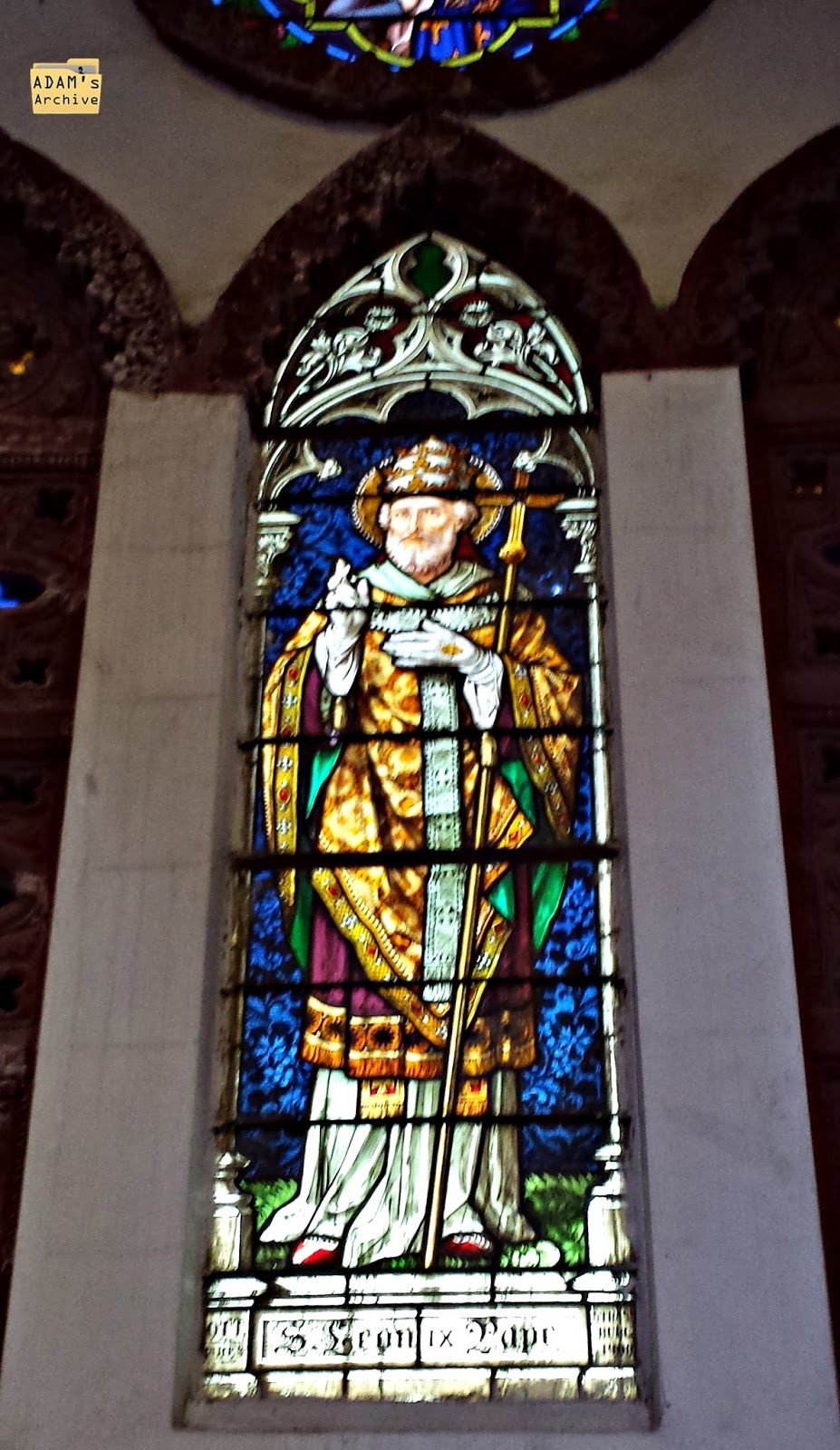
There is a church close to Pondy’s railway station, Basilique Sacre Coeur (Sacred Heart Basilica). This is an airy Gothic revival edifice, which was built between 1902 and 1907, when the first mass was held in its eastern wing. The church was completed by 1908[1]. While walking around the church, I noticed some particularly fine stained glass windows in the south wall of the nave. Each one of the windows depicted a saint, and below each saint was his or her name. To the right of each name was an inscription: “Strassburg 1908”, and to the left: “OTT Fres”.


My interest was immediately heightened. Strassburg was the German name for the now French city of Strasbourg. However in 1908, the city was under German administration. It had been since France was defeated in the Franco-Prussian War of 1870-71, and was to remain so until the end of the First World War (‘WW1). “OTT Fres” was, I assumed, an abbreviated form of OTT Frères, which I guessed (correctly) was the manufacturer of the stained glass.


On my return to the UK, I looked up ‘OTT Frères’ on the Internet, and was gratified to discover that such a company existed. OTT Frères (OTT brothers) was a company of stained glass painters based in in  Strasbourg/Strassburg. They furnished windows for a variety of buildings (churches and other public buildings) in Alsace, especially in the city of Strasbourg/Strassburg during the first two decades of the 20th century[2]. A set of postcards issued in about 1920 (see below) illustrates the interior of the OTT workshops[3]. The company was founded in the 1850s[4], and by 1900 its workshops opened onto the Cour du Corbeau. The company remained in existence until 1975[5]. Clearly, as I discovered, some of its creations travelled a long way from Alsace.


It is of interest to note that the (French) builder of the church in Pondy chose to commission windows from a company in enemy (German) occupied Alsace, but he did. However, not all of the windows in the church were made by Ott Brothers. Some, which seemed newer in design than those made by Ott and not nearly as finely executed, were manufactured by a company in Grenoble.

Strasbourg/Strassburg, like Pondicherry, changed hands. The city remained under German control for about 47 years, whereas Pondy remained under French control for far longer: from 1674 until 1954.

I have some French relatives living in present day Strasbourg. They have been there for several generations, having moved there from southern Germany at the end of the 19th century. When Alsace-Lorraine was occupied by the Prussians in 1870-71, another of my many ancestral relatives, quite unrelated to those of my family who live in Strasbourg today, was a soldier in the Prussian Army. This man was Leo Ginsberg (1845-1895), who was born in Prussia (Breslau) and was the half-brother of my great-grandfather the South African Senator Franz Ginsberg (1862-1936). Leo settled in the occupied Alsatian city. One of his grandchildren told me that when Leo married, he and his wife were required by law to purchase a set of china dishes from the royal Prussian porcelain factories.  Leo had 4 children, all of whom migrated to South Africa, where they lived in King Williams Town in which their uncle Franz had settled in 1880.

We would never have visited Sacre Coeur had I not wanted to see Pondy’s railway station, which turned out to be a bit of a disappointment visually. Since the church is across the road from the station, we felt that we should take a look at it, and I am glad that we did, as doing so revealed a tiny aspect of colonial history.


NOW VISIT

ADAM YAMEY'S

WEBSITE:


FOR SOME MORE WORKS OF INTEREST


[1] https://en.wikipedia.org/wiki/Basilica_of_the_Sacred_Heart_of_Jesus,_Pondicherry
[2] http://www.archi-wiki.org/personnalite-ott_fr%E3%A8res-494.html
[3] http://www.hoogeduinpostcards.com/webshop/lots/59239--lot_of_9_postcards_france,_strasbourg,_vitraux_d-art,_ott_freres_(67).html
[4] http://www.cc-porte-alsace.fr/tourisme/livret-jep-2011-nfb-v4.pdf & http://www.culture.gouv.fr/public/mistral/merimee_fr?ACTION=RETROUVER&FIELD_1=cmer1&VALUE_1=&FIELD_2=cmer4&VALUE_2=&FIELD_3=cmer5&VALUE_3=&FIELD_4=AUTR&VALUE_4=&FIELD_5=TOUT&VALUE_5=ott%20fr%e8res&FIELD_6=titre%20courant&VALUE_6=&FIELD_7=date%20protection&VALUE_7=&FIELD_8=DOSURLP&VALUE_8=%20&NUMBER=2&GRP=0&REQ=%28%28ott%20fr%e8res%29%20%3aTOUT%20%29&USRNAME=nobody&USRPWD=4%24%2534P&SPEC=9&SYN=1&IMLY=&MAX1=1&MAX2=100&MAX3=100&DOM=Tous
[5] https://www.facebook.com/media/set/?set=a.433426656788034.1073741843.366016053529095&type=3