Having trouble reading in English? Then translate it!

Popular Posts

Showing posts with label albanien. Show all posts

Wednesday, 10 November 2021

A LOST LANDMARK AND A DETAILED MAP OF ALBANIA


EVER SINCE I CAN REMEMBER, I have been fascinated by maps and collected them. I cannot say exactly why I enjoy them, but one reason is that I get satisfaction from aesthetic aspects of cartography. Another reason is that when I look at them, I try to imagine the reality that they represent, a form of virtual travelling. Whatever the underlying cause(s) of my fascination with maps might be, it is irrelevant to what follows because what I want to tell you is about a shop that I used to love to visit. It was Stanford in London’s Long Acre, a street not far from the old Covent Garden Market and Leicester Square.


Founded by Edward Stanford (1827-1904) in the early 1850s, his business was one of the best specialist suppliers of maps in the UK, if not the very best.  His company’s store on Long Acre opened in 1901, having moved there from Charing Cross. When I used to visit the shop to browse the lovely maps on display in the 1960s, there were two floors open to the public. The ground floor was the main showroom with maps of popular destinations that appealed to the majority of customers. The basement was less attractively arranged but far more interesting to serious travellers and map collectors such as me. There were no maps out on display down there. One had to ask a salesman to show you maps of areas that interested you. I believe it was there that I bought a nautical chart of the extremely remote French island of Kerguelen in the southern part of the Indian Ocean, a place that I had no intention of ever visiting.


In about 1966, my interest in Albania was born. I have tried to explain why this happened in my book “Albania on My Mind”, which I published in 2013, 101 years after Albania gained its independence.   In those days, not much was known in the UK about this small country in the western Balkans. Maps of Albania were not available in most shops, probably because few people visited the place, or were even remotely interested in it. So, I took the Underground from my local station, Golders Green, to Leicester Square. Stanford was a few yards from that station. At Stanford, I enquired about detailed maps of Albania, and was sent to the specialist map department in the basement.


Twenty-three shillings (£1.15) for the set of two detailed maps of Albania 


The only detailed map of Albania available at Stanford was a 1:200,000 scale map with the information that it was made:

“Auf Grund der Oesterreichischer-Ungarische Kriegsaufnahmen und der im Auftrage der Albanische Regierung Von Dr Herbert Louis gemachten aufnahmen sowie mit Benützung italienischer und franzoesischer Karten” (i.e., ‘On the basis of the Austrian-Hungarian war recordings and the recordings made by Dr Herbert Louis on behalf of the Albanian government, as well as with the use of Italian and French maps’)

The map, which comes as two sheets, was up to date in 1925. A small map alongside the main map shows which parts of the large map were surveyed by whom and when.        Between 1916 and 1918, the surveyors were the armies of Austria-Hungary, France, and Italy. Some information collected by Baron Nopcsa between 1905 and 1909 is included in the map, as well as data collected by Dr H Louis between 1923 and 1924.


Baron Nopcsa was the Hungarian aristocrat and politician Franz Nopcsa von Felső-Szilvás (1877-1933; see: www.smithsonianmag.com/history/history-forgot-rogue-aristocrat-discovered-dinosaurs-died-penniless-180959504/), a founder of paleobiology and a specialist on Albanian studies. This one-time candidate for the throne of Albania created the first geological map of northern Albania. The German Dr Herbert Louis (1900-1985), whose name is prominent on the map, was no stranger to Albania. In 1923, he accompanied the Austrian geologist Ernst Nowack (1891-1946) during his research in the country, and in 1925, he was awarded a doctorate for his studies concerning Albania.


The map looked beautiful, I fell in love with it, and I knew I had to obtain a copy of it, but it was priced at 23/- (23 shillings: £1.15) for the set. That might not sound excessive today in 2021, barely the price of a small bar of chocolate or a cup of tea (in a scruffy café). But in about 1966, it was a huge sum of money for me, many times more than my weekly pocket money. I left Stanford, determined to save up for it and hoping that in the meantime the shop would not run out of copies of it. Eventually, I was able to purchase a set of these maps.


Delicately drawn, covered with contour lines, shaded representations of rocks and mountains, a variety of colours, the map shows how few roads there were in Albania in the 1920s. The tiny black dots, which represented buildings or small groups of them are often shown to be connected by tracks or footpaths, but many of them are a long way from any line of communication marked by the map makers. Most of the names on the map are in Albanian, but a few are also in Italian (e.g., Durazzo [Durres], Valona [Vlora], San Giovanni di Medua [Shengjin], and Santi Quaranta [Saranda]). Some words on the map are also in German.


I treasure this set of maps I bought at Stanford so many years ago and my memory of first being shown them in the basement of the shop. Yesterday, on the 15th of August 2021, first day of the 75th year of India’s independence, we walked along Long Acre, and discovered that although its name on the building is still there, the map shop is not. I had not realised that in 2019 this repository of records of landmarks and one of my favourite childhood haunts had moved from Long Acre to nearby Mercer Walk near The Seven Dials.


Friday, 7 February 2014

A GREAT ALBANIAN SINGER


Vaçe Zela, the great Albanian chanteuse died on 6th February 2014
in Basel (Switzerland)

Sadly, I never met her nor attended any of her concerts. However, recordings of her songs were my first  encounter with music from Albania. This excerpt from my book Albania on my Mind tells how I 'discovered' the music of V. Zela in the mid to late 1960s:

"I had a Phillips radio in my bedroom. It was a valve radio, rather than the more modern transistor-based instruments, which were already available in the 1960s. Once it had warmed up - a slow business taking up to a minute - and had stopped emitting crackling sounds, it was able to receive broadcasts on three wavebands including short-wave. I used to enjoy twiddling its tuning knob, and listening to broadcasts transmitted from all over the world. It was a window to the world beyond the confines of the highly manicured, desirable but rather dull, Hampstead Garden Suburb, where we lived.


One day, I tuned in on an exceptionally clear transmission, and listened with some curiosity and a great amount of surprise to a woman who was speaking perfect English with only the hint of a foreign accent. After a few minutes, she informed her audience far and wide that they were listening to the voice of Radio Tirana. I could not believe my ears. I made a mark on the tuning gauge to ensure that I would be able to find this station again. I tuned into Radio Tirana regularly, listening with astonishment and also amusement at the various commentators’ beautifully articulated words - mostly rants and raves directed against the actions of the imperialists and capitalists. These were punctuated by stirring Albanian songs sung in a style that was new to me, as I had never experienced the music of the Balkans before. Incidentally, the clarity of the transmissions from Tirana was due to it being broadcast from a reputedly very powerful transmitter.

After a short while, I decided to write a letter to Radio Tirana. Somewhat tongue in cheek, I wrote to the unknown addressee (in English) that the songs, which were being broadcasted from Albania, inspired me greatly and helped to reinforce my faith in Socialism. After addressing the letter’s envelope to ‘Radio Tirana, Tirana, Albania’, I waited with little expectation of receiving any kind of reply. I thought that it was more likely that I would receive a communication from MI5 or MI6 than anything from Albania. However, I was wrong to have been so pessimistic. A flat parcel, wrapped in brown paper and string, arrived by post a few weeks later. It was from Albania. I unwrapped it carefully, my fingers thrilling at the thought of handling something that had arrived from the mysterious country that had begun to interest me so greatly.


The package contained a 10-inch diameter long-playing gramophone record in a garishly coloured cardboard sleeve. It was decorated with an electricity pylon; musicians in folk costumes; dancers dressed likewise; a man wearing baggy Turkish-style pantaloons; and an oil derrick. The plain, unadorned record label bore the name of the recording company: Pllake Shqipetare (‘Shqipëria’ being the Albanian word for Albania). I played this endlessly, much to the dismay of my parents who did not appreciate its special musical properties. Even today, I can still hear the tune of “O djell i ri” (a song about the sun) ringing in my head."

Click on the image below to hear this song:


And, the singer of that song and a few others on the disc was the late and much  lamented V Zela. There was also a song sung by her called  Fëmija i parë. For many long years I believed that that title meant 'Women are equal' but 3 days ago, I learnt that it actually means ' First born baby'. My informant was none other but the Albanian scholar, Bejtullah Destani. To hear this song sunng by V. Zela: click on this image:


Those of you who are interested in reading more of my experiences of Albania and the visit that I made there in 1984 may purchase a copy of my book, Albania on my Mind, (paperback and e-book) on Amazon, Barnes & Noble, and Bookdepository.  


Saturday, 29 June 2013

Rabbit with a Rifle


This is a brief extract from 
Adam Yamey's recently published book:
"ALBANIA ON MY MIND"

The setting is Tirana in 1984


"That night and the following were spent at the Tirana Hotel in the capital. This yet again unpredicted stay in Tirana annoyed some of our party, but was full of interest for me. We visited “Shqiperia Sot” (i.e. ‘Albania Today’). Housed in a large hangar-like building, this was an exhibition of Albania’s technical achievements. These included a tractor manufactured in Albania. The ever perceptive Maynard pointed out that although it differed in design from the Chinese tractors that we had seen on our travels, we had not seen even one of these home-made machines anywhere outside the exhibition. My favourite exhibit was under glass in a showcase containing Albanian toys. It was a yellow plastic bunny rabbit holding a rifle in exactly the same pose as the soldier, who had watched our arrival at the Albanian frontier. Even as infants, Albanians needed constant reminding of the need to defend their country. I would have loved to have purchased one of these militant bunnies, but I saw none for sale anywhere. It is my contention that the items exhibited were made especially for the exhibition, and not widely available, if at all."


View of the Shqiperia Sot exhibition showing a model of an oil-derrick


ALBANIA ON MY MIND 
can be purchased from Amazon 
both as a paperback and also as a Kindle

Sunday, 26 May 2013

TUBES


Gjirokastër,  Albania in May 1984

"That evening after dinner, a number of us sat with Aferdita and Eduart in the hotel’s night club. Each of the hotels in which we stayed had one of these. With the exception of our two guides and the musicians who performed in them, these clubs were out-of-bounds for Albanians. This evening we were entertained by a small band that played western pop music, mainly tunes originally performed by the Beatles. The noisy background of these clubs provided our two young guides with opportunities to ask us about life beyond their country’s tightly sealed borders. However, it was clear that Aferdita was trying to eavesdrop on Eduart and vice-versa. As the musicians strummed away in the semi-gloom of the club in Gjirokastër, Aferdita turned to me, rolled her lower lip away from her teeth, and asked my opinion of her gums. She wanted to know if they had been treated properly. I told her that I was unable to give her an opinion in such poor light.

The following morning, I spotted some tubes of Albanian toothpaste on display in a locked glass display case near the hotel’s main entrance. I tried to communicate to the receptionist (who did not understand English) that I wished to purchase a tube. I used to collect toothpastes from wherever I travelled, and was curious to taste its contents. Whilst I was doing this, Aferdita appeared, and asked me what I wanted. I told her. She explained my desire to the receptionist, and moments later I had become the proud owner of a tube of Albanian dentifrice."

This is a brief excerpt from my book "ALBANIA ON MY MIND" (Click HERE for more detail), published in 2012. Until two days ago, I had believed that I had lost or thrown away the Albanian toothpaste  bought in Gjirokastër,to which I referred in the excerpt.  Well, I found it amongst some goods that we had kept in storage for almost 20 years. The illustration below shows 2 of the tubes in greater detail:


These were not the only dental souvenirs that I discovered in our family storage locker. Here is an extract from the draft of my forthcoming book "SRABBLE WITH SLIVOVITZ - Once Upon a Time in Yugoslavia" about Yugoslavia before 1991:

"Between Niš and the dull, nearby Niška Banja, we encountered a large number of Russian and Bulgarian cars parked by the side of the main road. Each car had a stall - usually a folding table - set up beside it. Their owners were selling a wide variety of odds and ends. I bought tubes of toothpaste manufactured in the USSR and the People’s Republic of China. For a long time these, and the dentifrice that I had bought in the Albanian town of Gjirokastër a few years earlier, shared pride of place in my large collection of toothpastes from all around the world. Sadly, this collection no longer exists, and I have also lost the Russian toothbrush, which I bought there."

This section is now going to need re-writing, as I have found the missing toothpastes...


Sadly, the Russian  toothbrush remains missing!


For more information about my forthcoming book about Yugoslavia as it was,
please click HERE

Also, do pay a visit to 

Friday, 2 November 2012

PACKAGE FROM ALBANIA


Excerpt from my forthcoming book "Albania on my Mind"

I had a Phillips radio in my bedroom. It was a valve radio, rather than the more modern transistor-based instruments, which were already available in the 1960s. Once it had warmed up - a slow business taking up to a minute - and had stopped emitting crackling sounds, it was able to receive broadcasts on three wavebands including short-wave. I used to enjoy twiddling its tuning knob, and listening to broadcasts transmitted from all over the world. It was a window to the world beyond the confines of the highly manicured, desirable but rather dull, Hampstead Garden Suburb, where we lived.

One day, I tuned in on an exceptionally clear transmission, and listened with some curiosity and a great amount of surprise to a woman who was speaking perfect English with only the hint of a foreign accent. After a few minutes, she informed her audience far and wide that they were listening to the voice of Radio Tirana. I could not believe my ears. I made a mark on the tuning gauge to ensure that I would be able to find this station again.  I tuned into Radio Tirana regularly, listening with astonishment and also amusement at the various commentators’ beautifully articulated words - mostly rants and raves directed against the actions of the imperialists and capitalists. These were punctuated by stirring Albanian songs sung in a style that was new to me, as I had never experienced the music of the Balkans before.

After a short while, I decided to write a letter to Radio Tirana. Somewhat tongue in cheek, I wrote to the unknown addressee (in English) that the songs, which were being broadcasted from Albania, inspired me greatly and helped to reinforce my faith in Socialism.  After addressing the letter’s envelope to ‘Radio Tirana, Tirana, Albania’, I waited with little expectation of receiving any kind of reply. I thought that it was more likely that I would receive a communication from MI5 or MI6 than anything from Albania. However, I was wrong to have been so pessimistic. A flat parcel, wrapped in brown paper and string, arrived by post a few weeks later. It was from Albania. I unwrapped it carefully, my fingers thrilling at the thought of handling something that had arrived from the mysterious country that had begun to interest me so greatly. 

The package contained a 10-inch diameter long-playing gramophone record in a garishly coloured cardboard sleeve. It was decorated with an electricity pylon; musicians in folk costumes; dancers dressed likewise; a man wearing baggy Turkish-style pantaloons; and an oil derrick. The plain, unadorned record label bore the name of the recording company: Pllake Shqipetare (‘Shqipëria’ being the Albanian word for Albania)...


Now, why not read  "ROGUE OF ROUXVILLE" ?


Dicing with debt, Jakob Klein struggles to support his growing family. He'll stop at nothing to achieve this. His dubious business ethics inevitably lead him into trouble with the law. He is imprisoned. His family have to flee from the small town in the Orange Free State, where they have lived. 

What wll become of them, and of Jakob? Will they ever be reunited? 

Read all about it in Adam Yamey's historical novel "ROGUE OF ROUXVILLE", available on AMAZON (Click HERE FOR KINDLE)  and also on www.lulu.com (Click HERE FOR PAPERBACK ) .

For more details, click HERE

Saturday, 6 October 2012

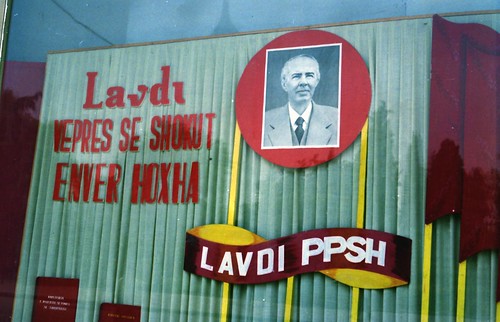
ALBANIA: 1984 - SLOGANS


It was a long drive from Korçë back to Tirana. We passed countless domed concrete bunkers and a stream of political slogans. Some of these, which were as widely distributed throughout the country as were the bunkers, were on hoardings by the roadside. Others were spelled out in enormous letters on hillsides and mountain tops and could be seen for miles around. The letters forming these gigantic propaganda messages were made up of innumerable white pebbles painstakingly gathered together by children and other ‘volunteers’. This is well illustrated in “Slogans”, a film by an Albanian director made in 2001.

The film depicts a school in a small Albanian village during the late 1970s. The director has had news that an important party member is planning to visit the area. The teachers take their young pupils out onto a mountainside and day after day they collect stones and frantically prepare a giant political slogan. Meanwhile, other preparations are being made to welcome the dignitary. The great day finally arrives, and the villagers line up along the village street, waiting excitedly. The car carrying the celebrity roars right through the village at high speed without stopping. The party member being transported does not even look up from the papers that he was perusing as he was driven past the people so eagerly awaiting his visit.

The roadside propaganda was so successful that a number of the messages remained firmly etched in my brain. There were many slogans plastered all over the country, but little variety in the messages that they conveyed. “Work, Disciple, Vigilance” written in Albanian, was a common roadside exhortation. Many a mountainside was adorned with “Parti Enver” (‘Party of Enver’) or “Laudi PPSH”, which those who have learnt Latin will recognise as meaning ‘Praise the PPSH’ (PPSH being an abbreviation for ‘Partia e Punës e Shqipërisë’ - the Albanian Workers' Party. And, the words “Rroftë shoku Enver!” that translate as ‘Long live Comrade Enver’ praised the country’s only party’s leader.

In 2001, long after my trip to Albania, I began working in a dental practice in west London. Many of my patients were and still are refugees from the places in the world, which are stricken by military and political conflicts. Algerians, Iraqis, Afghans, Kurds, Palestinians, Eritreans, and many other others who have fled their far-off disturbed homes sit in my surgery and reveal the ravages that life has inflicted on their teeth. During the terrible conflicts in the former Yugoslavia, many of my patients hailed from Kosovo, and usually spoke poor English in addition to their native Albanian. Many was the smile I elicited from them when I quoted the old party slogans, and wished them ‘Mir u pafshim’ instead of ‘Goodbye’.


NOW READ 
"ALBANIA ON MY MIND"
By
Adam YAMEY
Available:
Amazon
Barnes & Noble
www.lulu.com
Bookdepository