Having trouble reading in English? Then translate it!

Popular Posts

Showing posts with label south india. Show all posts

Sunday, 20 December 2015

STRASBOURG or STRASSBURG? - from ALSACE to PONDICHERRY


In late November, early December 2015, I visited the southern Indian coastal city of Pondicherry (‘Pondi’). Until 1954, this small place on the coast of the Bay of Bengal was a French colony. Now, it is an Indian Union Territory. When the French left in 1954, the ethnically Indian (mainly Tamil) inhabitants of Pondy were offered the opportunity of becoming French citizens. Many accepted. So, at present many of the inhabitants of Pondi are still French subjects, and enjoy the benefits associated with this status. Apart from architecture, there are many left-overs from Pondi’s days as a French colony. For example, policemen wear red képis on their heads and street signs are bilingual: Tamil and French.
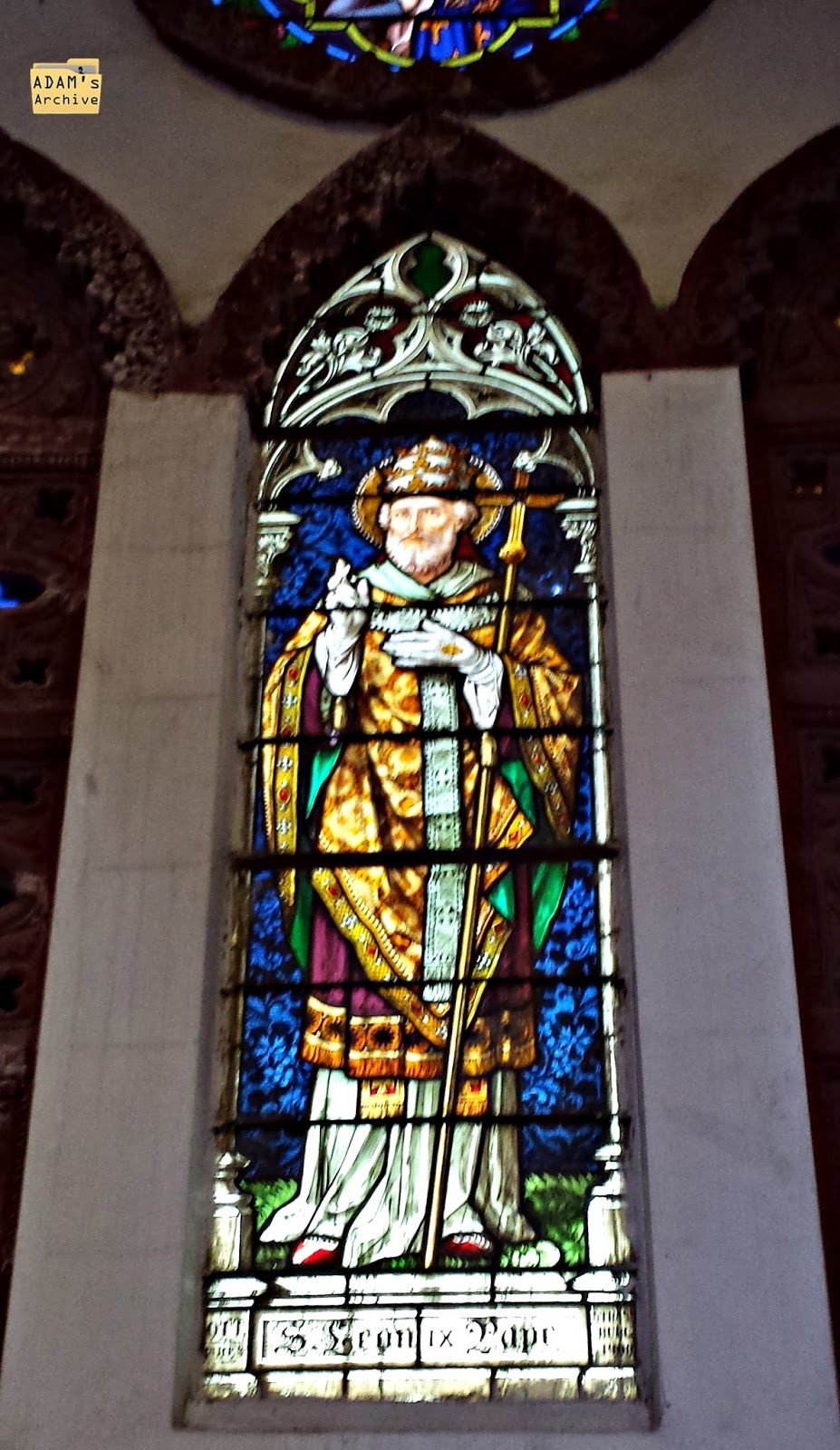


There is a church close to Pondy’s railway station, Basilique Sacre Coeur (Sacred Heart Basilica). This is an airy Gothic revival edifice, which was built between 1902 and 1907, when the first mass was held in its eastern wing. The church was completed by 1908[1]. While walking around the church, I noticed some particularly fine stained glass windows in the south wall of the nave. Each one of the windows depicted a saint, and below each saint was his or her name. To the right of each name was an inscription: “Strassburg 1908”, and to the left: “OTT Fres”.


My interest was immediately heightened. Strassburg was the German name for the now French city of Strasbourg. However in 1908, the city was under German administration. It had been since France was defeated in the Franco-Prussian War of 1870-71, and was to remain so until the end of the First World War (‘WW1). “OTT Fres” was, I assumed, an abbreviated form of OTT Frères, which I guessed (correctly) was the manufacturer of the stained glass.


On my return to the UK, I looked up ‘OTT Frères’ on the Internet, and was gratified to discover that such a company existed. OTT Frères (OTT brothers) was a company of stained glass painters based in in  Strasbourg/Strassburg. They furnished windows for a variety of buildings (churches and other public buildings) in Alsace, especially in the city of Strasbourg/Strassburg during the first two decades of the 20th century[2]. A set of postcards issued in about 1920 (see below) illustrates the interior of the OTT workshops[3]. The company was founded in the 1850s[4], and by 1900 its workshops opened onto the Cour du Corbeau. The company remained in existence until 1975[5]. Clearly, as I discovered, some of its creations travelled a long way from Alsace.


It is of interest to note that the (French) builder of the church in Pondy chose to commission windows from a company in enemy (German) occupied Alsace, but he did. However, not all of the windows in the church were made by Ott Brothers. Some, which seemed newer in design than those made by Ott and not nearly as finely executed, were manufactured by a company in Grenoble.

Strasbourg/Strassburg, like Pondicherry, changed hands. The city remained under German control for about 47 years, whereas Pondy remained under French control for far longer: from 1674 until 1954.

I have some French relatives living in present day Strasbourg. They have been there for several generations, having moved there from southern Germany at the end of the 19th century. When Alsace-Lorraine was occupied by the Prussians in 1870-71, another of my many ancestral relatives, quite unrelated to those of my family who live in Strasbourg today, was a soldier in the Prussian Army. This man was Leo Ginsberg (1845-1895), who was born in Prussia (Breslau) and was the half-brother of my great-grandfather the South African Senator Franz Ginsberg (1862-1936). Leo settled in the occupied Alsatian city. One of his grandchildren told me that when Leo married, he and his wife were required by law to purchase a set of china dishes from the royal Prussian porcelain factories.  Leo had 4 children, all of whom migrated to South Africa, where they lived in King Williams Town in which their uncle Franz had settled in 1880.

We would never have visited Sacre Coeur had I not wanted to see Pondy’s railway station, which turned out to be a bit of a disappointment visually. Since the church is across the road from the station, we felt that we should take a look at it, and I am glad that we did, as doing so revealed a tiny aspect of colonial history.


NOW VISIT

ADAM YAMEY'S

WEBSITE:


FOR SOME MORE WORKS OF INTEREST


[1] https://en.wikipedia.org/wiki/Basilica_of_the_Sacred_Heart_of_Jesus,_Pondicherry
[2] http://www.archi-wiki.org/personnalite-ott_fr%E3%A8res-494.html
[3] http://www.hoogeduinpostcards.com/webshop/lots/59239--lot_of_9_postcards_france,_strasbourg,_vitraux_d-art,_ott_freres_(67).html
[4] http://www.cc-porte-alsace.fr/tourisme/livret-jep-2011-nfb-v4.pdf & http://www.culture.gouv.fr/public/mistral/merimee_fr?ACTION=RETROUVER&FIELD_1=cmer1&VALUE_1=&FIELD_2=cmer4&VALUE_2=&FIELD_3=cmer5&VALUE_3=&FIELD_4=AUTR&VALUE_4=&FIELD_5=TOUT&VALUE_5=ott%20fr%e8res&FIELD_6=titre%20courant&VALUE_6=&FIELD_7=date%20protection&VALUE_7=&FIELD_8=DOSURLP&VALUE_8=%20&NUMBER=2&GRP=0&REQ=%28%28ott%20fr%e8res%29%20%3aTOUT%20%29&USRNAME=nobody&USRPWD=4%24%2534P&SPEC=9&SYN=1&IMLY=&MAX1=1&MAX2=100&MAX3=100&DOM=Tous
[5] https://www.facebook.com/media/set/?set=a.433426656788034.1073741843.366016053529095&type=3

Sunday, 1 September 2013

COAKER KODAI


In July 2013, we visited Kodaikanal's Fairy Falls, illustrated above in a 1909 photograph, but we saw a very different sight:


The Fairy Falls were devoid of water. Despite the luxuriance of the vegetation in Kodaikanal, it is currently suffering from a lack of rainfall .  The Bear Shola Falls, which we reached by a short footpath that was hemmed in by overgrown plants - many with beautiful flowers, was almost dry, but not quite:


The same was the case for Silver Cascades (illustrated in my earlier blog: CLICK HERE ). However from a distance, the artificial lake for which  Kodaikanal is famous looks the same today:


as it did in 1909:


The 8 Km convoluted edge lake is bounded by a roadway.. This pleasant scenic pathway around the lake is lined with villas from different eras; stalls selling a variety of goods to visitors; and boat-houses. One group of stalls sells Tibetan goods:


There are numerous tea-stalls:


The biggest boat-house rents out anything from pedalos :


To fancy looking shikaras:


We hired a boat with an oarsman and spent about 45 minutes being rowed around a part of the lake:


There was a café in what looked like a very old Victorian dwelling:


This was closed as was the ferry station when we passed it:


We strolled around the lake on foot, but many rode on horses accompanied by grooms on bicycles:


There is a variety of trees around the water's edge, all labelled with interesting  information :


At one point along the lake there was a park dedicated to the memory of an Indian patriot:


Maharaja Ripudaman Singh (4 March 1883 – 12 December 1942) was  maharajah of Nabha, a Princely State in the Punjab , until 1923, when the British suspected him of nefarious deeds, and exiled him to Kodaikanal.  Further around the lake, there is a monument to Sir Vere Henry Levinge(1819-1885), who created it:


Its celtic motifs make reference to his Irish origins. His portrait adorns a wall of one of the boathouses: 


Within a few feet of this mnument to a British colonialist there stands a statue of Mahatma Gandhi. The lake is undoubtedly one of Kodaikanal's greatest features. Another one of these is only a few minute's walk awasy from the lake. It is Coaker's Walk, one of whose entrances lies close to the Van Allen Hospital , which was founded by Dr Van Allen in 1915. Coaker's Walk is named after Lieutenant Colonel Coaker who was on duty in Kodaikanal in 1872 when the path that runs around Mount Nebo was constructed in 1872. The views from Coaker's Walk are spectacular:


All along the path, there were stalls  to amuse or distract those who hadd had enough of the  panoramic splendour:


The other end of Coaker's walk is  near the Doordarshan Television Tower, which may be reached after a steep climb up a forested slope. Here it is, partially enveloped by a passing cloud:


So much for outdoor attractions. Just outside the town in Shembaganur, there is a natural history museum that is in itself a museum piece:


It was founded in the 1920s by the Jesuit Philosophical Seminary  of Sacred Heart, which is adjacent to it. The exhibits that have been collected by the students and professors of this institution include some curiosities including  coins from the 'Saarland':


The obligatory animal skulls:


And a python spinal cord:


Even if you are not a nature lover, this antiquated museum is worth a visit. Now, you must be exhausted after all of this sight-seeing. I will reveal more about the attractions of Kodaikanal in another article


FOR SOMETHING
 COMPLETELY DIFFERENT
READ
ADAM YAMEY's LATEST BOOK:


"SCRABBLE WITH SLIVOVITZ"

CLICK H E R E

FOR MORE INFORMATION


Sunday, 25 August 2013

A MISSIONARY POSITION


Even during the coolest time of the year, the temperature in the plains in the south of India can exceed 30 degrees Celsius. In summer, the sky's the limit! As the summer temperature soared in the plains during the 19th century, Europeans sought refuge from the heat in so-called 'hill-stations'. These included members of the American Madura Mission, who decided to set up their own hill-station in Kodaikanal. The Americans built their first church (illustrated above: picture from a 1909 guidebook) there in 1857. It was used for services until 1896 when a new church was built . By 1908, the original church had been demolished. Today, all that remains of this is an obelisk in the midst of the overgrown American Cemetery:


The cemetery is close to one of the earliest dwellings - if not the earliest - to have been built by the American Missionaries:


This building is still privately owned by some Americans and is, like the other remaining original building, built without foundations. The successor to the original church is the Union Church, which is near one of the entrances to Coaker's Walk:


We noticed a wall-mounted clock inside the church. It looked quite old, and had been supplied by a company in Madras, but had been made in the USA:


The Americans were not the only non-British 'Europeans' to settle in Kodaikanal. They were joined by Swedes and Germans. Scarcely anything remains of the Swedish settlement apart from an indication of its location on a map issued by Tamil Nadu Tourism at the rather basic tourist office on PT Road, which is almost opposite a small, super short-order  restaurant called Pot Luck.  The German Missionary Church stlll stands alongside its separate wooden bell-tower and is in good condition:


Two stone crosses surrounded by a circle of thorns stand near to the bell-tower. They are without inscriptions. Maybe, they mark graves. It is difficult to say whether this is the case.


A commemorative stone in the church's south wall reads as follows:

I


Sadly, I cannot find any information about this pastor G Lohmann on the Internet. This old church, which we were unable to enter, is not the only Lutheran church in Kodaikanal. There is another one opposite the main buildings of Koadikanal International School:


Within the grounds of Kodaikanal International School ('KIS'), which were priviliged to be shown around, we saw another of the town's churches. The construction of the school's chapel began in the 1930s. It is named in honour of the school's first  Principal Margaret Eddy (1848-1935)


The school was founded at the beginning of the 20th century by members of several missions. Roughly 50% of its about 600 students come from outside India.


The KIS is close to a complex of restaurants that includes a pizza outlet. There is nothing surprising about this in a town with so many students, but the pious exhortations on the signboard outside it are unusual:


Maybe, we should not be so surprised as  a missionary atmosphere does seem to pervade the town. 
We visited two other churches in the town. One of them overlooks the road that leads from Kodaikanal down the ghats to the plain far below.


This church, the Sacred Heart Church, is a Roman Catholic parish church built in 1910 to accommodate the growing Catholic congregation in Kodaikanal (For more information, click HERE ) . Here are some views inside:


The Sacred Heart was not the first Catholic church in the town. That honour goes to the Church of Our Lady of La Salette, which was built in 1866. This fine edifice stands high above the town close to the Doordarshan television tower and Hindustan Unilever's mercury thermometer factory, and also a compound whose rusting gates proclaim that they give access to the 'Oceanic Shrimping Company'.


Here is a picture of the steps leading up to the venerable church:


And here is a view of its interior:


We noticed something hanging in the church's porch. It looked rather like an embroidered Holy Icon:


We saw another of these at the Sacred Heart Church (mentioned above):


A statue of Our Lady of La Salette stands close to the La Salette Church and above its circular souvenir shop:


I have described the churches that we managed to visit in Kodaikanal. We would have liked to have investigated St Peter's Church, but it was closed each time we passed it. 

Although churches predominate the landscape of Kodaikanal, there are also mosques and temples. This mosque is in the heart of the bazaar area:


And this temple, the Kurinji Andavar Temple is on the edge of town close to Chettiyar Park:


Given that Kodaikanal was built in a position chosen by Christian missionaries, I will not dwell further on these non-Christian places of worship. 


READ ABOUT ADAM YAMEY'S
PUBLISHED WRITING
BY CLICKING: