

 Posts
Posts


NAPOLEON
BONAPARTE DIED in captivity on the tiny island of St Helena in the south
Atlantic. While he was imprisoned on the island, Lieutenant General Sir Hudson Lowe
(1769-1844) was the Governor of St Helena. He was buried at St Mark’s Church in
North Audley Street in London’s Mayfair, where a commemorative plaque can be
found by the main entrance. St Mark’s was built in the Greek Revival Style in
1825-28, designed by John Peter Gandy (1787-1850). In 1878, the church
architect Arthur Blomfield (1829-1899) made considerable alterations to its
interior including adding a timber vaulted ceiling over the nave.
 During
the 1950s and 1960s, the size of St Mark’s congregation diminished significantly.
In 1974, the church was made redundant, and this is how it remained until 1994,
when the church was used by The Commonwealth Christian Fellowship. It continued
to serve this group until 2008. After that, it was used as a venue for
occasional events. In about 2019 after a 5 million Pound restoration programme,
the church underwent a surprising reincarnation.
 After
passing beneath the grand portico supported by two columns topped with ionic
capitals, one enters the church’s large vestibule. Since 2019, this has become
a marketplace selling upmarket Italian delicatessen goods. Entering the body of
the church is rather like taking part in a Fellini film. The floor of the nave is
filled with tables and chairs and people drinking and dining. The side aisles,
north and south, contain several kitchens, preparing and serving a wide variety
of foods, from Turkish to Thai. On the north side of the chancel, just behind
the neo-gothic stone pulpit, there is a gin bar, and facing it on the south
side of the chancel, there is another bar providing alcoholic refreshments. Look
upwards and you can admire the splendid timber roof supports. The wide gallery
surrounding the nave at the first-floor level is home to more food stalls, each
offering tempting looking fare at not unreasonable prices, especially by local
Mayfair standards.
 In
2019, the church became home to a branch of Mercato Metropolitano, whose first
venture was converting a 150,000 square foot disused railway station in Milan during
the 2015 World Expo in that Italian city. The idea of the company was: “The
development of the first Mercato Metropolitano was carefully planned to retain
the site’s original appearance, which nurtured the local community’s affection
for a special part of their urban history.” (https://www.mercatometropolitano.com/mmarketplace/#the-mercato-story).
 And
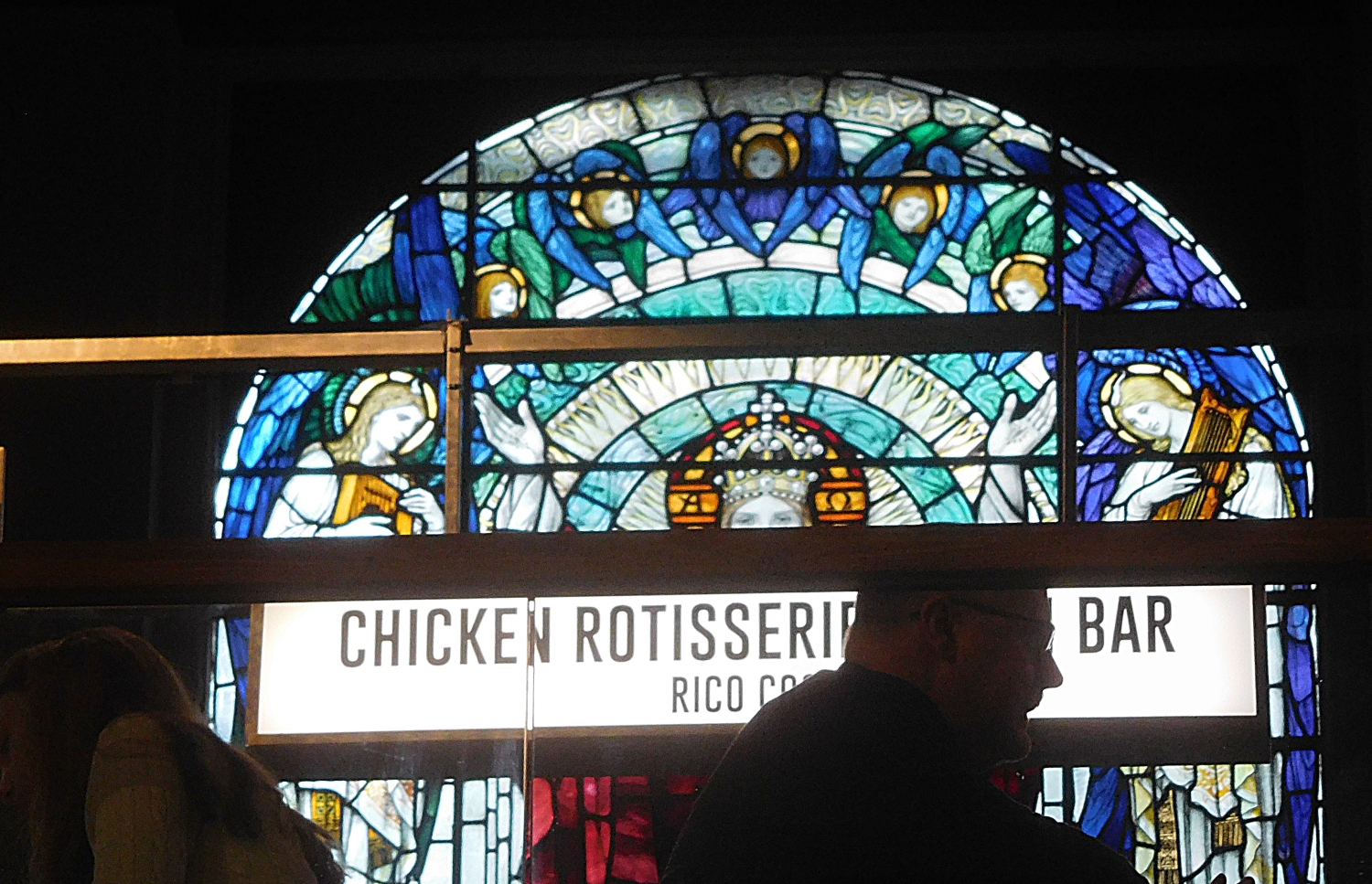
this is what has been done at the former St Mark’s in Mayfair. Many of the
church’s fittings (for example, the tiled floors, the stained glass, the monuments,
the pulpit, and the sacred paintings at the east end of the chancel) have been
preserved. Entering the church is like entering the scene of a lively gargantuan
feast. Seeing the large number of customers on a weekday lunchtime demonstrates
that Mercato Metropolitano have successfully created a great place to meet,
eat, and drink. It is highly original and exciting, both visually and
gastronomically.
 In
Chapter 21 (verses 12-13) of the Gospel according to Matthew, we learn that: “…Jesus
went into the temple of God, and cast out all them that sold and bought in the
temple, and overthrew the tables of the money changers, and the seats of them
that sold doves, And said unto them, It is written, My house shall be called
the house of prayer; but ye have made it a den of thieves.” I
just cannot help wondering, as many of you might also be doing, what The Good
Lord would have made of what can now be seen inside the Church of St Mark’s in
Mayfair.  |
Showing posts with label food. Show all posts
Showing posts with label food. Show all posts
Tuesday, 9 November 2021
GIN AND TONIC BEHIND THE PULPIT AND CHICKEN IN THE CHURCH

Saturday, 18 July 2015
Only at Christmas...

-A divertissement-
I qualified as a dental surgeon at University College Dental School (London) in March 1982. I began my first job in practice soon after that. I joined a small well-run practice in Rainham (Kent), an overgrown village between Gillingham and Sittingbourne. I was about 60 miles (~96 Km) from Central London, but it felt as if it were on a different planet.
My patients were delightful on the whole, and not overly demanding. The principal dentist, Julian Unter, was helpful and never put me under any pressure. I recall once after I had been in practice for only a few weeks that a patient asked me how long I had been a dentist. Not wishing to alarm her that I had only been ‘let loose’ from dental school a few weeks earlier, yet wanting to be honest, I replied: “I have been working up in London for five years”. This, which was true because I had been studying in a dental environment for that length of time, appeared to satisfy the questioner.
There was a branch of Tesco’s supermarket in Rainham. I used to buy bits and pieces there for my lunch. Whenever I handed a chocolate bar or any other piece of dentally unsuitable confectionary, the cashiers, many of whom were patients of our practice, would then wave the chocolate or similar in the air and then shout to everyone in the shop: “Look what the dentist is eating”.
I was brought up eating Mediterranean dishes at home, and learned to cook them myself. Garlic was an essential ingredient in my cooking. I used to cook for myself in my digs in Kent. One day, I was working on an elderly lady’s teeth, when she swept my hand away, and exclaimed: “Ooh, you’ve been eating garlic, Mr Yamey.” From then on, whilst I was working in Kent – and that was for about 11 years – I desisted from eating garlic during the working week. Now, I work near Central London and few of my patients are of Anglo-Saxon origin, and almost all of them eat garlic, so my consumption of the stuff is no longer a problem.
Parsley was another of my favourite ingredients during the 1980s when I worked in Kent. When I began working there, I went into Tescos, which was almost the only food store in the village, and asked for parsley. The reply I received from the surprised store assistant was: “No dear, there’s no call for it. We only get parsley in at Christmas.” I was only 60 miles from London, where parsley was readily available throughout the year, but no one wanted it in Rainham except at Christmas. This and many other similar cultural differences made me realise how different Kent was to London and many of the exotic places that I had visited much further away from it.
READ MORE BY
ADAM YAMEY
CLICK: HERE
Sunday, 16 November 2014
EATING IN COCHIN

When we informed our friends in Bangalore that we were going to spend 12 days in Cochin (in the Indian State of Kerala), they all wondered what we would find to do there for such a long time. "Ah, well," some of them said, "you can always spend a few days on the backwaters or in a nature reserve. That would help the time pass nicely." Despite advice such as this, we managed to find plenty to do in and around Fort Cochin without having to leave it as our friends suggested.

One of the things that we particularly enjoyed in Cochin was eating. This small city is well provided with restaurants, many of which serve food - both Indian and European - of the highest quality. In 12 days, we had plenty of opportunities to sample the fare on offer in this delightful, laid-back historic town. I plan to make your mouth water by describing some of the many places that served us food. The opinions expressed in this article are entirely my own and completely unbiased by inducements offered by the establishments to be discussed.

There is a line of 4 restaurants along one pavement of Tower Road opposite the grounds of Delta College. They look rather like the beach-side 'tavernas' that I used to enjoy visting in Greece during the 1960s and 1970s. At any time of day or night, it is impossible to walk past them without being solicited by the people who work there. Even if you tell them that you have just eaten, they will encourage you to take your next meal there. I had never eaten at Maxim's in Paris, and thought it would be interesting to sample Little Maxim's, one of these pavement restaurants in Cochin. Sadly, it was one of the least enjoyable places that we patronised. There was nothing wrong with the food, but it lacked interest. The restaurant's prices were no less than other establishments that we visited, which had better food and more pleasant ambiences.

24 hours later, we ate dinner in one of the best places that we discovered in Fort Cochin. The Old Harbour House is located in a beautifully preserved building that was probably built by the Dutch several centuries ago. It has an internal courtyard (see above) and a lovely walled garden where meals can be eaten. Costing little more than Little Maxim's,this restaurant is blessed with a chef who learnt his craft in Italy. The seadood pasta (see below), which I ordered, was second to none, even some of the splendid pasta that we had sampled earlier in the year in Sicily. My wife had a superb Keralan fish curry. On our second visit to this restaurant we drank wine, but now this may no longer be possible as Kerala has just become a 'dry state' in which the serving of alcohol is severely restricted by law.

The Old Harbour House is not the only place that serves excellent pasta in Cochin. Located on the first floor of a building opposite the Santa Cruz Basilica, Upstairs is an Italian restaurant, Its owner was trained to cook in Genova in Italy, and the food that he serves shows much eveidence of this. Both the pastas that we tried and the one pizza were superb - well up to the standard of most good restaurants in Italy.


Upstairs calls itself a 'jazz café'. Diners are regaled by an endless stream of recorded jazz music, which is not unpleasant. An Italian who spends several months a year working in Cochin confirmed our opinion of the high quality of the Italian food served here, but his only criticism was that he did not think that they used extra-virgin olive oil! On one of our visits to Upstairs we shared a table with a young lady who reccommended that we tried the nearby Fusion Bay Restaurant. We did as she advised, but were disappointed. This pleasant looking restaurant is very popular, but we did not find that the food was as high a quality as many of the other places where we ate in Cochin. Equally, Talk of the Town, which is opposite Upstairs, was not worth revisiting.

David Hall (see picture above) is a building built by the Dutch, and looks like many of the houses built by the Dutch settlers in the Cape of Good Hope (South Africa). Beautifully restored and preserved, this has become a cultural centre. Some of its rooms house works of contemporary art, and the largest of these is used occasionally as a venue for performances. We were lucky enough to attend a fine jazz concert there. Behind the building there is a garden. On one side of this there is an open air café covered by a canopy. This restaurant serves food and drinks. Its kitchen is provided with a pizza oven (see below). The pizzas that I tried there were not as good as that which I ate at Upstairs, but they were quite acceptable and better than many pizzas that I have eaten elsewhere in India.

Other offerings from the menu at David Hall are best avoided. Whether or not you plan to eat at David Hall, it is a place that is well worth visiting in Cochin. David Hall is located at the side of Fort Cochin furthest from the bus stand and various ferry stations. Between the bus stand and the ferry landing stage where boats to Ernakulam may be boarded, there are a number of eateries of interest. The 'poshest' of these is Brunton Boatyard. The two places that we looked at here were the groundfloor bar-cum- restaurant, which is reached by walking along a passageway lined with fascinating old maps of Cochin (the one shown below was dated 1663), and another much fancier place upstairs called the 'History' restaurant.

The ground floor place has an outdoor garden overlooking the lagoon and with a view of distant cranes at the container terminal on Vallarpadam Island. Incidentally, it is surprising that the two most luxurious hotels in the area - the Brunton and the Taj Vivanta on Willingdon Island - have rather spoilt vistas rich in industrial objects. The filter coffee served in the ground floor café was pricey but excellent. Feeling peckish on one occasion I ordered a 'beer slider with bacon' (see below). This was beautifully presented but disappointingly prepared - poor in taste and not good value for money. The History Restaurant has an elaborately written menu, but offered little that could not be obtained elsewhere in Cochin at a fraction of the price. Each main dish cost more than a decent meal for 2 or 3 people elsewhere in the town.

The Cochin Fort restaurant is directly across the road from the Brunton Boatyard. It is a lively, popular place set back from the busy main road. On arrival, we were invited to look at the freshly caught fish on display and if we had wanted we could have selected specimens that caught our eye. We ate a good meal during an exceptionally heavy rain storm.

The fish peera, a dryish preparation of fish with cococonut, was delicately flavoured and delicious. The fish moilee was also excellent as were the prawns prepared in a north Indian way. The Aleppy fish curry was tasty but not as good as the other dishes that we ate. 'Continental' and Italian dishes were also on the menu but our hosts did not reccommend these.

Further away from the bus stand and almost opposite the rather disappointing Greenix exhibition of Kerala arts, crafts, and traditions, there stands the Pepper House. Like the David Hall already described, Pepper house is both an eatery and a cultural centre. The café overlooks a peaceful and very beautiful grassy courtyard. We sampled a Bombay Sandwich which was essentially a cucumber sandwich with a spicy masala - surprisingly tasty. The café serves a fresh lime soda laced with ground sarsaparilla root (see below).

This curiously flavoured drink is both refreshing and enjoyable. The café is adjacent to a large room containing a magnificent library of books on art - mostly contemporary - and a huge collection of DVDs of western 'art' movies. This library is open to members of the public, who are free to browse and read the books. There are also facilities for watching the DVDs. The library belongs to, and was collected by, Bose Krishnamachari, the director of the Kochi-Muziris Biennale that is about to begin in December 2014.

The Fort House Hotel is close to Pepper House. Its small restaurant, which is one of the best that we visited in Fort Cochin, is housed under a huge traditional palmleaf canopy (see above).

We ate at this restaurant twice , as we did at Old Harbour House which is only just a slightly better eatery. The squid olarithu (see above) was perfect as was grilled fish. Other seafood dishes that we tried were also good. This is a very pleasant place to eat.

One of our few visits to places outside Fort Cochin was to nearby Mattancherry. We entered a particularly unpretentious looking, rather shabby place opposite the bus stand and the entrance to the Dutch Palace. This was the Indian Hotel , where we ate beef biriani (see above). This typically Moslem preparation was one of the best birianis that I have ever tasted. Oddlly enough some of the other really good birianis that I have eaten were also made by Moslems in Kerala (in Calicut).

Returning to Fort Cochin, there are two cafés that deserve mentioning. One of these is Tea Pot. This is housed in an old Dutch (or Portuguese?) house that used to be the home of a family. The walls of this place are lined with shelves containing a large collection of teapots and kettles; they also hang from hooks above. The centrepiece of the place is a circular glass table supported by the upturnerd roots of a tree.

Drinks at Tea Pot are good as was the prawn kurma that I tried. I cannot say the same for what I saw and sampled of the sandwiches and other food offerings. Nevertheless, the Tea Pot is an extremely pleasant place in which to linger. Nearby in Burger Street, there is the lovely Kashi's. Filled with interesting works of contemporary art - mostly sculptural (see below) - and a good selection of art journals, this is a 'happening' place filled with visitors and locals.


Although the food that we saw being served at Kashi's did not look particularly exciting, the cold coffees and ginger lime sodas that we drank there frequently were second to none. There are many other cafés in Kochin, but the 2 that I have described are by far the best.

The Cafe du Mahe is the restaurant of the Tea Bungalow homestay (see detail above: this illustrates the type of rainwater conducting chains found in buildings all over Cochin)), and is excellent. It is a little way away from the centre of Fort Cochin, but worth visiting. We ate beside a swimming pool in the small garden surrounded on three sides by the hotel.

The grilled fish that we ate (see above) was exquisitely prepared. The vegetables accompanying the fish were cooked to perfection lightly flavoured with garlic and celery leaves in a European manner.

Back in the centre of Fort Cochin, close to the Chinese fishing nets and next to the Harbour House restaurant stands the Tower House hotel that is housed in a 17th century building. This establishment contains a restaurant that we tried to enter several times unsuccessfully. The rude watchman at the door put us off twice, and on another occasion it was closed because the cook was 'away'. I am glad that we persisted because when we did finally get to eat at the restaurant, the food was above average. We ate a light lunch consisting of an authentic tasting gazpacho, deep fried squids that were perfect, and a curious cheese croquette. This consisted of cheese sandwiches that had been coated with breadcrumbs and then deep fried; it was delicious.

The Bright Heritage Hotel on Tower Road, where we stayed, also had a good restaurant, which serves non-residents as well as hotel guests. This is open to the outside under a canopy on the top of the hotel. Everything was made from scratch when it was ordered. A team of 4 young cooks chopped, ground, stirred, and fried, once the order for a dish was given. The results were tasty. We particularly enjoyed a prawn and raw mango curry. The payasam (see above) served as a dessert made a great finale for the good meals that we ate there.

During our only visit to Ernakulam, the modern city of Cochin across the lagoon from Fort Cochin, we were taken to have lunch at the beautifully restored old Grand Hotel on MG Road. It has a large dining room, which was filled with locals enjoying the excellent food served there. We enjoyed several Keralan dishes - both seafood (see below) and meat - served with flaky Kerala parathas (see above).

In summary, Fort Cochin is not only a delightfully picturesque place to visit but also a wonderful place for gourmets. Both local dishes and European dishes of a high quality are available at reasonable prices in pleasant surroundings.

Spice shop run by Gujuratis in Ernakulam
READ MORE OF
ADAM YAMEY's WRITING
BY CLICKING
Sunday, 10 November 2013
PARIS WITHOUT EIFFEL

Four days in Paris during the autumn of 2013

TUESDAY 29 OCT 2013
To celebrate our 20th wedding anniversary, we decided to visit Paris. Before setting off on the Eurostar train at London's St Pancras Station, I had some misgivings about revisiting a city which I had visited many times before. As soon as I stepped out of the metro train that took us from Gare du Nord to Place St Michel, these misgivings evaporated. Far from making me feel blasé, the sights of the city uplifted my soul. I felt as if I was seeing the city anew. I was filled with wonder. After taking possession of our room at the Hotel Esmeralda on the Rue St Julien le Pauvre - its window provided an excellent view of the north side of Notre Dame - we took the metro to the station named 'Stalingrad'.

We were hungry. Someone in a bar close to the station directed us to a nearby restaurant called Canal Huit. This moderately priced, unpretentious local eatery served food prepared to perfection. In addition to the marquise de jambon/chevre, which consisted of chunks of smoked ham stuffed with goats cheese, I also enjoyed beef sautéed with carrots in a richly flavoured reddish sauce - perfection. My wife ate a perfectly prepared entrecote. Satisfyingly replete, we strolled over to the nearby Bassin de la Villette, which used to serve as a port for boats using the canal system that served Paris before the advent of railways.

After looking at the Bassin, we began walking alongside the Canal St Martin that connects north-east Paris with the Seine, which it enters near to the Arsénale. At first the canal was lined by 'edgy' looking establishments, but nearer the centre of the city the canal becomes increasingly chic.

We watched a tour boat passing through one of the series of double-locks that allow ships to descend gradually to the level of the Seine.

And then we continued our pleasant stroll along the canal. Every now and then we encountered small parks along the water's edge. Often these were alongside the double-locks. Near the Place de la République, the canal disappears into a tunnel. We took a bus from the Place to Place St Michel. From there we walked to the famous bookshop called 'Shakespeare & Co.' (see: HERE for more detail), which was just around the corner from our hotel.

We waited there for the arrival of my cousin J-B, who has attended workshops at this famous establishment. Eventually, he appeared, and we accompanied him to the nearby Café Panis, which is an example of the nicest kind of traditional Parisian café. We chatted and enjoyed a supper together. After eating, we accompanied J-B to his RER station, and then took a walk around the lively part of the Quartier Latin near to our hotel.


St Severin
Before entering our hotel, we took a peek inside the nearby church of St Julien le Pauvre. We were able to enter it despite it being after 10 pm because a concert that had been held inside it had just ended. The church is now used by a Melkite Greek Catholic congregation. See below:

WED 30 OCT 2013
We awoke early in order to beat the queues that form soon after Notre Dame opens its doors at 8 am. I am glad that we did not have to queue as the interior of Notre Dame proved to be disappointing. Unlike many other Gothic cathedrals and churches that I have visited, the interior of N-D is sombre. It lacks the lightness and uplifting nature of other churches built at the same time as N-D. In contrast, its exterior is magnificent.

We looked at various places for breakfast. Most of the cafés in the vicinity of N-D and near to Place St Michel offer a pathetic 'breakfast menu' for at least € 7.50, that is more than £7. For this, all you are offered is a croissant, a hot drink, and a glass of orange juice. We left the banks of the Seine and walked into the Quartier Latin, where we found a neighbourhood bar. Here, we enjoyed 2 hot drinks and an excellent fresh croissant for under €5 for the two of us. We were served by a witty barman and his assistant. They made jokes as funny as any that you would associate with New York City banter. After this truly small petit déjeuner, we walked along the Boulevard St Germain and then the Rue Bonaparte, passing the house where the painter Edouard Manet was born.

St Germain des Prés
We arrived at the Musée d'Orsay just before 10 am, hoping to avoid having to join a queue, but found that a long one had already formed. The museum is housed in the shell of what used to be a railway station.

Just before joining the queue, we spotted a plaque on the exterior wall of the former station. It commemorated the deportation from this station of many innocent victims of the Nazis. While we were waiting in the line for the ticket hall of the museum in which we were hoping to enjoy seeing great works of art, I could not help thinking of those unfortunates who must have had to wait near or in this station in the early 1940s before facing a far worse fate. After 20 minutes, we entered the museum.
The best thing we saw in the museum was a well-displayed temporary exhibition called Allegro Barbaro. This is the name of a piece of music written in 1911 by the Hungarian composer Bela Bartok. The exhibition displayed paintings executed by Hungarian artists during the first 20 years of the 20th century. All of the paintings on show were of the highest artistic quality. Many were painted by Robert Bereny (1887-1953) and Joszef Rippl-Ronai (1861-1927). I particularly liked the only painting on display by the short-lived Joszef Nemes-Lamperth (1891-1924) and a couple of pictures by Laszlo Moholy-Nagy (1895-1946). However, all of the pictures were worth seeing.

The top floor of the museum contains a vast number of paintings by French Impressionist artists. Many of them were very familiar to me, having seen them often in reproductions. Each painting displayed was magnificent, but there were too many of them on display to be able to focus properly on individual works. Likewise, there were far too many visitors trying to view them, many of them clutching miniature electronic devices that looked like mobile 'phones. These gadgets fitted with headphones contain recorded information about selected paintings. There were too Manet (excuse the pun!) pictures and art pilgrims for my liking. Great as the pictures are, I feel that better places to enjoy the works of the Impressionists include the National Gallery and the Courtauld Institute in London.
Several floors beneath the Impressionist gallery there was a gallery containing works executed by Vincent Van Gogh whilst he lived in France. These hung alongside a number of paintings made by Gauguin in the Far East. Sadly, the crowd in this particular gallery was far too dense to enjoy these superb canvases properly.
The main space of the former railway station has been over-restored and wrecked. What must have once been a wonderful open space where passengers and porters milled around has been spoilt by the construction of step-like concrete partitions that break up the space unharmoniously. This poor treatment of space contrasts markedly with the successful handling of space in the cavernous former Turbine Hall at the Tate Modern in London. Both my wife and I left the Musée d'Orsay a little disappointed - not with the art, but with the building itself.

RER station beneath Musé d'Orsay
A long ride on a metroi train took us to the north of Paris, to the municipality of St Denis. We were hungry when we arrived, but could not face any of the 'fast-food' joints that we found near the town's main square. Eventually, we homed in on an isolated restaurant called 'Les Orangines'.
It was a time-warp. We felt as if we had stepped into a modest restaurant in provincial France in the 1960s or maybe before. It looked as if the place had not been decorated since then. When we entered, there was a bald-headed man sitting at a table directly beneath a large television screen, his eyes glued to the football match that was being broadcast with the volume turned off. Across the room next to the entrance to the kitchen there was another man with a bushy moustache. Both men were taking occasional swigs from their alcoholic drinks. Baldy was drinking Pastis; the moustachioed was drinking Scotch whiskey.

We ordered our meal from the friendly Algerian waiter, who, we discovered, was not Arab but Kabyle. While my wife awaited her cous-cous with merguez sausages and lamb kebab and I for my home-made meatballs, we asked the two other seated men whether they thought it would be safe for us to visit the Parisian district of Belleville. Baldy replied that he did not know because it was là bas in Paris rather than in his beloved St Denis. He added that it was full of les chinois unlike St Denis which was full of Pakistanis and other Moslems that he referred to as les barbus - the bearded ones. At this point the other man, the moustachioed, looked up from his drink and said that Baldy was racist. Baldy turned to him and said (in French, of course) "Yes, I am VERY racist ". The 2 men and the waiter all laughed. Shortly after this, Baldy described both Canada and India as being colonies of France.
The food arrived. It had been freshly prepared and was delicious. Usually, I do not enjoy cous-cous, but what was served was tastier than any that I had ever eaten previously.The meatballs were delicately flavoured. When I asked the waiter which meat had been used to prepare them, he replied beef. Baldy, who was nursing yet another glass of Pastis, hastened to add proudly that it was not just beef, but it was French beef. Every now and then, he made meaningless exclaimations whenever soething exciting happened on the screen above him. The mustachioed man stood up, went behind the bar, and helped himself to another large whiskey, and then, a few minutes later, a small pitcher of wine.
Baldy turned to us and asked if we had visited the Basilica at St Denis. When we told him that we were going to do that after eating, he began listing all of the attractions of his town of St Denis.He suggested that we should visit all of them after seeing the Basilica. He was very proud of St Denis, where he had lived for 62 years since leaving Spain, his native land.
Meals arrived for Baldy and the moustachioed fellow just after we had eaten ours. After serving the 2 other men, the waiter presented us with a large slice of sweet melon as a gift for our desert. After drinking coffee, we left Les Orangines, and headed for the Basilica of St Denis.

The interior of the gothic basilica is a complete contrast to that of Notre Dame. The nave was tall, light, airy, and uplifting. The apse, the north transept, and the crypt of the Basilica form the final resting places of many of France's royalty. At some point during the early 19th century (around about 1817), many royal tombs were relocated from places all over France and placed in the Basilica at St Denis. For an immoderate entry fee, we were allowed to look at this splendidly laid out collection of graves and funerary sculpture. A black marble slab in the crypt marks the resting place of Marie Antoinette, which lies next to that of her husband Louis XVI. A solitary fresh bouquet lay on her stone.

A long, slow bus ride brought us from the market place in the centre of St Denis to Porte de la Chappelle on the northern edge of Paris. On the way, we crossed the Canal St Denis, where I spotted a shanty town on one of its banks, which looked just a small version of one in Bombay, India. At Porte de la Chappelle, there were many gypsies waiting by the bus stop. Each of them was accompanied by a heavily laden shopping trolley.

We took a metro train to the Gare de l'Est. Above the entrance to the platforms there is a painting by Albert Hester, done in 1923, showing French soldiers setting off to war:

Elsewhere in the station there are monuments to those who were forced to travel against their will by the Nazis and their French collaborators in the 1940s.

We strolled along the Boulevard Strasbourg that connects the Gare de l'Est with the centre of Paris. Near the station many of the pedestrians were black Africans. There were many crowded, busy hair salons filled with Black women having their hair and nails done. After passing a couple of theatres, we turned off the boulevard and onto the Boulevard St Martin. A short way along it we came across the Porte St Martin:


We took a bus from there to Place St Denis, and ate at Café Panis, where we had eaten with J-B the day before:

For desert, I at a crèpe made at the Patisserie Sud Tunisien:


After that, we managed to enter the church of St Séverin, where we saw a religious painting with a Polish inscription beneath it.

THURS 31 OCT 2013

We are sitting in a café on the chic Ile St Louis. A little overpopulated with tourists, this small island in the Seine maintains the charm it had when I first visted Paris (with my parents) in about 1968. During that visit we stayed in the only hotel on the Ile. The hotel still exists, but is no longer the sole one and it is quite unaffordable. We have arrived on the island after a long trip form the the south to north-east of Paris.
This morning we began by travelling south towards the Place d'Italie. When our bus reached the Rue Monge, we disembarked to visit the Arenes de Lutèce. Surrounded by apartment blocks, this site contains the ruins of a Roman arena discovered in the 1870s.


After visiting this little-known archaeological site, which I first learned about from Ian Nairn' quirky guide book to Paris, Nairn's Paris (first publ. 1968), we headed for another of Nairn's recommendations, the much visited Rue Mouffetard.

After taking coffee in a small bar, where we were served by another witty barman, we entered the church of St Médard. The church is small and mostly gothic. The neo-classical pillars surrounding the high altar were built later than the rest of the church:

The Rue Mouffetard winds gently up a hillside. It is lined with foodshops displaying a wide range of mouthwatering foods - both ready-to-eat and also raw ingredients. Each display is a work of art:

The road ends at a small attractive square at the summit of the slope. A road leads from there downhill towards the Seine, which can be seen in the distance. We passed the house where James Joyce wrote his Ulysses, and soon after that we reached the Collège des Ecossais.


A sign next to this old palace informs that the brain of King James II of England, who died in Paris in 1701, is stored in the chapel. He came to France when he refused to give up Roman Catholicism. We tried to enter the building, but were told that tourists need to make a prior appointment to do so. In general, it used to be the tradition in France that the corpses of royalty were dismembered, and the various organs, such as the heart and brain, would be interred in different locations.

We took a bus to the Gare d'Austerlitz, where we made use of its elegant toilets. For a mere € 0.5 each we entered the suite of bathrooms and toilets, which looked more like a high class beauticians' salon than a railway station WC.

We caught a metro train from this railway terminal and headed for the north-eastern district of Belleville.

Metro station at Gare d'Austerlitz
Belleville is full of Chinese shops and restaurants. Amongst these we found and entered a modest-looking tiny Vietnamese eatery. We ordered three dishes that were prepared in the tiny kitchen in this establishment. We enjoye some of the best Vietnamese food that we have ever eaten.


The owner told us that he had come to France from Saigon 30years ago. When I asked to use the toilet, he told me that there was not one in his restaurant, but that he would take me to one nearby. I followed him out of the shop and down the street to the door to an apartment building. He opened this and took me through a leafy courtyard to the WC.

View from the 'loo'.
We walked up the steep Rue de Belleville, occasionally passing through vegetable shops that extended across the pavement and onto the roadway.

Eventually, we reached the Parc des Buttes-Chaumont, a place that I have long wanted to visit having first learnt about it in Nairn's Paris many years ago. The centre-piece of this 19th century park that spreads across the slope of a hill is a cliff-like rock on the top of which there is a temple-like structure.

Many of the paths in the park were closed for repair, but that did not prevent us from seeing some of its attractions such as a delightful late 19th century café:

After leaving the park, we passed in front of the elegant 19th century Mairie of the XIXth arrondisement, before entering the metro at Laumange station.

We disembarked at Quai des Rapées, a station next to the Bassin d'Arsenale, where the Canal St Martin enters the Seine. We walked from there along the right bank of the Seine before crossing the Pont Sully in order to reach the Ile St Louis, where I wrote this entry.

As we walked along this central street on the small island we passed the church of St Louis-en-Ile, which we entered briefly:

After a refreshing beer on the island we crossesd another bridge onto the Ile de la Cité.


Having had a well-deserved rest in our hotel, we returned to Place Stalingrad to eat at the Canal Huit restaurant, where we ate a couple of days earlier. After eating another excellent meal there, we returned to the Bassin de la Villette, which is quite lively at night.

At one end of the Bassin thare ia a round building, La Rotonde designed in about 1784 by Claude-Nicolas Ledoux (1736-1806). It that now contains a restaurant. In former days it had been a customs house where dues were levied on imported goods brought to the city by the canals.

We returned to Place St Michel, where I ate a crèpe before we returned to the hotel.


FRI 01 NOV 2013

It was All Saints Day, a public holiday in France. The rain began in the morning and fell all day, but that did not deter us. We took an RER train to the Musée d'Orsay, and before crossing over the Seine on a modern foot-bridge, the Passarelle Solférino, a scruffy fellow picked up a shiny gold coloured ring from the pavement just in front of us. He asked my wife if it was hers. When she said it was not, he said that she should keep it anyway. We stepped onto the passarelle, and noticed that we were being followed by the scruffy man. He came up to us and asked us for money, claiming that he was hungry. We said 'non', and then he demanded that we return the ring, which we did. Moments later, we saw that he was trying the same trick on someone else.

The railings of the foot-bridge are covered with padlocks, love tokens. Apparently, there are so many of these that thier combined weight might threaten the integrity of the bridge.


We walked through the rain sodden Tuileries gardens, which have been disfigured by mediochre outdoor sculptures, and past the Louvre to the Rue Rivoli, which we crossed before entering the deserted courtyards of the Palais Royale.


At the far end of the Palais, we passed the Le Grand Véfour, an elegant restaurant, with prices that are sky high - a set menu for €298, for example.


We continued walking through the rain towards Les Halles, stopping on the way at a beautifully designed café called Père et Fils for a coffee. We entered the magnificent gothic church of St Eustache in time to catch the tail-end of a service. As Ian Nairn once wrote, the organ's music seems to scrape away at the beautifully vaulted high ceiling of this building.

We ate la well-prepared lunch in a bistrot on Boulevard Sébastopol. After an aperitif of Pastis, I enjoyed Soupe à l'oignon followed by steak tartare. My wife enjoyed her serving of paté de foie gras de canard.


We continued to walk after we had eaten, and soon arrived at the Centre Pompidou. This building seems to have survived the passage of time well. An adventurous building, I did not think that it is as elegant as the Nat West Tower in London, which like the Pompidou Centre, also exposes its innards to the outside world.

St Merri seen from Place Stravinsky
After viewing the sculptures by Jean Tinguely and Niki de Saint-Phalle that stand in the pool in the Place Stravinsky, we entered the nearby church of St Merri. Its spelling seems to be uncertain. Even within it we saw the saint's name spelled as both 'Merri' and 'Merry'.


The Rue des Rosiers, a Jewish district, not far from St Merri, was teeming with crowds of tourists. Many of them were queing outside counters selling beigels and falafels. A number of Lubavitch men dressed in black with tzitzes dangling from their belts were dancing in the streets and asking men, including me, whether they were Jewish.

A little further aloing the street, we passed a building (Hamam St Paul) that had once been the Jewish public baths. Next to it, there was a boys' school, which bore a plaque commemorating the deportaition of Jewish schoolboys to Auschwitz in 1943-44.

The 17th century Place des Vosges is truly magnificent. I had been looking forward to seeing it, but was a little disappointed. The square is surrounded by arcades in which there are now many art galleries selling unexciting works of contemporary art. Once, these vaulted arcades contained shops for the French aristocracy.


We took a bus from near the Place to Place St Michel. The route taken by the bus was fascinating as it involved driving through a narrow arch that entered the Louvre, passing the new glass pyramid before crossing the Seine near the Musée d'Orsay.

Sévres-Babylone

Cluny
We ended the day by eating dinner with another of my cousins at his home in the 7th Arrondisement. Next day, we set off for Strasbourg from the Gare de l'Est.

After returning to London, someone asked me whether we had seen the Eiffel Tower. I thought for a moment, and then realised that we had not caught even a distant glimpse of it during our few days in Paris

Metro Monge
NOW, READ ABOUT
ADAM YAMEY's
PUBLISHED BOOKS
ON:
Subscribe to:
Posts (Atom)

