Having trouble reading in English? Then translate it!

Popular Posts

Showing posts with label travel. Show all posts

Monday, 8 November 2021

Free ebook: EXPLORING EXCITING WEST LONDON


WALKING   WEST   LONDON


This book is an informative companion for people who want to get to know west London (London west of Park Lane): history, curiosities, anecdotes, and much more.

Because I would like you to discover the fascination of west London by reading and, I hope, enjoying my book, I am distributing it as an ebook (pdf) FREE OF CHARGE (with no hidden conditions). 

 CLICK HERE to reach the web page from which you can download my book


Tuesday, 28 August 2018

LOOKING THROUGH STONE IN GUJARAT


Baroda

Before setting out on our recent extended travels through Gujarat, I booked accommodation via a well-known travel website. The hotel I chose for Ahmedabad was the aptly named ‘Hotel Goodnight’. Its address, ‘Opp. Sidi Saiyed’s Jali, near Electricity House…’, intrigued me. What is a ‘Jali’, I wondered, apart from being an anagram of ‘jail’.


Ahmedabad


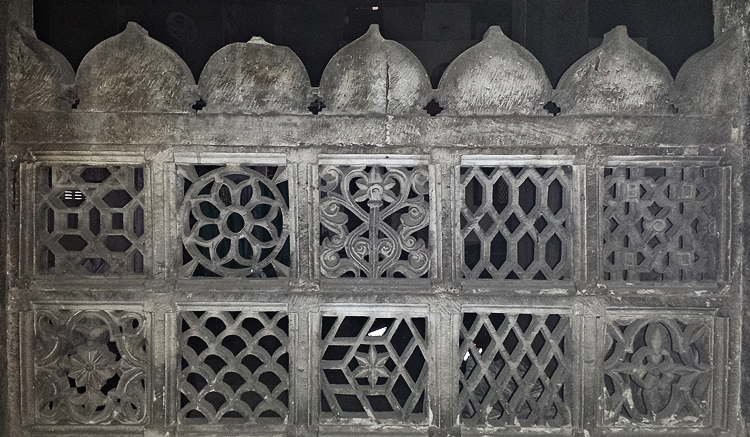
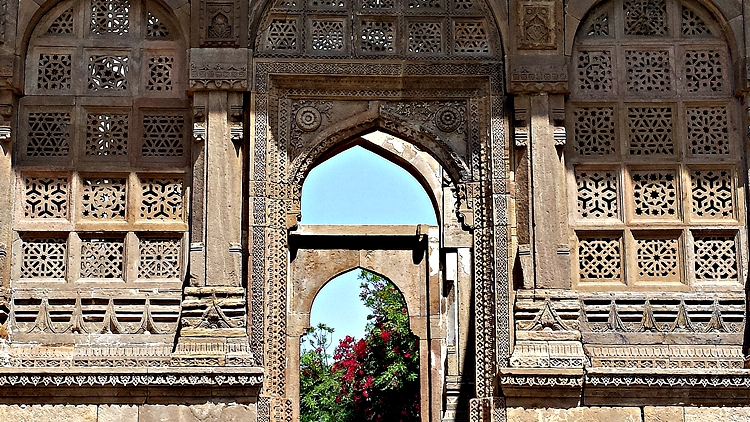
The word ‘jali’ (or ‘jaali’) means ‘net’ in Hindustani. As an architectural term, it refers to stone grille window screens. These screens are carefully and usually intricately carved in stone (usually). A flat stone is carefully perforated to produce an often elaborate pattern of spaces surrounded by the remaining strands of stone. In India, they are found in temples (Hindu and Jain), mosques, and secular buildings. They are usually very attractive. These carved stone window coverings, that simultaneously provide shade and the passage of light, can be seen outside India. There is at least one church in Palermo (Sicily), which contains jali work. In this case, it was created by Moorish craftsmen who remained in Sicily after it was conquered by the Normans.


Palermo (Sicily)


Jali work can be found not only in buildings constructed many centuries ago, but also in more recently built structures, such as the Arts Faculty Building in Baroda and the Vijay Vilas Palace in Kutch Mandvi.


Baroda Faculty of Arts (19th century)


Vijay Vilas (Kutch Mandvi)


The best places in Gujarat for seeing jali, which we visited, were Ahmedabad and Baroda. If you don’t wish to travel so far afield, The Victoria and Albert Museum in London has some very fine examples in its South Asian galleries.


In Victoria and Albert Museum


Returning to Sidi Saiyed’s Jali in Ahmedabad, here is an excerpt from my new book:

Opposite our hotel and across the busy Relief Road, which one should not cross without first saying a prayer, is one of the city’s many architectural treasures. It is the Sidi Saiyed Mosque (aka: ‘Sidi Saiyed’s Jali’), which was built in 1573 during the last year of the Gujarat Sultanate. It was constructed by Sidi Saiyed, an Abyssinian general in the army of Sultan Shams-ud-Din Muzaffar Shah III. A learned man with a great library, he had served with Rumi Khan, a son of Khwajar Safar, who died at Diu. The Sidi’s grave lies in a wire mesh enclosure near the north east corner of the mosque. His much-revered gravestone is usually covered with beautiful coloured silk cloths.

This mosque is a long rectangular open-fronted pavilion. It is entered through any of five wide arches with pointed tops. The mosque’s domed ceiling is supported by four rows of pillars each supporting arches, which together form an arcade. The stonework is decorated in places with floral motifs that are not especially Islamic. The lower part of the rear wall facing the entry arches is plain stonework apart from a centrally placed mihrab.  The upper third of this wall has five almost hemi-circular stone arches. The central one is solid stonework. It is flanked on either side by pairs of exquisite, intricately perforated stone lattice screens, exceptional examples of jali work. They allow light to filter into the mosque from the west.  The screen at the south end of the mosque is carved to represent a Tree of Life with swirling, tangled branches…


Champaner

READ MORE ABOUT GUJARAT IN ADAM YAMEY's
LATEST BOOK

AVAILABLE in PAPERBACK by clicking HERE

DOWNLOAD on to your KINDLE by clicking HERE


Friday, 24 August 2018

OPEN YOUR EYES TO GUJARAT


DISCOVER GUJARAT AND  THE FORMER PORTUGUESE COLONIES OF DAMAN AND DIU

"Gujarat, the land of Gandhi and Patel, is also the land of business"
[Narendra Modi, 2017]

Almost wherever you live, you are bound to have met members of the Gujarati diaspora. Yet, Gujarat in western India, where they originated, is hardly known or visited by foreign and Indian tourists.
Adam Yamey’s richly illustrated book describes his travels through Gujarat and two former Portuguese colonies, Daman, and Diu, with his wife. Her knowledge of Gujarati allowed the travellers to speak with locals and gain their insightful views about Gujarat’s past, present, and future.


Join Adam and his wife in their adventures through the land where Mahatma Gandhi grew up and Lord Krishna ascended to heaven. Meet the people and discover places whose beauty rivals the better-known sights of India.

This book will be of great interest to tourists. It is an insightful personal view of the region rather than a guide book.


GET TO KNOW GUJARAT
WITHOUT LEAVING YOUR SEAT:


BUY THE PAPERBACK H E R E


DOWNLOAD ONTO YOUR KINDLE H E R E


Friday, 10 August 2018

GUJARAT - a new link


GUJARAT has been an important trading area since time immemorial and a place where diverse peoples have mingled. It offers the visitor a rich cultural tapestry: history, tradition, architecture, and much more. Its people are welcoming. 

Good accomodation is available, and transportation is not a problem.


Find out more about GUJARAT at this exciting new website:

Friday, 24 November 2017

EXPLORING INDIA WITH A BABY


It was early in 1996. We never intended taking our nine-month old daughter to visit Hampi in the Indian state of Karnataka to see the ruins of the once great city Vijayanagara, which had in its heyday rivalled Rome in its splendour. We had hoped that her grandparents in Bangalore were going to baby-sit for us, but just before my wife and I were about to depart they felt unable to oblige. So, with little preparation, we boarded the sleeper from Bangalore to Hospet, the nearest town to Hampi. My wife clutched our little one on a narrow, hard, swaying railway bunk bed, desperately trying to prevent her from falling off.

At Hospet, our hosts, officials at a local mining company, greeted us with banners which they had made for us. They drove us to a comfortable hotel, whose rooms lacked air-conditioning and fridges. The ambient temperature never dropped below thirty Celsius, even at night. When our daughter needed a bottle of milk, we prepared it, and had to use, and then dispose, of it in less than 45 minutes because in that heat the artificial milk deteriorated rapidly.

Hospet in 1996 was less sophisticated that it was, say, a decade later. We ate in simple restaurants, often outdoors under shades. Our daughter took a shine to the South Indian food that we were usually served. She took this from our plates and, also, to our horror, off the not too clean floor. Years later, I can report that unlike many of her school friends she has never suffered from allergies. I am sure that her foraging in Hospet is to some extent to be thanked for that.


Occasionally, I felt like eating North Indian food. We found places, which bore the notice “NIDS”, which meant ‘North Indian dishes served”. I should have known better than to order a ‘NID’ in a very provincial South Indian area, but I did, and was usually disappointed by the curious concoctions that appeared on my plate. On one occasion, I ordered a ‘Peshawari naan’, something that I love. What arrived was surreal. It looked like a circular pizza base that had been painted bright green, and it was covered by bits of dried fruit and fresh banana. It was almost, as they say in the USA: ‘close, but no cigar’.

Optimistically, we had taken a folding ‘buggy’ to Hospet. This never got used, as there was hardly a square metre of ground smooth enough to roll it. Luckily, our hosts drove us around the vast archaeological site in a large four-wheel drive. Our daughter, sat happily perched on or other of our laps as we bounced across the rough ground between the various attractions.

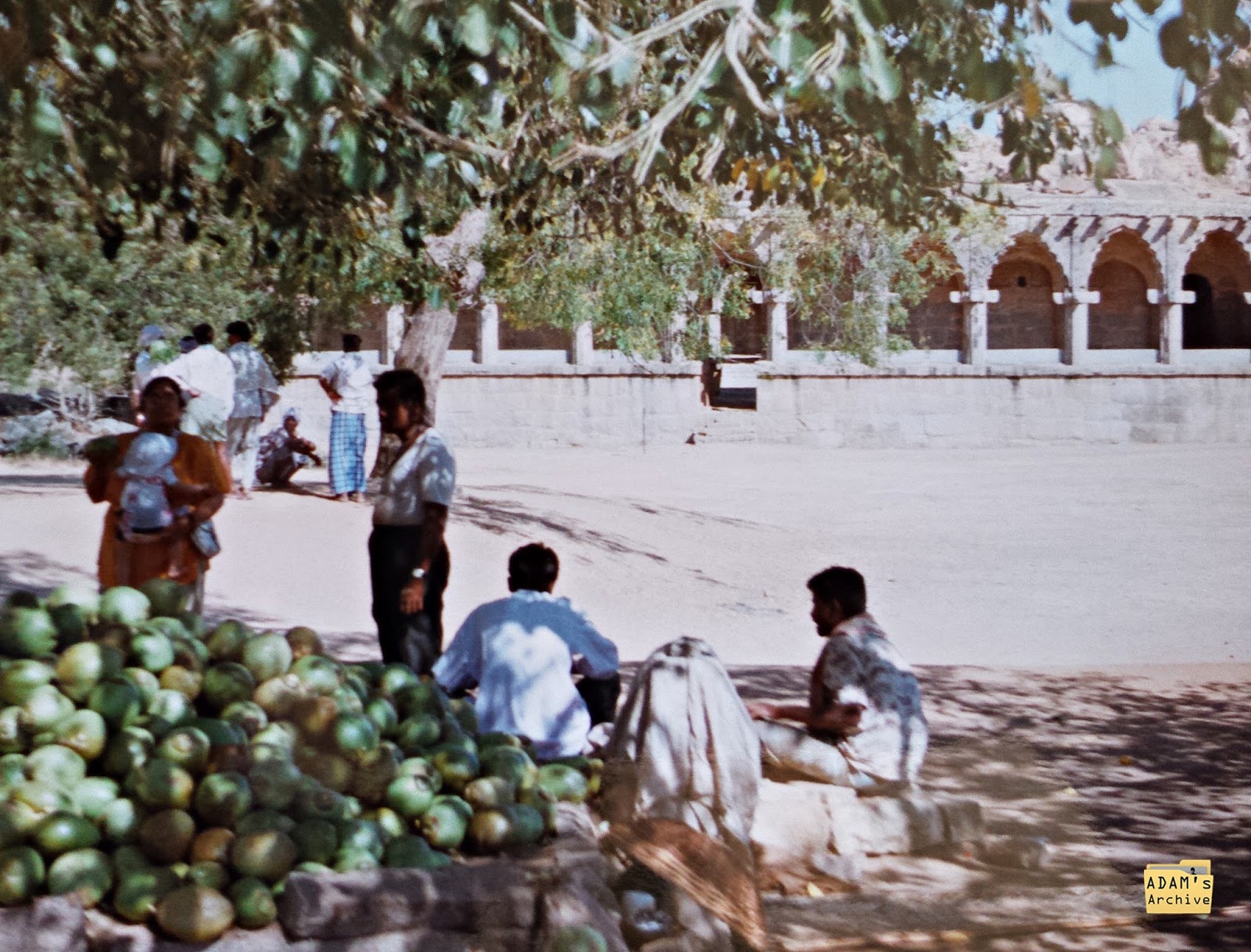
In 1996, the ruins at Hampi were in a far better condition than they are now. For example, the Vittala Temple with its musical pillars was in fine condition. Now, it is a sad shadow of what it was in 1996. It has been vandalised by evil-doers as well as by the authorities, who have tried to save it from collapsing by adding hideous concrete supports.  Back in ’96, it was possible to wander from one attraction to another through a landscape romantically dotted with fragments of earlier civilisations, both Hindu and Islamic. In contrast, today the major attractions are walled off, and attract entry fees. Although I consider Hampi still to be a most exciting archaeological area, it has lost some of the charm that it had when we visited with our baby. She has not only visited Hampi thrice since and is planning another trip soon, but has also grown up to become a professional art-historian. I like to think that her early exposure to mediaeval Indian art has played a role in the evolution of her professional interests.

Our baby had no difficulty with the high temperatures and discomforts during our visit to Hampi and Hospet. She seemed to have enjoyed it immensely. Not only that, but so did the locals. Wherever we went, and this was true of most other places that we visited in India in 1996, she was adored by everyone including total strangers. We had thought that I, a ‘gora’ (a fair-skinned non-Indian), would have attracted attention during our trip from Bangalore, but this was not the case. I was ignored, but our little child was mobbed by well-meaning passers-by, especially little boys who patted her affectionately and told us how sweet she was.


Some short while after our trip to India, we visited Italy, a country famed for spoiling children with affection. At the end of our visit, we concluded that the Indians are far more ‘soppy’ about little children that even the Italians.


Enjoy books written by the author-dentist, ADAM YAMEY.

Monday, 5 May 2014

CHARLIE CHAPLIN WAVED TO ME


The captions to this and the rest of the pictures in this article may be discovered 
by reading Adam Yamey's  Charlie Chaplin waved to me 


Capturing memories of youth...


"The attic of my parents’ house in north London contained a number of old Revelation suitcases. These were plastered with ageing colourful paper stickers bearing the names of shipping lines and also of places such as: Cape Town, Southampton, Harwich, New York, Montreal, and Rotterdam. Had they been animate and able to speak, what tales they would have been able to tell!

If, as a child, I had become a suitcase, I too would have been covered with an exotic assortment of stickers including some of those mentioned above. But, I did not become a piece of baggage, and the stickers that I carry are not made of paper. Instead, they are memories stuck in various compartments of my brain. Unlike the inanimate objects in the attic in the eaves of our house, I am able to speak: to divulge my impressions of the places that I visited in my childhood; to describe the remarkable people I met in those places; and to reveal the unusual experiences that resulted from travelling with my learned father and my talented mother."


Adam Yamey's latest book, Charlie Chaplin waved to me, contains his memories of the holidays and trips that he took with his parents, mostly during the first eighteen years of his life. 

They are worth relating because they differed markedly from the kinds of holidays that most people took during the 1960s and 1970s. Rather than exposing their children to the sun on the beach, his parents preferred to expose their 'kids' to cultural experiences that, they hoped, would benefit them in the future. This was due to Adam's father’s great interest in the history of art, which resulted from his mother having been an artist. Whereas now he appreciates what they did for him then, he did not always do so at the time ...


Here is a very brief extract from the book:


 ... my mother noticed a gondola draped with green cloths pulling up at the corner where the nearby small side canal, which ran alongside the Pensione Seguso, met the much larger Giudecca Canal. The gondolier, a young man, was dressed in green livery that matched the drapes on his highly polished black boat.

Soon after this gondola had moored, we noticed our elderly American fellow diner emerging from the main entrance of the Calcina. He headed straight for the recently arrived gondola, and then boarded it. Next, he sat down, and then started reading a newspaper whilst the gondolier began to row him across the Giudecca Canal. We watched his gondola crossing the water until it disappeared into one of the small canals that traversed the Giudecca Island. We were fascinated and intrigued. After he was out of sight, we began our morning’s activity.

My mother was never shy when she needed to know something. So, after lunch that day, she stopped our mysterious American lunch neighbour and asked him about the gondola and its liveried oarsman. He explained that everyday, he was ferried out into the lagoon in the gondola. When he reached the lagoon, he took over the oar and rowed around the waters of the lagoon for an hour before handing the oar back to the gondolier, who then rowed him back to the Calcina in time for lunch. Remarkable as it was that a non-Venetian could row a gondola competently, what he told us next was even more amazing.

Mr Milliken, as he identified himself, was, as my father was most excited to learn, none other than the director of the well-respected Cleveland Art Museum in the USA. The liveried gondolier, who we had observed, was the grandson of his late mother’s personal gondolier. She used to accompany Mr Milliken on his annual visits to Venice before WW2, and employed her own gondolier during her stays. "


"Charlie Chaplin waved to me"

by Adam Yamey

is available from:


WWW.LULU.COM

AMAZON (including KINDLE)

BARNES & NOBLE (Soon)


Sunday, 22 September 2013

AM I A CAMERA?


I knew that I had them. I knew where these foolscap (not even A4) pages were stored, stuffed into the pages of an old road atlas of Yugoslavia. But, I believed that they contained little more information than the list of places that I had visited with a friend when we drove around Serbia in 1990, the last time that I visited Yugoslavia. I was under the impression that the notes contained only the itinerary that we had followed when we visited lesser-known places in the heart of Yugoslavia, a country that was soon to be torn apart by uncivil civil wars.

However, when I did eventually take a look at these papers more than 20 years after having written them, I realised that I was wrong. These pages contained much more than a simple listing of where we had been and on which day; they contained extremely detailed notes about what we did at each of these places. At the insistence of the Yugoslav friend with whom I had made this trip in May 1990 I had kept a detailed contemporaneous record of our Serbian 'odyssey'.


I re-read these notes whilst I was working on the finishing touches to my book about Albania, "Albania on my mind", and it occurred to me that it would be interesting to write something about the numerous trips that I made to Yugoslavia between about 1967 and 1990. Thus, the idea of writing "Scrabble with Slivovitz - Once upon a time in Yugoslavia"  (which I shall now abbreviate to 'SWS') was born. At first, I thought of writing up my 1990 notes into a short book, but soon after this I decided that I would trawl through my memories and try to write about the decades of experiences that I gleaned from visiting Yugoslavia.


I knew that I had taken many photographs during my numerous visits to ths country and its neighbours, but I had not seen them for over 20 years. They were all colour transparencies taken on 35 mm film. When I moved house in about 1993, all of these pictures were placed, along with many other surplus goods, into a lock-up in a warehouse a long way from where I moved in with my wife. I had no idea what condition they were in and what was depicted on them. Consequently, most of the text of SWS was based on what memories that remained stored in my aging brain. The only part of the book that was based on more than pure memory was my description of the last trip that I made to Yugoslavia (that was in May 1990).


Just when the manuscript of SWS was nearly ready for publication, the company which managed the long-term storage of our goods contacted us urgently. The section of the warehouse in which our storage locker was located was due to be remodelled shortly. The company needed us to move our goods to a new locker, and felt that it would be best if we were present to supervise the moving. We agreed, and whilst the moving was in progress I decided to take a look at some of the numerous boxes of colour transparencies that I had not seen for over 20 years.In each box that I examined, the colour slides were in pristine condition. We returned home, and I ordered a slide scanner from Amazon. 


When the scanner arrived, I returned to our locker, and selected several boxes of slides including most of those that I had taken during my trips to Yugoslavia and its neighbours (SWS also describes excursions that I made from Yugoslavia to Bulgaria and Hungary). I scanned furiously for about 3 weeks until the scanner failed to function any more. I hasten to add that this was not due to over-use but to faulty electronics, which the supplier was gracious enough to acknowledge by making me a refund.  Since returning the scanner, I have devised my own slide scanning apparatus, which, incidentally, produces far better results than the one that I bought. I may describe its construction in a future blog.

I had originally decided to illustrate SWS with pictures 'borrowed' from the Internet, from old books and old tourist brochures in my possession, but the rediscovery of my slides made me change my mind.  I illustrated the book with my own photographs. And this is where the process of writing SWS became interesting. As I scanned the slides and turned them into digital images (.jpeg files), I realised that many of the things that I had written about, and which were based on what I could remember, were things that I had also photographed. It was if the act of taking the photograph not only made changes on the emulsion of the 35 mm camera film but also on my grey matter, or wherever it is that memories are stored in my head. Christopher Isherwood once wrote, "I am a camera...". Well, it appears that so am I!


The object of this little essay was to illustrate something of how my memory works, and I hope that I have succeeded in doing that. However, many of you may be wondering why Scrabble? Slivovitz or Slivovica almost everyone associates with the Balkans, and especially the lands which were once known as 'Yugoslavia', but few would have reason to associate Scrabble, a word game developed in the USA in 1938, with travels in the Balkans.  Well, if you want to know why I played Scrabble in Belgrade (sometimes after eating Chinese noodles in Novi Sad) as well as Sijarinska Banja and Studenica, you will have to read my book!


"SCRABBLE WITH SLIVOVITZ 
- Once upon a time in Yugoslavia"

by Adam Yamey

is available by clicking HERE

OR via Amazon's online stores, 
where it is also available as a Kindle version.


Sunday, 1 September 2013

COAKER KODAI


In July 2013, we visited Kodaikanal's Fairy Falls, illustrated above in a 1909 photograph, but we saw a very different sight:


The Fairy Falls were devoid of water. Despite the luxuriance of the vegetation in Kodaikanal, it is currently suffering from a lack of rainfall .  The Bear Shola Falls, which we reached by a short footpath that was hemmed in by overgrown plants - many with beautiful flowers, was almost dry, but not quite:


The same was the case for Silver Cascades (illustrated in my earlier blog: CLICK HERE ). However from a distance, the artificial lake for which  Kodaikanal is famous looks the same today:


as it did in 1909:


The 8 Km convoluted edge lake is bounded by a roadway.. This pleasant scenic pathway around the lake is lined with villas from different eras; stalls selling a variety of goods to visitors; and boat-houses. One group of stalls sells Tibetan goods:


There are numerous tea-stalls:


The biggest boat-house rents out anything from pedalos :


To fancy looking shikaras:


We hired a boat with an oarsman and spent about 45 minutes being rowed around a part of the lake:


There was a café in what looked like a very old Victorian dwelling:


This was closed as was the ferry station when we passed it:


We strolled around the lake on foot, but many rode on horses accompanied by grooms on bicycles:


There is a variety of trees around the water's edge, all labelled with interesting  information :


At one point along the lake there was a park dedicated to the memory of an Indian patriot:


Maharaja Ripudaman Singh (4 March 1883 – 12 December 1942) was  maharajah of Nabha, a Princely State in the Punjab , until 1923, when the British suspected him of nefarious deeds, and exiled him to Kodaikanal.  Further around the lake, there is a monument to Sir Vere Henry Levinge(1819-1885), who created it:


Its celtic motifs make reference to his Irish origins. His portrait adorns a wall of one of the boathouses: 


Within a few feet of this mnument to a British colonialist there stands a statue of Mahatma Gandhi. The lake is undoubtedly one of Kodaikanal's greatest features. Another one of these is only a few minute's walk awasy from the lake. It is Coaker's Walk, one of whose entrances lies close to the Van Allen Hospital , which was founded by Dr Van Allen in 1915. Coaker's Walk is named after Lieutenant Colonel Coaker who was on duty in Kodaikanal in 1872 when the path that runs around Mount Nebo was constructed in 1872. The views from Coaker's Walk are spectacular:


All along the path, there were stalls  to amuse or distract those who hadd had enough of the  panoramic splendour:


The other end of Coaker's walk is  near the Doordarshan Television Tower, which may be reached after a steep climb up a forested slope. Here it is, partially enveloped by a passing cloud:


So much for outdoor attractions. Just outside the town in Shembaganur, there is a natural history museum that is in itself a museum piece:


It was founded in the 1920s by the Jesuit Philosophical Seminary  of Sacred Heart, which is adjacent to it. The exhibits that have been collected by the students and professors of this institution include some curiosities including  coins from the 'Saarland':


The obligatory animal skulls:


And a python spinal cord:


Even if you are not a nature lover, this antiquated museum is worth a visit. Now, you must be exhausted after all of this sight-seeing. I will reveal more about the attractions of Kodaikanal in another article


FOR SOMETHING
 COMPLETELY DIFFERENT
READ
ADAM YAMEY's LATEST BOOK:


"SCRABBLE WITH SLIVOVITZ"

CLICK H E R E

FOR MORE INFORMATION