Having trouble reading in English? Then translate it!

Popular Posts

Showing posts with label london. Show all posts

Saturday, 27 November 2021

A POTTERY AND A PRISON


HAMPSTEAD IN NORTH London is full of interesting nooks and crannies.


At the west end of Well Walk in Hampstead, near the lower end of Flask Walk, there is a corner building with a Georgian shop front. It is now a small theatre but was once the Well Walk Pottery, which occupied this place for many years. The pottery was started by the potter Christopher Magarshack in 1959. According to Bohm and Norrie, writing in their “Hampstead: London Hill Town”, published in 1980, Elsie, the widow of the Russian Jewish translator and writer David Magarshack (1899-1977), lived there. She bought this corner building, which had formerly been Sidney Spall’s grocery shop in 1957, for Christopher to use as his pottery. His father, David, left his birthplace Riga, then in Russia in 1918 and later lived above the shop. Elsie died in 1999, aged 100. In addition to selling pottery there, the pottery also held classes for ceramicists, some of whom now have good reputations. David’s daughter Stella, a fine artist, was the Head Art Teacher at King Alfred’s, a ‘progressive’ school situated between Hampstead and Golders Green. In 2016, aged 87, she was brutally attacked in the street close to her home. Now, the premises is to be home to a theatrical enterprise, The Wells Theatre. Its present owners have decorated one of its windows has been decorated with a pictorial history of the premises.


Before returning uphill along Flask Walk towards the pub, you will pass a pair of doors covered in metal studs arranged neatly in geometric patterns. According to an article in the January 2018 issue of “Heath and Hampstead Society Newsletter”, this pair of studded doors:

“…is supposed to have come from Newgate Prison,”

The prison closed in 1902.


Monday, 15 November 2021

COSTLY COFFEE, GEORGE FRIDERIC HANDEL, AND JIMI HENDRIX


Coffee, the blues, and baroque in London's Mayfair


THERE ARE TWO entrances to Lancashire Court from Mayfair’s Brook Street. One of them, the closest to New Bond Street, is a cobbled lane leading down to a courtyard occupied by the back entrance of the Victoria’s Secret store and the outdoor tables of a restaurant called Hush Mayfair. The tables under delightfully decorated canopies looked enticing, and as we felt the need for some coffee, we sat down to enjoy small macchiatos (maybe more correctly, ‘macchiati’). The coffees were enjoyable but not exceptional. However, the bill that arrived after we had drunk our tiny coffees was far from unexceptional. We were charged just under £13 (US $17.46, INR 1300, or EUROS 15.25) for our two hot drinks. Just in case you are not familiar with the London café scene, today, November 2021, two macchiatos usually cost between £4 and £6.


Hush, Mayfair

Lancashire Court is a network of lanes and courtyards located behind the buildings on the southwest corner of the intersection of New Bond Street and Brook Street. It was once a part of London, the Conduit Mead Estate (www.ianvisits.co.uk/blog/2021/07/05/londons-alleys-lancashire-court-w1/, an informative web page), that followed the course of an old water conduit that ran through the area in a north/south direction (for a map of the district, see: www.bl.uk/onlinegallery/onlineex/crace/t/largeimage88092.html). From the 1730s until the 1970s, the buildings in Lancashire Court included many workshops, warehouses, and builder’s yards. In 1987, there was a plan to demolish the network of alleys and replace it with a new shopping complex, but this never materialised. Now, the old businesses have been replaced by ‘chic’ establishments including the place where we enjoyed our exorbitantly priced coffees.


Returning to Brook Street, the short section lying between the two entrances to Lancashire Court has two neighbouring houses, numbers 23 and 25, which have importance in the history of music in London. The composer of well-known works such as “The Messiah” and “The Water Music”, George Frideric Handel (1685-1759), moved into what is now number 23 in the summer of 1723, and lived there until his death (https://handelhendrix.org/plan-your-visit/whats-here/handel-house/). In Handel’s time, Brook Street was known as ‘Lower Brook Street’. Handel’s home included a Music Room in which as many as 40 people would be accommodated to perform and listen to Handel’s latest creations.

23 and 25 Brook Street


In 1968, 209 years after Handel died, another musician moved into number 25, the house next door to number 23 Brook Street. Like Handel, the occupant of number 25 was a musical innovator. His name was Jimi Hendrix (1942-1970). According to a useful website (https://handelhendrix.org/plan-your-visit/whats-here/hendrix-flat/):

“The flat on the upper floors of 23 Brook Street was found by Jimi’s girlfriend Kathy Etchingham from an advert in one of the London evening newspapers in June 1968 while he was in New York. He moved in briefly in July before returning to the United States for an extensive tour. He spent some time decorating the flat to his own taste, including purchasing curtains and cushions from the nearby John Lewis department store, as well as ornaments and knickknacks from Portobello Road market and elsewhere. He told Kathy that this was ‘my first real home of my own’.

He returned to Brook Street in January 1969 and almost immediately launched into an exhaustive series of press and media interviews and photo shoots in the flat. On 4 January he made his infamous appearance on the BBC Happening for Lulu TV show, and gave his two Royal Albert Hall concerts in February. In March he was back in New York again and although Kathy remained at Brook Street for a while longer Jimi did not live there again.”


Handel mural in Lancashire Court

After Hendrix’s girlfriend left the flat, it was used as office space. In 2000, it was taken over by the Handel House Trust. By 2016, both Handel’s House and Hendrix’s flat became open to the public as a museum, which I have yet to visit. Sadly, since the onset of the covid19, the museum, now known as ‘Handel and Hendrix in London’ is only open occasionally and will open fully in March 2023.


Lancashire Court is marked in red

The westernmost of the two Brook Street entrances to Lancashire Court is lined with an attractive mural made from ceramic tiles. Created in 2001 by Michael Czerwiǹski (with Ray Howell), it celebrates Handel’s residence in Brook Street. Amongst the many works he composed whilst living there, here is a very small selection of them: the opera “Rodelinda”; “The Messiah” and “Semele”; and “Music for the Royal Fireworks”.


Each of the two musicians of Brook Street did much to change the course of musical history. I wonder what each would have thought of the other, and which of them has the most listeners today. Whatever the answers, their names will live on in people’s minds far longer than that of both the place where we had costly coffee and the currently trendy Victoria Secret high-end but low-cut lingerie store.


Saturday, 13 November 2021

FIELD OF REMEMBRANCE: FALLEN LEAVES AMONGST THE FALLEN


I HAVE LIVED in London for well over 60 years, but it was only this November (2021) that I first became aware of, and experienced, something that has been happening annually on the north side of Westminster Abbey since November 1928 (www.poppyfactory.org/about-us/history-timeline/#). For eight days following the Thursday preceding Remembrance Sunday, the Sunday closest to Armistice Day, the 11th of November, the day on which WW1 ended, the field bounded by Westminster Abbey and its neighbour, the church of St Margaret’s Westminster, is covered with a myriad of mostly tiny wooden memorials hammered into the grass. The memorials are mostly cross-shaped, but some are in the form of crescents, six-pointed stars, and other shapes including some that bear the Sanskrit symbol representing ‘aum’ (or ‘om’). Each of these tiny wooden items commemorates a fallen service person or other victim of war. The shapes of the wooden pieces denote the religion of the person or persons being remembered, be they Christian, Hindu, Sikh, Moslem, Jewish, or of no religion. Many of the wooden memorials have red poppies attached. Oddly, few if any of the Islamic crescents had poppies on them. The small wooden memorials are arranged in groups, according to which service or regiment or organisation the remembered people were members of, or associated with. The whole ‘event’ is organised by The British Legion Poppy Factory. This annual garden of memorials is called The Field of Remembrance.

Fallen leaves amongst the fallen


The Poppy Factory, a charity, was founded in 1922 by Major George Howson (1886-1936) to provide employment for veterans injured during WW1. He bought a site in Richmond (south-west London), where he established a factory to manufacture Remembrance poppies and other related items to be sold to raise money for The British Legion’s Red Poppy Appeal, a charity that supports the Armed Forces community.


Apart from the small wooden memorials, there are many badges and emblems of the groups in which those remembered were members. Looking at these and the small wooden memorials is both fascinating and extremely moving. The fascination lies in the huge variety of regiments and organisations, too many to list, which lost people during military conflicts (and terrorist incidents) since the onset of WW1.


One group of memorials interested me because of their emblem that incorporates a heraldic creature, which has fascinated me for several decades. The creature is the double-headed eagle (‘DHE’), currently used as an emblem by countries including Albania, Serbia, Montenegro, the Indian state of Karnataka, and Russia. The DHE appears on the crests of some of the various regiments of The Royal Dragoon Guards. The Dragoon Guard regiments were first established in the 18th century, in 1746, and consist of mounted infantry. While the Austro-Hungarian Empire existed, it also used the DHE. In 1896, Emperor Franz Joseph I of Austria (1830-1916) of Austria-Hungary was appointed Commander-in-Chief of the 1st King’s Dragoon Guards, some of whose members are remembered in the Field of Remembrance. The emperor allowed the regiment to wear his empire’s emblem (https://web.archive.org/web/20130303033912/http://www.qdg.org.uk/pages/Uniform-1843-Onwards-81.php), the DHE. In addition, the regiment adopted “The Radetzky March” as one of its official march tunes; it is still used today. It was sad that in 1914, Franz Joseph, became the ruler of one of the powers against whom Britain and its allies were fighting. Some of those who fought in the British Royal Dragoon Guard regiments with the DHE on their headwear were killed by allies of the emperor in WW1, who had earlier been appointed their C-in-C. They are commemorated the Field of Remembrance. Judging by the small wooden memorials planted in the Royal Dragoon Guard’s section of the Field of Remembrance, members of at least four religions fell while serving in these regiments. I wondered why the DHE was retained even after Austria-Hungary became one of Britain’s opponents in war.

Double-headed eagles of the Royal Dragoon Guards


Returning to the Field of Remembrance as a whole, it is a poignant sight to behold. Although war is both horrific and ugly, this annual memorial is both moving and beautiful. The Field is laid out beneath trees lining its northern edge. Seeing the dead leaves from these trees lying fallen amongst the thousands of tiny memorials to victims of war seemed most apt to me.

A war memorial next to the north door of Westminster Abbey

Remembering some Jewish people who fell whlst fighting


St Margaret's Westminster behind The Field of Remembrance


Friday, 12 November 2021

ART DECO AND PIANOS IN MAYFAIR


THE CORNER OF BROOK Street and Haunch of Venison Yard (in London’s Mayfair) is adorned with a fine building with a white Portland stone façade. It is built in the art deco style. The building, Greybrook House (28 Brook Street), was constructed in 1929 and designed by Sir John Burnet and Partners (https://historicengland.org.uk/listing/the-list/list-entry/1392996). 
Burnet, born in Scotland, lived from 1857 to 1938.


Greybrook House was built to house the showrooms of the piano company, Bechstein, founded in 1853 by Friedrich Wilhelm Carl Bechstein (1826-1900). In 1901, the firm opened a concert hall, Bechstein Hall, on Wigmore Street. In 1917, the hall was renamed the Wigmore Hall and is still used today. The hall was next to Bechstein’s showrooms, which were closed in 1916 because of its German connection. In 1928, Bechstein’s, which had been closed during and after WW1, re-established itself in the UK, and commissioned the building of Greybrook House to be used for their new showrooms. In addition to showrooms, the new building included practice rooms and office space.


I am not sure when Bechstein left its Brook Street premises. However, I noticed that beside the entrance to the flats there is a beautifully carved calligraphic inscription that reads “Allied Ironfounders Ltd”. This company had its showroom in Greybrook House in the 1950s. Judging by a photograph I have seen on the Internet (www.ribapix.com/allied-ironfounders-showrooms-28-brook-street-mayfair-london-the-showrooms-entrance-with-the-brick-mural-men-of-iron-designed-by-trevor-tennant_riba25422#), it must have been quite exciting visually.


Currently, the ground floor of Greybrook House is occupied by Joseph, an upmarket clothing retailer. The upper floors have been converted into luxury flats by Fenton Whelan and Vanbrugh Prime Property. This was done recently.


The lovely art deco façade of Greybrook House remains unaltered. By chance, or who knows, maybe deliberately, Bechstein’s Brook Street showrooms were almost opposite the house where the composer George Frideric Handel (1685-1759) lived from 1723 until his death. Finally, the company that had its piano showrooms in Greybrook House is currently constructing a new set of showrooms and a small 100 seat concert hall back in Wigmore Street where their first London premises were located (www.rhinegold.co.uk/international_piano/c-bechstein-returns-to-londons-wigmore-street/).


AN 'ICONIC' LONDON LANDMARK


The southern tower of London's Tower Bridge seen from between modern buildings close to the River Thames is  a glorious sight for both tourists and locals. The bridge was built between 1886 and 1894. It was designed by Horace Jones and it was engineered by James W Barry. For many visitors, it symbolises London. Contrary to a popular misconception, it was never for sale and the authorities in Lake Havasu City (Arizona) who bought the last London Bridge knew that they were not expecting to receive Tower Bridge


Thursday, 11 November 2021

THEY HAD NO CHOICE


ARMISTICE DAY IS celebrated annually on the 11th of November, the day that fighting came to an end in WW1. 


The day is to celebrate and:

“…remember all those who gave their lives in service to their country since 1914.” (https://www.britishlegion.org.uk/get-involved/remembrance/about-remembrance/armistice-day). It was not only humans who sacrificed their lives, either willingly or less willingly, but also animals, who had been employed in warfare. A monument on a wide traffic island in London’s Park Lane was constructed to remember these four-legged creatures who lost their lives prematurely during battles from which they were unlikely to gain any benefit.


Erected by The Animals in War Memorial Fund (www.animalsinwar.org.uk/) and unveiled in 2004, this dramatic monument consists of a semi-circular Portland stone wall with a gap near its centre. Two bronze horses laden with military equipment are depicted walking towards the gap. and beyond the gap, a bronze sculpture of a running dog can be seen. The western part of the concave side of the wall has bas-reliefs depicting, horses, elephants, and camels. The eastern side of the concavity bears several inscriptions including one with the words “They had no choice”. The convex surface of the wall bears stylised silhouettes of horses. The monument was designed by David Backhouse and was inspired by the book “Animals in War” by Jilly Cooper.


“They had no choice” is a poignantly appropriate sentence on a memorial to creatures who were taken into fields of battle innocent of their likely fate. Seeing this moving monument made me think that these same four words could easily be applied to the numerous Indian participants in WW1 and WW2 who were sent to Europe as ‘volunteers’ innocent of their horrendous destination by their rulers in the Princely States of India, who wished to please the British, whom they served. Had these unfortunate servicemen known what they were about to face, some of them might have objected. That option was not one that would ever been open to the slaughtered animals commemorated on Park Lane.


Wednesday, 10 November 2021

Oscar Wilde, a bishop, and an art gallery


DOVER STREET RUNS north from Piccadilly, not far from The Royal Academy. It is a thoroughfare we often visit because it contains several commercial art galleries that frequently put on interesting exhibitions. One of these is the London gallery of Thaddeus Ropac. Not only does this international art dealer have good exhibitions, but the house in which the works of art are displayed, 37 Dover Street, is an artwork itsef, an architectural treasure.


The architectural historian, Nikolaus Pevsner (1908-1983), whose writing I enjoy greatly, is a little dismissive of the buildings in Dover Street with one exception. In his “London Volume 1”, which was co-authored by Bridget Cherry, he wrote of this street:

“The only house which needs special attention is Ely House (No. 37)”

This is the building that is now home to Thaddeus Ropac. Ely House was built in the 1770s by the then Bishop of Ely, Edmund Keene (1714-1781), who was appointed to that post in January 1771. According to The Dictionary of National Biography (1885-1900 edition), Keene:

“… obtained in 1772 an act of parliament for alienating from the see, in consideration of the payment of 6,500l. [i.e., £6,500] and an annuity of 200l., the ancient palace in Holborn, and for purchasing, at a cost of 5,800l., the freehold of a house in Dover Street, Piccadilly, London. The present house on that site was built by him about 1776.”

Clearly, the bishop was not short of cash; he was married to Mary (née Andrews), daughter and sole heiress of Andrews of Edmonton, once a successful linen draper in Cheapside.


The architect of Ely House was Sir Robert Taylor (1714-1788). The building remained the London residence of the Bishops of Ely until the beginning of the 20th century. In 1909, the interior of Ely House was greatly modified by the Arts & Crafts architectural firm Smith and Brewer (https://ropac.net/news/245-galerie-thaddaeus-ropac-ely-house-london/), and it became the home of The Albermarle Club. This private members’ club, founded in 1874, was open to both men and women, and was first housed at 13 Albermarle Street. Known for its liberal views on women’s rights, it was in 1895 the site of an incident that led to the first trial of one of its members, the writer Oscar Wilde (www.back2stonewall.com/2021/02/gay-lgbt-history-feb-18-oscar-wilde-accused-sodomite.html). Because of the club’s connection with proceedings that led to Wilde’s downfall, it moved to 37 Dover Street to distance itself from Albermarle Street where these unfortunate events had occurred.

Bottle rack by Marcel Duchamp


During WW2, Ely House became used by The American Red Cross Interstate Club. Later, it housed a private bank. When Pevsner and Cherry published their book in 1973, the house was being used by Oxford University Press. In Spring 2017, Thaddeus Ropac announced that they would open their London gallery in Ely House.


The exterior of Ely House might not have changed much since it was constructed. A medallion on the façade depicts a bishop’s mitre. The magnificent wrought iron railings topped with several models of lions was a 19th century addition based on the lions designed for The British Museum by the sculptor Alfred Stevens (1817-1875). The interior of Ely House would now be unrecognisable to Bishop Edmund Keene apart from a few decorative features that have been preserved. Furthermore, the artworks that are so beautifully displayed in the lovely, whitewashed rooms of the former Ely House would have seemed totally alien to the long-since departed bishop. Rarely, if ever, do the artworks displayed superbly in the gallery lack in visual interest and originality. What drew us to the gallery on the 9th of November 2021 was a small, intriguing collection of creations by Marcel Duchamp (1887-1968) in one room, and several rooms containing disturbingly lifelike, but not always life-sized, sculptures by Ron Mueck, an artist born in Australia in 1958, son of German-born toymakers.


Part of a sculpture by Ron Mueck

Dover Street is part of a network of Mayfair thoroughfares containing commercial art galleries. Amongst them Thaddeus Ropac has the most beautiful premises and is worth seeing not only for its artworks but also as a fine example of London’s architectural heritage.


A LOST LANDMARK AND A DETAILED MAP OF ALBANIA


EVER SINCE I CAN REMEMBER, I have been fascinated by maps and collected them. I cannot say exactly why I enjoy them, but one reason is that I get satisfaction from aesthetic aspects of cartography. Another reason is that when I look at them, I try to imagine the reality that they represent, a form of virtual travelling. Whatever the underlying cause(s) of my fascination with maps might be, it is irrelevant to what follows because what I want to tell you is about a shop that I used to love to visit. It was Stanford in London’s Long Acre, a street not far from the old Covent Garden Market and Leicester Square.


Founded by Edward Stanford (1827-1904) in the early 1850s, his business was one of the best specialist suppliers of maps in the UK, if not the very best.  His company’s store on Long Acre opened in 1901, having moved there from Charing Cross. When I used to visit the shop to browse the lovely maps on display in the 1960s, there were two floors open to the public. The ground floor was the main showroom with maps of popular destinations that appealed to the majority of customers. The basement was less attractively arranged but far more interesting to serious travellers and map collectors such as me. There were no maps out on display down there. One had to ask a salesman to show you maps of areas that interested you. I believe it was there that I bought a nautical chart of the extremely remote French island of Kerguelen in the southern part of the Indian Ocean, a place that I had no intention of ever visiting.


In about 1966, my interest in Albania was born. I have tried to explain why this happened in my book “Albania on My Mind”, which I published in 2013, 101 years after Albania gained its independence.   In those days, not much was known in the UK about this small country in the western Balkans. Maps of Albania were not available in most shops, probably because few people visited the place, or were even remotely interested in it. So, I took the Underground from my local station, Golders Green, to Leicester Square. Stanford was a few yards from that station. At Stanford, I enquired about detailed maps of Albania, and was sent to the specialist map department in the basement.


Twenty-three shillings (£1.15) for the set of two detailed maps of Albania 


The only detailed map of Albania available at Stanford was a 1:200,000 scale map with the information that it was made:

“Auf Grund der Oesterreichischer-Ungarische Kriegsaufnahmen und der im Auftrage der Albanische Regierung Von Dr Herbert Louis gemachten aufnahmen sowie mit Benützung italienischer und franzoesischer Karten” (i.e., ‘On the basis of the Austrian-Hungarian war recordings and the recordings made by Dr Herbert Louis on behalf of the Albanian government, as well as with the use of Italian and French maps’)

The map, which comes as two sheets, was up to date in 1925. A small map alongside the main map shows which parts of the large map were surveyed by whom and when.        Between 1916 and 1918, the surveyors were the armies of Austria-Hungary, France, and Italy. Some information collected by Baron Nopcsa between 1905 and 1909 is included in the map, as well as data collected by Dr H Louis between 1923 and 1924.


Baron Nopcsa was the Hungarian aristocrat and politician Franz Nopcsa von Felső-Szilvás (1877-1933; see: www.smithsonianmag.com/history/history-forgot-rogue-aristocrat-discovered-dinosaurs-died-penniless-180959504/), a founder of paleobiology and a specialist on Albanian studies. This one-time candidate for the throne of Albania created the first geological map of northern Albania. The German Dr Herbert Louis (1900-1985), whose name is prominent on the map, was no stranger to Albania. In 1923, he accompanied the Austrian geologist Ernst Nowack (1891-1946) during his research in the country, and in 1925, he was awarded a doctorate for his studies concerning Albania.


The map looked beautiful, I fell in love with it, and I knew I had to obtain a copy of it, but it was priced at 23/- (23 shillings: £1.15) for the set. That might not sound excessive today in 2021, barely the price of a small bar of chocolate or a cup of tea (in a scruffy café). But in about 1966, it was a huge sum of money for me, many times more than my weekly pocket money. I left Stanford, determined to save up for it and hoping that in the meantime the shop would not run out of copies of it. Eventually, I was able to purchase a set of these maps.


Delicately drawn, covered with contour lines, shaded representations of rocks and mountains, a variety of colours, the map shows how few roads there were in Albania in the 1920s. The tiny black dots, which represented buildings or small groups of them are often shown to be connected by tracks or footpaths, but many of them are a long way from any line of communication marked by the map makers. Most of the names on the map are in Albanian, but a few are also in Italian (e.g., Durazzo [Durres], Valona [Vlora], San Giovanni di Medua [Shengjin], and Santi Quaranta [Saranda]). Some words on the map are also in German.


I treasure this set of maps I bought at Stanford so many years ago and my memory of first being shown them in the basement of the shop. Yesterday, on the 15th of August 2021, first day of the 75th year of India’s independence, we walked along Long Acre, and discovered that although its name on the building is still there, the map shop is not. I had not realised that in 2019 this repository of records of landmarks and one of my favourite childhood haunts had moved from Long Acre to nearby Mercer Walk near The Seven Dials.


Tuesday, 9 November 2021

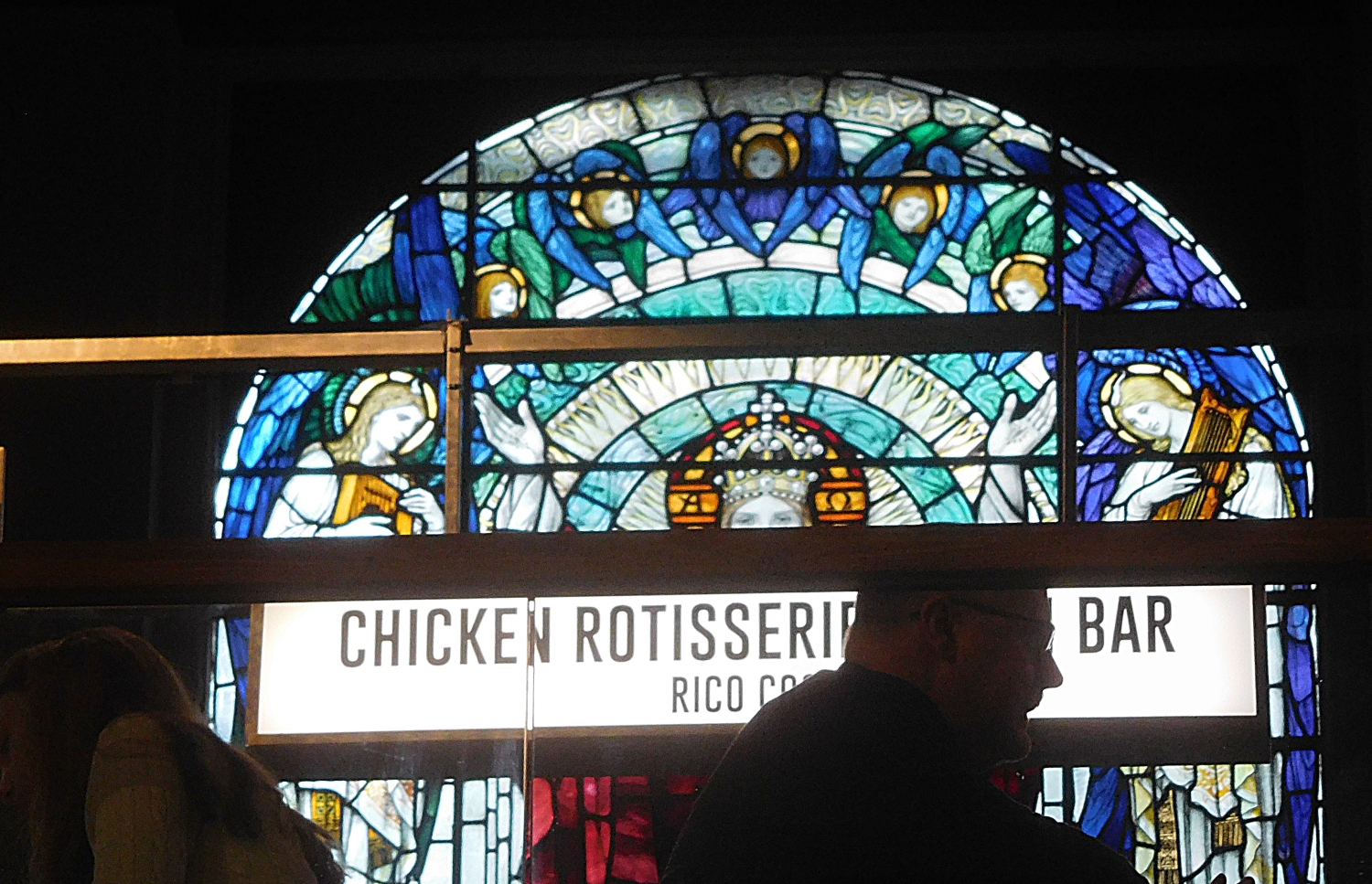
GIN AND TONIC BEHIND THE PULPIT AND CHICKEN IN THE CHURCH


NAPOLEON BONAPARTE DIED in captivity on the tiny island of St Helena in the south Atlantic. While he was imprisoned on the island, Lieutenant General Sir Hudson Lowe (1769-1844) was the Governor of St Helena. He was buried at St Mark’s Church in North Audley Street in London’s Mayfair, where a commemorative plaque can be found by the main entrance. St Mark’s was built in the Greek Revival Style in 1825-28, designed by John Peter Gandy (1787-1850). In 1878, the church architect Arthur Blomfield (1829-1899) made considerable alterations to its interior including adding a timber vaulted ceiling over the nave.


During the 1950s and 1960s, the size of St Mark’s congregation diminished significantly. In 1974, the church was made redundant, and this is how it remained until 1994, when the church was used by The Commonwealth Christian Fellowship. It continued to serve this group until 2008. After that, it was used as a venue for occasional events. In about 2019 after a 5 million Pound restoration programme, the church underwent a surprising reincarnation.


After passing beneath the grand portico supported by two columns topped with ionic capitals, one enters the church’s large vestibule. Since 2019, this has become a marketplace selling upmarket Italian delicatessen goods. Entering the body of the church is rather like taking part in a Fellini film. The floor of the nave is filled with tables and chairs and people drinking and dining. The side aisles, north and south, contain several kitchens, preparing and serving a wide variety of foods, from Turkish to Thai. On the north side of the chancel, just behind the neo-gothic stone pulpit, there is a gin bar, and facing it on the south side of the chancel, there is another bar providing alcoholic refreshments. Look upwards and you can admire the splendid timber roof supports. The wide gallery surrounding the nave at the first-floor level is home to more food stalls, each offering tempting looking fare at not unreasonable prices, especially by local Mayfair standards.


In 2019, the church became home to a branch of Mercato Metropolitano, whose first venture was converting a 150,000 square foot disused railway station in Milan during the 2015 World Expo in that Italian city. The idea of the company was:

“The development of the first Mercato Metropolitano was carefully planned to retain the site’s original appearance, which nurtured the local community’s affection for a special part of their urban history.”

 (https://www.mercatometropolitano.com/mmarketplace/#the-mercato-story).


And this is what has been done at the former St Mark’s in Mayfair. Many of the church’s fittings (for example, the tiled floors, the stained glass, the monuments, the pulpit, and the sacred paintings at the east end of the chancel) have been preserved. Entering the church is like entering the scene of a lively gargantuan feast. Seeing the large number of customers on a weekday lunchtime demonstrates that Mercato Metropolitano have successfully created a great place to meet, eat, and drink. It is highly original and exciting, both visually and gastronomically.


In Chapter 21 (verses 12-13) of the Gospel according to Matthew, we learn that:

“…Jesus went into the temple of God, and cast out all them that sold and bought in the temple, and overthrew the tables of the money changers, and the seats of them that sold doves, And said unto them, It is written, My house shall be called the house of prayer; but ye have made it a den of thieves.”

I just cannot help wondering, as many of you might also be doing, what The Good Lord would have made of what can now be seen inside the Church of St Mark’s in Mayfair.


A pub in London's Hampstead


ONCE LONDON’S HAMPSTEAD had two pubs or taverns named ‘The Flask’. This should not come as a great surprise as Flask used to be a common name given to pubs. One of them, The Upper Flask, used to be located at the top (northern) end of East Heath Road and the other, The Lower Flask’ was (and still is) on Flask Walk, a street leading off Hampstead High Street.


The Upper Flask used to be a remarkable establishment. Once called ‘The Upper Bowling Green House’ because of its good bowling green, it was a meeting place favoured by fashionable and ‘cultured’ men (mainly) and women during the 18th century. It was a summer meeting place for The Kit Kat Club, which thrived in the early 18th century and whose members included literary figures and political personalities, who supported the Whig Party. The Upper Flask figures several times in “Clarissa”, a lengthy novel by Samuel Richardson (1689-1761), first published in 1747. The place ceased operating as a hospitality business in the 1750s, when it became a private residence (www.british-history.ac.uk/vch/middx/vol9/pp81-91). In 1921, it was demolished to clear the site for building the Queen Mary Maternity Hospital (https://ezitis.myzen.co.uk/queenmaryhampstead.html), which has since become the site of a luxury housing complex.


The Lower Flask (in Flask Walk) is also mentioned in “Clarissa”, but unflatteringly as:

“… a place where second-rate persons are to be found often in a swinish condition,” (quoted from “Old and New London”, by Edward Walford, about 1880).

Unlike the lost Upper Flask, the formerly named Lower Flask is still in business, but much has changed since Richardson published his novel.


Located at the eastern end of the pedestrianised stretch of Flask Walk, the former Lower Flask, renamed The Flask, was rebuilt in 1874 (and extended in 1990; https://historicengland.org.uk/listing/the-list/list-entry/1322190). Formerly, it had been a thatched building and was a place where mineral water from Hampstead’s chalybeate springs was sold. It and Keith Fawkes’ second-hand bookshop are the only things in Flask Walk, which were in existence when I used to visit Hampstead regularly in the 1960s and 1970s. In those, now far-off, days, I remember that there used to be another second-hand bookshop and a butcher, both on the south side of the passageway. Before the 20th century, there used to be a fair held for a few days in August on the triangular open space a few yards downhill from The Flask pub. Close to The Flask, also on Flask Walk, miscreants could be found languishing in the parish stocks. Both the stocks and the fair are now but long distant memories recorded only in books published many decades ago.


Oddly, despite visiting Hampstead literally thousands of times during the last more than 65 years, it was only on Halloween 2021 that I first set foot in the Flask pub, and I am pleased that I did. The front rooms of the pub retain much of their Victorian charm and the rear rooms are spacious. Although we only stopped for a drink, I could see that the Sunday lunches being served to customers around us looked delicious. We hope to return there soon.