

 Posts
Posts


NAPOLEON
BONAPARTE DIED in captivity on the tiny island of St Helena in the south
Atlantic. While he was imprisoned on the island, Lieutenant General Sir Hudson Lowe
(1769-1844) was the Governor of St Helena. He was buried at St Mark’s Church in
North Audley Street in London’s Mayfair, where a commemorative plaque can be
found by the main entrance. St Mark’s was built in the Greek Revival Style in
1825-28, designed by John Peter Gandy (1787-1850). In 1878, the church
architect Arthur Blomfield (1829-1899) made considerable alterations to its
interior including adding a timber vaulted ceiling over the nave.
 During
the 1950s and 1960s, the size of St Mark’s congregation diminished significantly.
In 1974, the church was made redundant, and this is how it remained until 1994,
when the church was used by The Commonwealth Christian Fellowship. It continued
to serve this group until 2008. After that, it was used as a venue for
occasional events. In about 2019 after a 5 million Pound restoration programme,
the church underwent a surprising reincarnation.
 After
passing beneath the grand portico supported by two columns topped with ionic
capitals, one enters the church’s large vestibule. Since 2019, this has become
a marketplace selling upmarket Italian delicatessen goods. Entering the body of
the church is rather like taking part in a Fellini film. The floor of the nave is
filled with tables and chairs and people drinking and dining. The side aisles,
north and south, contain several kitchens, preparing and serving a wide variety
of foods, from Turkish to Thai. On the north side of the chancel, just behind
the neo-gothic stone pulpit, there is a gin bar, and facing it on the south
side of the chancel, there is another bar providing alcoholic refreshments. Look
upwards and you can admire the splendid timber roof supports. The wide gallery
surrounding the nave at the first-floor level is home to more food stalls, each
offering tempting looking fare at not unreasonable prices, especially by local
Mayfair standards.
 In
2019, the church became home to a branch of Mercato Metropolitano, whose first
venture was converting a 150,000 square foot disused railway station in Milan during
the 2015 World Expo in that Italian city. The idea of the company was: “The
development of the first Mercato Metropolitano was carefully planned to retain
the site’s original appearance, which nurtured the local community’s affection
for a special part of their urban history.” (https://www.mercatometropolitano.com/mmarketplace/#the-mercato-story).
 And
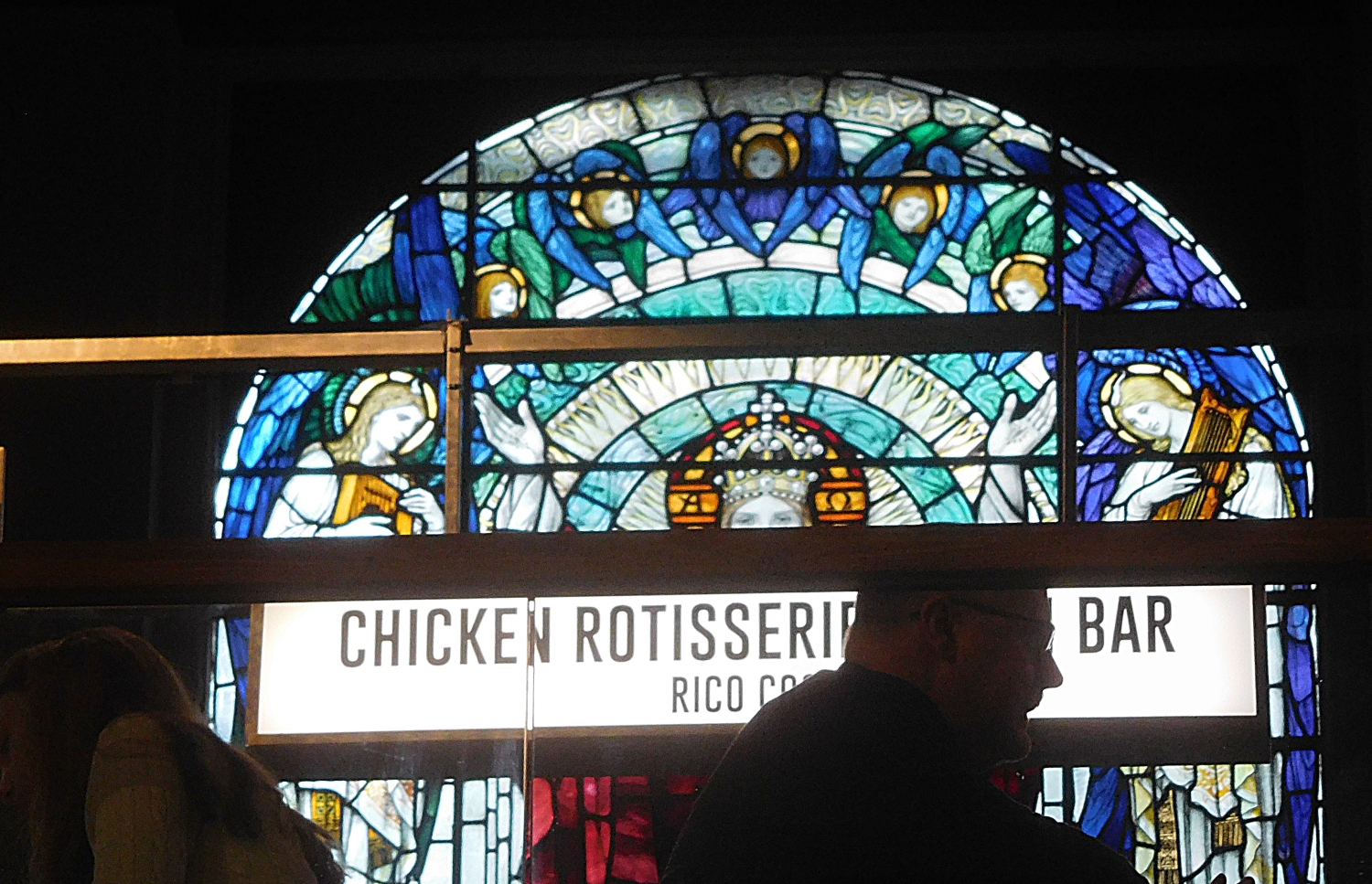
this is what has been done at the former St Mark’s in Mayfair. Many of the
church’s fittings (for example, the tiled floors, the stained glass, the monuments,
the pulpit, and the sacred paintings at the east end of the chancel) have been
preserved. Entering the church is like entering the scene of a lively gargantuan
feast. Seeing the large number of customers on a weekday lunchtime demonstrates
that Mercato Metropolitano have successfully created a great place to meet,
eat, and drink. It is highly original and exciting, both visually and
gastronomically.
 In
Chapter 21 (verses 12-13) of the Gospel according to Matthew, we learn that: “…Jesus
went into the temple of God, and cast out all them that sold and bought in the
temple, and overthrew the tables of the money changers, and the seats of them
that sold doves, And said unto them, It is written, My house shall be called
the house of prayer; but ye have made it a den of thieves.” I
just cannot help wondering, as many of you might also be doing, what The Good
Lord would have made of what can now be seen inside the Church of St Mark’s in
Mayfair.  |
Tuesday, 9 November 2021
GIN AND TONIC BEHIND THE PULPIT AND CHICKEN IN THE CHURCH

A pub in London's Hampstead
ONCE
LONDON’S HAMPSTEAD had two pubs or taverns named ‘The Flask’. This should not
come as a great surprise as Flask used to be a common name given to pubs. One
of them, The Upper Flask, used to be located at the top (northern) end of East
Heath Road and the other, The Lower Flask’ was (and still is) on Flask Walk, a
street leading off Hampstead High Street.

The
Upper Flask used to be a remarkable establishment. Once called ‘The Upper Bowling
Green House’ because of its good bowling green, it was a meeting place favoured
by fashionable and ‘cultured’ men (mainly) and women during the 18th
century. It was a summer meeting place for The Kit Kat Club, which thrived in
the early 18th century and whose members included literary figures
and political personalities, who supported the Whig Party. The Upper Flask
figures several times in “Clarissa”, a lengthy novel by Samuel Richardson (1689-1761),
first published in 1747. The place ceased operating as a hospitality business in
the 1750s, when it became a private residence (www.british-history.ac.uk/vch/middx/vol9/pp81-91).
In 1921, it was demolished to clear the site for building the Queen Mary
Maternity Hospital (https://ezitis.myzen.co.uk/queenmaryhampstead.html), which has
since become the site of a luxury housing complex.
The
Lower Flask (in Flask Walk) is also mentioned in “Clarissa”, but unflatteringly
as:
“…
a place where second-rate persons are to be found often in a swinish
condition,” (quoted from “Old and New London”, by Edward Walford, about 1880).
Unlike
the lost Upper Flask, the formerly named Lower Flask is still in business, but much
has changed since Richardson published his novel.

Located
at the eastern end of the pedestrianised stretch of Flask Walk, the former
Lower Flask, renamed The Flask, was rebuilt in 1874 (and extended in 1990; https://historicengland.org.uk/listing/the-list/list-entry/1322190).
Formerly, it had been a thatched building and was a place where mineral water
from Hampstead’s chalybeate springs was sold. It and Keith Fawkes’ second-hand
bookshop are the only things in Flask Walk, which were in existence when I used
to visit Hampstead regularly in the 1960s and 1970s. In those, now far-off,
days, I remember that there used to be another second-hand bookshop and a
butcher, both on the south side of the passageway. Before the 20th
century, there used to be a fair held for a few days in August on the
triangular open space a few yards downhill from The Flask pub. Close to The
Flask, also on Flask Walk, miscreants could be found languishing in the parish
stocks. Both the stocks and the fair are now but long distant memories recorded
only in books published many decades ago.
Oddly,
despite visiting Hampstead literally thousands of times during the last more
than 65 years, it was only on Halloween 2021 that I first set foot in the Flask
pub, and I am pleased that I did. The front rooms of the pub retain much of
their Victorian charm and the rear rooms are spacious. Although we only stopped
for a drink, I could see that the Sunday lunches being served to customers
around us looked delicious. We hope to return there soon.

