Having trouble reading in English? Then translate it!

Popular Posts

Showing posts with label jews. Show all posts

Wednesday, 6 December 2017

IN THE GODS' OWN COUNTRY - ISLAM & CHRISTIANITY IN KERALA


Until recently, I had blithely assumed that Islam entered the Indian subcontinent from its northwest fringes – from Afghanistan and elsewhere. In November 2017, I made a trip to Kochi (Cochin) in Kerala during which we were taken to see a mosque, the first to be built on the Indian subcontinent.  Built long before the Mughal invasion, it is in the Kodungallur district on the estuary of the River Periyar, about thirty kilometres north of Ernakulam. I learned that this small area of southwestern India is of historical significance for at least three religions.

Kodungallur, watered by the River Periyar and backwaters, was a globally-important historical economic area, variously known as: ‘Muziris’, ‘Cranganore’, and ‘Shingly’. Until it silted up (many centuries ago), it was one of the ports where much trade (export of: spices, textiles, pearls, gems, and other exotic valuables) occurred between foreigners from the west and the local inhabitants. The silting resulted from the opening-up of a passageway for the River Periyar from the lagoon to the Arabian Sea at Cochin (now ‘Kochi’). This reduced the flow of the river through the backwaters between Cochin and its original mouth near Kodungallur, and caused its consequent clogging up. 

Long before the invasion of the Portuguese in the 15th century (AD), these foreigners included the Greeks, the Romans (who were great consumers of pepper from Kerala), the Arabs, the Jews, the Chinese, and many others. The Romans spent so much on pepper that ancient authors recorded that it led to a great depletion in the empire’s coffers. Once, I visited a museum in Kozhikode (Calicut), which had many examples of foreign coins (Roman and otherwise) that had been found in the area. Extensive finds of ancient foreign coins have also been made in the   Kodungallur area.


After crossing the water in a vehicle ferry from Fort Cochin, we drove along the long, slender Vypin Island through luxuriant, densely populated, countryside towards Kodungallur. The roads in this crowded tropical Garden of Eden were richly ‘decorated’ with flags and posters bearing the hammer and sickle of Communism, and placards showing portraits of Marx, Engels, Lenin, and, sometimes, Stalin and/or Che Guevara. The Communists have been an important and, most say, a constructive political influence in Kerala since the 1950s. 


When we parked in Kodungallur, I spotted a banner with a fine portrait of Stalin opposite the Cheraman Jumma Masjid. This mosque was established during the life of, or very shortly after the death of, the Prophet Muhammad (c. 570-632 AD).

It is said that one night the Hindu ruler of Kodungallur Cheraman Perumal (a member of the Chera dynasty) had a dream in which the full moon was split in two. No one could explain the meaning of this until he met some traders, who had sailed across from Arabia. Their explanation led Cheraman to travel to Mecca, where he met the Prophet Muhammad, and became converted to Islam. He sent word back to Kerala that his people should embrace Islam and follow the teachings of Malik bin Deenar (died 748 AD), whom he dispatched to India. Cheraman, who remained for some years in Arabia, died on his way back to India.

When Malik arrived in Kodungallur, he was permitted to build what is now called the Cheraman Mosque. This was the first ever mosque to be constructed on the Indian subcontinent. Nothing remains of the original building. It was reconstructed in the 11th century, then again in the 14th. In 1504, the mosque was destroyed by the Portuguese when Lopo Soarez de Algabria (c. 1460-1520) attacked Kodungallur (see: “Muslim Architecture of South India”, by M Shokoohy, publ. 2003). Later, it was rebuilt, and in 1974 it was enlarged and surrounded by a modern structure. What the visitor sees from outside is largely unexceptional apart from the tiled roof of the oldest part of the mosque which can be seen above the modern extensions.


Male visitors may enter after washing their feet in a special area close to the mosque. I was shown the inner sanctuary, which is all that remains of the pre-1974 building. A remarkable feature is a large metal lampstand in which oil lamps (‘diyas’) may be held. This lampstand would not look out of place in a Hindu temple. The wooden ‘mimbar’ (pulpit) is elaborately constructed and delicately decorated. Next to it is the ‘mihrab’, a niche in the wall facing in the direction of the Kaaba in Mecca, with its semi-circular arch. This is a part of the mosque built in the 16th century. There are two graves draped with red and green silk cloths in a small room leading off from the inner sanctuary. These are the graves of Habib bin Malik and his wife Khumarriah. A door beyond the graves leads into a poky room from which women are allowed to view the graves. Although Malik bin Deenar was the first ‘Ghazi’ (leader) of the mosque, he handed it over to his relative Habib after a few years. Malik was buried elsewhere in Kerala (at Kasaragod).


The museum and gardens of the mosque are open to all. The garden has an attractive square tank (rather like a Hindu temple tank), where fishes swim. It is next to a cemetery. I noticed that several trees growing nearby were home to a colony of large bats, who hung from branches upside down and motionlessly.


The museum attached to the mosque contains a lovely model of what the mosque must have looked like before it was modernised. Like some historic mosques that I have seen in Kozhikode, the earlier Cheraman mosque, was similar architecturally to Hindu temples (and other buildings) in Kerala. Other exhibits included photographs and a wooden funeral bier. I was thrilled to stand where Islam made its first concrete foothold in India. This shrine is a site that is more evocative than visually interesting. I was told that the mosque has very few foreign visitors, who are neither Muslim nor Arab, and that I was one of its rare ‘white’ tourists.

From the Cheruman Mosque, it is a short drive to the Thiruvanchikulam Mahadeva Temple (‘Mahadeva’ for short). This Hindu temple, probably first built in the 8th century (AD), is dedicated to Shiva. The earliest recorded reference to it is in some Tamil hymns, which were first recorded in writing in about the 10th century. With its many steep, often gabled, tiled roofs, it is a typical example of Keralan temple architecture. Some buildings within the temple’s compound have several roofs, each one projecting from different levels of the building, producing a pagoda-like effect that is characteristic of many temples and other buildings in Kerala.


The white outer walls of the central building, the inner sanctum, are covered, from ground to roof-level, with dark timber planks arranged to form a huge lattice of rectangles, rather like a huge set of pigeon-holes. At the base of each rectangle, there is a small horizontal metal dish that can be used to hold oil and a taper. When lit, each of these little dishes become small diyas (lamps).

To the rear (east) of the central sanctuary, there is a shelter supported by eight thick circular columns with Doric capitals. Immediately east of this, but within the walls of the compound, there is a tall pagoda-like building whose stone walls are covered with elaborately carved pilasters. This building is above the compound’s eastern doorway.


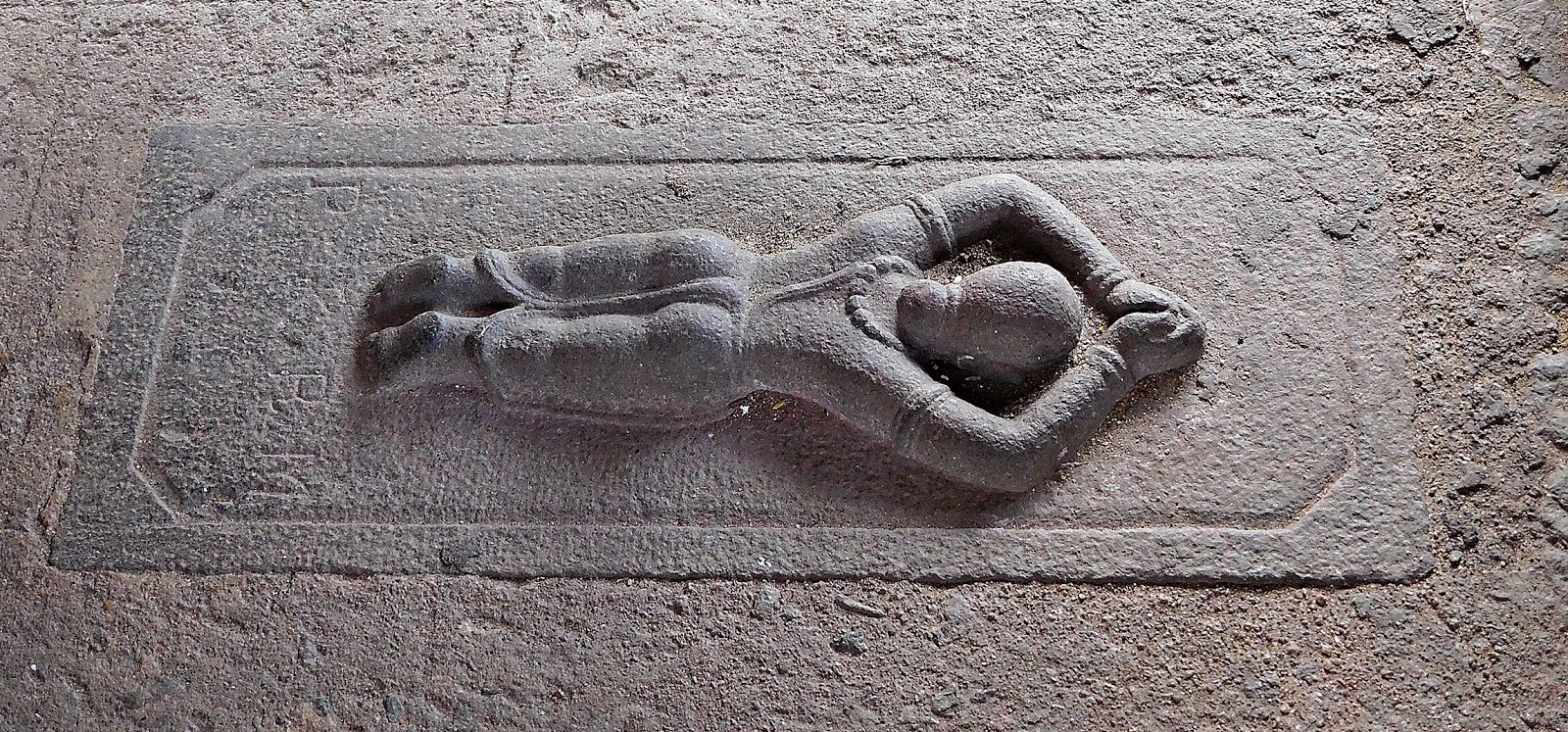
Under the shelter, we saw a set of weighing scales. These are used to weigh offerings to the temple. For example, a donor would sit on one of the weighing pans, whilst his gift (be it rice or gold) is loaded on the other pan until it weighs the same as its donor. The scales were close to a tall metal lamp stand used for oil lamps. A simple wooden ladder rested against it. This is used to place, and light, diyas out of reach at the top of the tall stand. The base of the stand was sculpted in the form of a tortoise. Set into the floor surrounding the lampstand there were several prostrate women carved in stone, their clasped hands pointing towards the stand. Between them and the inner temple building, there was a ring of seated metal sculpted deities, each with four arms.


Many of the roof gables were decorated with painted sculptures of religious figures. Some of these supported the edge of the tiled roofs of the gables like caryatids. Apart from the buildings already described, the compound contained several smaller buildings housing shrines. Unfortunately, during our visit there was nobody about to unlock any of the buildings including the main temple.

Less than six kilometres southwest of the Temple lies the St Thomas Shrine (in the district of Azhikode) also known as the ‘Marthoma Church’. It stands close to the north bank of the River Periyar about two kilometres from its entry into the sea. It is at, or near, this spot where the apostle St Thomas is supposed to have landed in India in 52 AD, some five to six centuries before Islam reached the same district. I have injected an element of uncertainty because some authorities have proposed that Thomas first set foot in India in various places far away from Kerala. However, many agree that he landed first somewhere near to modern day Kodungallur, and this has been commemorated by the shrine, which was built in its present incarnation in the early 1950s. It replaces an earlier church in old Cranganore, which was destroyed during a battle between the (Roman Catholic!) Portuguese and the Muslims in 1536.


The shrine that faces the lovely tree-lined shores of the River Periyar is a flamboyant construction painted in white. The domed church, which lacks any architectural merit and contains a relic of St Thomas, lies between two sweeping curved colonnades topped with statues. The relic was brought to Kerala from Italy in 1953.  The whole structure, church and colonnades, looks like an elaborate wedding cake or the set for a Bollywood dance routine.

Between the church and the water, there is a tall shiny metal column surmounted by a golden cross with two cross-bars. This high structure resembles those often found in or outside Hindu temples (used for holding diyas). We noticed that these columns, inspired by those associated with Hindu temples, are becoming quite common outside churches in Kerala. Both in mosques and churches that I have visited in India, features ‘borrowed’ from Hinduism can be found within them. Despite the introduction of ‘newer’ religions such as Christianity and Islam, it seems that Indian worshippers do not entirely abandon their ‘Hindu heritage’.


There is a colourful building, the Marthoma Smruthi Tharangam, which is next to the church and behind one of the colonnades. Its imaginative architectural style defies categorization. You might describe it as ‘A Keralan Disneyland meets the Vatican’. The building houses a theatre where ‘digital shows’ describing the life of St Thomas and the story of his relic may be watched.

St Thomas is believed to have been martyred in Chennai. There is a cave, which I have visited, at the top of St Thomas Mount in Chennai, where the saint was speared. It contains a slab of rock in which there are two hand-shaped impressions, which are believed to have been made Thomas’s hands. This cave, like the shrine at Kodungallur, attracts many pilgrims.

When St Thomas landed in Kerala, there were already Jews living there. Shortly after his arrival, following the destruction of Jerusalem in 70 AD, many more arrived as refugees. Jewish people have been associated with Kerala for a long time. For how long, the historians disagree. Most agree that Jews on King Solomon’s trading vessels visited the Keralan ports about 900 years before Christ’s birth. These Jewish mariners are believed to have brought exotic items such as peacocks, monkeys, and ivory from India to Solomon’s palace in the Holy Land. It is unlikely that any of Solomon’s people settled in Kerala.

From some centuries before and after the birth of Christ, Cranganore was ruled by the Chera dynasty. The Cheras permitted the settlement of Jewish people in Cranganore. Their descendants lived in India until after independence (in 1947) and the foundation of Israel, where many of India’s Jews migrated (for economic reasons).

The Cheras allotted the Jews a small piece of land, named Anjuvannam, in the Cranganore district, which became a ‘Jewish kingdom’. Its inhabitants collaborated in many fruitful ways with their Chera, and then later, Chola hosts.

Various factors including the silting up of the Periyar as well as the decline of the Chera dynasty and their succession by the rival Cholas, caused many of the local Jewish people to move to Cochin. However, some Jews remained in what remained of Cranganore after it became less important than Cochin. The Jewish ‘kingdom’ of Anjuvannam continued after the fall of the Chera dynasty, which fell in the 12th century. By the time that the Portuguese began establishing themselves in Kerala, the Jewish community in Cochin was much more significant economically than that in Cranganore.

Today, several synagogues still stand in the Kodungallur, the old Cranganore, area. There was a total of twelve in Kerala during the heyday of Jewish presence in the state. We visited two synagogues near Kodungallur. Both have been looked after well, but are no longer used for worship.  The two that we saw are far less-visited than the well-known and undoubtedly beautiful Pardesi Synagogue in bustling Mattancherry, in whose Jew Town the Jewish traders, of which only one remains, have been replaced by mainly Kashmiri Muslim traders, who are, incidentally, excellent salesmen.


The Paravur synagogue was first established in the 12th century AD, and then renovated by David Yakov Castlier in the late 16th, or early 17th century. Its architecture is typically Keralan. The first floor of the front entrance building has a deep veranda beneath a tiled roof supported by four pairs of columns. A covered passageway lined by stout columns leads from the entrance to the synagogue itself. The roof of the corridor is lined with wood.

The synagogue’s interior is simple. The original fittings have been moved to Israel, and have been replaced by replicas. If you were unaware of this, you would believe that you were seeing the originals. The carved wooden ark, or cupboard, in which the Torah scrolls were kept, has been reproduced, but is empty. The centrally located circular ‘bima’ or pulpit is wooden, constructed with turned wood balustrades. As with other synagogues in Kerala, there is an upper bima, which is formed by a semi-circular platform projecting from the first-floor gallery where women worshippers were required to be. The upper bima, a speciality of Keralan synagogues, was used only on special occasions, whereas the lower one was for routine use.


Women worshippers entered their first-floor gallery by way of the covered corridor running above that which connects the entry building to the ground floor of the synagogue. This upper corridor is lined with wooden slats which curve outwards from the floor towards the arched ceiling. In cross-section, this corridor resembles the hull of a boat. The slats sheltered women from the sun, and, also, made them difficult to see from outside.

Descriptive notices and photographs line the walls of the synagogue’s buildings. These provide information about Jewish life as it was in Kerala. From Paravur, it is a short drive (about two kilometres) to the smaller Chendamangalam Synagogue, which is close to the left bank of the Periyar. This synagogue was first built in 1420 AD, rebuilt after a fire in 1614, and renovated several times since. In the grounds in front of the main entrance, there is a small stone memorial to Sara, daughter of Israel, who died in 1269. This might have been brought by the Jews who migrated to Chendamangalam in the 13th century.


The entrance hall of the synagogue leads into the main prayer space through a door surrounded by colourful paintwork. Glass lamps of various designs hang from the colourful wooden ceiling decorated with carved, painted lotus flowers. The centrally located circular wooden bima is similar in design to that at Paravur. As in Paravur, there is an upper bima, which forms part of the gallery reserved for women. The female congregants stood or sat behind wooden lattice-work screen, the ‘meshisah’, hidden from the men during services. A staircase leads from the main entrance to the women’s area behind the screen. Another staircase with carved wooden banisters allowed the clerics to climb up from the main prayer area to the upper bima without having to see the women.


The ark, which was used to contain the Torah scrolls, is made of colourfully painted teak wood.  There are three intricately carved pillars decorated with floral motifs on either side of the cupboard doors. The doors are also covered with painted plant motifs in bas-relief. The luxuriant decorative vegetation continues as decoration on the parts of the ark above the doors. Red, green, and gold are the colours which figure most on this almost baroque piece of furniture.

In the small grounds within the synagogue’s perimeter walls, there are a few gravestones with inscriptions in Hebrew. 


I noticed a carved circular stone, whose perimeter was carved with a ring of leaf-shaped depressions. These were probably filled with oil and tapers, and then lit to be used as diyas. Thus, we find the diya holders characteristically used in Hindu temples not only in temples but also in mosques, churches, and synagogues. The reason for this is likely to have been because this was the normal form of lighting in India of old.

Most of Kerala’s Jewish folk have left for foreign parts. Neighbouring the synagogue in Chendamangalam, there is a newly built house bearing a Jewish name plate. The guardian of the synagogue told us that this was the home of a Keralan Jew who had left for Israel, but had returned to Kerala to live out his retirement.

We returned via the Vypin ferry station to Fort Cochin, where we were staying. On our way we drove along roads decked with Communist (and, also, BJP) banners. Our route took us past peaceful, rustic backwaters with occasional Chinese fishing nets. These backwaters are far more pleasant than those near to Alleppey, which are unpleasantly congested with boats and house-boats used by tourists.


Our brief visit to the Kodungallur district, a centre of global trade many centuries ago, was fascinating. It is an area, where four religions co-exist peacefully, and where two of them are supposed to have entered the Indian subcontinent. While reading about the history of this small corner of Kerala, one thing impressed me. That is, the almost complete lack of certainty about its early history. Like St Thomas, its story is full of doubts. To quote the small guidebook I bought at the Cheraman mosque:

“Total absence of reliable historical records make early history of Kerala a bundle of legends.”


PLEASE VISIT
ADAM YAMEY'S
WEBSITE:

Saturday, 31 October 2015

JEWISH IMMIGRATION: SOUTH AFRICA 1930


 DESIRABLE PEOPLE

This is a sample chapter from a work in progress by Adam Yamey. It is from the life of his great-grandfather Franz Ginsberg.
Here is a brief ‘blurb’ or introductory note about the book. It was kindly suggested to me by Sandra Haven:

Franz Ginsberg left Germany in 1880. He settled in South Africa as an 18-year-old photographer, escaping the restrictions on Jews, only to adopt a homeland with escalating restrictions on ‘black’ and other non-European people. Franz flourished as a manufacturer of a large variety of domestic products, becoming well-known as an industrial pioneer. Soon, his concern for people’s welfare plunged him to politics. From 1927 onwards, as one of the 32 elected Senators of the Union of South Africa, he attempted to mitigate the racist policies that many of his fellow legislators promoted. During his progression from Town Councillor to Senator, Franz opposed the law-making processes that were to lead eventually, after his death in 1936, to the establishment of apartheid. Franz Ginsberg, the author’s great-grandfather, battled for a better world in a time not yet ready for that change—leaving a unique story and legacy on the blueprint of our modern world.

This is the sample chapter from the draft manuscript (with footnotes omitted):

COPYRIGHT: ADAM R YAMEY, 2015

Less than a year after the German trade treaty had been signed, the Senate discussed a Bill in March 1930, the Immigration Quota Bill, relating to another kind of ‘import’: human beings - immigrants wishing to enter South Africa. This was just over two years before Adolf Hitler became Chancellor of Germany, and not much longer before the Jews of Germany would begin fleeing from their homes in ever increasing numbers.

The Minister of the Interior, DF Malan, who was later, in the words of A Parker, to begin “… the apocalyptic legislative assault on black South Africans… ” during the apartheid era, explained to the Senate that the new Bill was in response to questions being asked all over the country about:
“…whether there was not a vast stream of immigrants coming to this country, immigrants who were undesirable.”
People wanted to know what the Government was going to do about them. Malan said that there had been a large number of complaints that the then existing Immigration Act was being applied in an unfair and unjust way.  He explained:
“That was one of the complaints of a large section of the population, and more especially of the Jewish community in this country.”
Next, Malan talked about the Immigration Act passed in 1913. He said:
“The problem which I have mentioned is that we have a great influx of people on the one hand, chiefly from Eastern Europe. A vast and growing stream of immigrants is coming into this country, and the vast majority of them belong to a class of persons who follow a calling in life which has enough adherents in the Union, with the result that reinforcements are not required.”
Now, DF Malan was a highly educated man (he achieved a Master in Philosophy at Victoria College [which is now Stellenbosch University] and a Doctorate of Divinity at University of Utrecht) and chose his words carefully. He knew that one meaning of ‘adherents’ was ‘followers’ of, for example, a religious belief.  He must have also known that ‘calling in life’ can have a religious connotation. He continued to speak about this ‘class of persons’:
“They belong to what was known as the middle classes the commercial classes, people … who belong to the commercial classes, and do not produce … The commercial community is too large for the country. This is one side of the matter.”
The other side of the problem, he explained, was emigration: too many (white) people were leaving South Africa. The solution that he favoured was adopting a quota system such was already in force in countries like the USA, Australia, and Canada. This would be incorporated in the new Bill, which proposed that on certain countries there would be no restriction, and on all other countries there would be a quota. Those admitted on the quota system would be carefully selected by the Immigration Control Board. Malan said that the Bill envisioned admitting about 1000 people per year from quota countries, and that the line which was to be drawn between countries that were unrestricted and those that were restricted would depend on the current composition of the population already in South Africa. Next, he said something that sounds very sinister in the light of what we now know about Malan’s country:
“The second principle, on which we base this discrimination, is that every country desires immigrants that will strengthen the race and that will be readily assimilated. A nation wants to be homogenous…”
Then, to drive his point further:
“There can be no doubt that there has been a certain amount of nervousness in the country during the last few years on account of the stream of immigration out of Eastern Europe.”
There was a third principle behind the new Bill, namely the safeguarding of Western Civilisation in South Africa. On this point, Malan said the following:
“South Africa has set its heart on maintaining the western form of civilisation in this country. … There is the eastern civilisation, the European civilisation and then there is the western civilisation and the civilisation of Eastern Europe. These two civilisations differ from one another, and when we draw a line between the different countries in the future, we must be very careful that we note countries belong to the western civilisation and which do not.”
According to the tree principles, Malan explained to the Senate, a line was to be drawn between Eastern and Western Europe, and no restrictions were to be placed on any of the following: USA, Western Europe, and the various parts of the British Empire. He did not state it, but I imagine that an immigrant’s skin colour was also an important factor determining whether he or she should be allowed to settle in South Africa. In any case, this was a Bill directed mainly at certain members of the world’s ‘white’ population, as Franz was to point out later in the debate.

Franz was against the new Bill, considering that it was unnecessary: most of what was being proposed was already in the Immigration Act of 1913. He knew that there was an overwhelming majority of people in favour of the Bill, and he regretted that. He had been told that the new Bill was a reaction to the country’s then poor economic condition (low wool prices and so on). Franz continued by saying that he had heard the Minister saying often that he wished to keep ‘undesirables’ out of the country. He too was in favour of this, but had difficulty understanding how an ‘undesirable’ was defined. He said:
“I think in a country like this, every decent man ought to be admitted.”

Franz had been very pleased to hear that the Minister of Labour (FHP Creswell), Mr Tielman Roos , and a number of other leaders, had praised the patriotism and usefulness of the Jewish population of South Africa. Who were these people, Franz asked. They were, he said answering his own question, the very same class of people that the minister of the Interior wished to exclude with his new Bill. To a very large extent, he added, these useful Jews had come from the east, very largely from Lithuania and other countries in Eastern Europe.  Then, he spoke subtly to the Senate:
“I would like to say here that I do not hold the opinion that many people have expressed, that this Bill is anti-Semitic legislation, because I have too many proofs of goodwill extended towards the Jewish population of this country, so much proof that I cannot for one moment, believe, unless someone is lying, that there is, so far as personal experience is concerned, anything but sympathy and friendship with the Jewish people. I do not think there is much in the way of anti-Semitism in South Africa. … I have heard very much about the capabilities, the loyalty, and the patriotism of the Jewish people. So much so that one gets a little suspicious about these expressions, and I should ask why, if they are such good citizens, they are to be kept out of this country? There is a difference in outlook … between the Jewish people who come from the eastern part of Europe and those who come from the western part, but … that outlook quickly disappears in this country; in fact, it has been remarked that in an incredibly short time these people have become assimilated to such an extent that … they could not be distinguished from any other people.”

Regarding the Minister’s statement that there were too many middle-men in the country, he agreed. However, he pointed out, that the situation was changing: people were moving from one kind of occupation to another; the country population was moving into towns, and people were moving into industry and the professions. Gradually, Franz undermined the reasons that D Makan had given to back up his promotion of the new Bill.

After a short interruption, Franz continued with an impassioned speech, some of which is quoted here:
“Considerable difficulties will arise in connection with this Bill… It has caused ridiculous anomalies. … There have been perfectly new boundaries created in Europe since the war, countries that formerly belonged to Germany have become, for instance, Polish … there is Silesia too. My birthplace is in Silesia and I am very glad to think I would not come under the ratio of prohibited countries, although that might have been the case if the boundary laid down in the Peace Treaty had been shifted a few miles.”
Beuthen, where Franz was born, remained in Germany until 1945 when it was transferred to Polish rule following the Potsdam Conference in that year. Franz continued:
“I was born in Germany and the boundary was about 20 to 25 miles from my town. Since the war, however, my native town has been cut in half, and the one part is in Poland, and the other part in Germany, and, therefore, I might well have become a Pole if I had lived on the other side of the boundary. Are we to look upon Kubelik, who charmed Cape Town with his violin when he was here, as a prohibited immigrant, or would Mr Paderewski, supposing he wanted to become a music teacher in Cape Town, be permitted to do so, unless the Minister was good enough to allow him? And what would be the position of a person like Professor Voronoff?...”
I am not sure that the city of Beuthen was actually divided in two after WW1; maybe Franz was really referring to the countryside surrounding it. Kubelik, the violinist was Jan Kubelik (1880-1940) who was born in Prague ; Jan Paderewski (1860-1941), born of Polish parents in Czarist Poland, was  the composer and one-time Prime Minister of Poland ; and Serge Voronoff (1866-1951)  was a celebrated (in Franz’s time, but not these days) surgeon born of Jewish parents in Czarist Russia .  Returning to Franz’s speech:
“Apart from these cases, I would like the Minister to explain what the position is of the man in Rhodesia … at least so far as I understand the Bill they would still come under the quota number.”
Southern Rhodesia (now Zimbabwe), which shared a long border with South Africa, refused to join the Union of South Africa when the chance was offered in 1922, and was annexed by the UK to become a colony in 1923 . The point that Franz raised was that under the new Bill, Rhodesia, which contained many people who would have been acceptable or ‘desirable’ immigrants in the eyes of the Nationalist dominated Government of South Africa, would have become subject to the rules that were designed to limit immigration from Eastern Europe.  Franz went on to say:
“… I do not agree with the arguments of so-called assimilation. How many people who are now in the country, people belonging to a variety of nationalities, do assimilate? Even between Scotch and English, Dutch and English, or German and English or Dutch. How many intermarry?  They all work hand in hand and there does not seem to be any difficulty. They hold their different views and have their different traditions, but presumably they are trying to work hard for the good of the country.”

With regard to the ‘desirability’ of people from Western Europe, Franz asked:
“… whether people from the south of France and from Portugal are to be considered Nordics. I do not know whether they are to be considered more desirable than the people from Lithuania.”
Later on, he told the House that there were 60-70,000 people in South Africa, whose feelings were hurt by the Bill. Then, he said:
“The objects of the Bill could have been attained otherwise, and the restrictions that are considered desirable could have been managed by some other means without making it so obvious that those concerned are not to be considered part and parcel of South Africa. I am referring to the Jewish people of South Africa who have settled here. I came here almost 50 years ago as a stranger. This country has given me a home and has made me welcome, and I have been able to get a comfortable position here … I have considered myself a South African. I have come to live in this country, but I now begin to be doubtful whether I am going to be permitted in future whether to consider myself wholly and solely South African. The Honourable minister has spoken about problems with which this country is faced, and to me it is an insult of the first water to compare the problems of the natives and the Indians with the problems of Jews in South Africa. I am sorry that such an insult should have been levelled at a people which is supposed to be held in high esteem from the Prime Minister downwards, and it makes me wonder whether I am permitted in future still to love this country.”

Senator GG Munnik  (Transvaal) followed Franz’s speech by saying that he felt strongly that just as everyone has a right to say who is his guest, the country had the right to say who could enter, and who could not. He agreed with the Minister of the Interior that the stream of immigrants from Eastern Europe was undesirable for three reasons. First, he said that South Africa has two industries - mining and agriculture - but the Eastern European immigrants engaged in neither of these ‘industries. Secondly, because they were poor, it seemed to Munnik that:
“…South Africa may now be called a Tom Tiddler’s land. Everyone who comes here to the Tom Tiddler’s land and desires to play the master.”
Tom Tiddler’s land (or ground), for those who are unfamiliar with this, is land or ground occupied by someone who is easily taken advantage of, or “…where pickings may be sought or had without effective interference ”. Munnik was implying that the South Africans (probably his fellow Afrikaners) were easy prey to the new arrivals. Thirdly, he said that the people from Eastern Europe knew neither Afrikaans nor English, and:
“…scarcely ever learn them; they only come here to make money by some means and such people are unnecessary in the country. They will remain a separate colony and we do not need them. Are we in need of people who are going to increase the problems of the country?”

Having just listened to Senator Munnik, Senator JA Neser (Transvaal) was amused by what his colleague had just said about the Eastern European immigrants. He said:
“Only a few days before he [i.e. Munnik] had brought forward a Bill for the encouragement of horse-breeding and horse-racing, and it is the people who he has now been denouncing who are the greatest supporters of horse-racing in this country.”
Then, a few moments later, he slipped into the disingenuousness so typical of racist policy-makers in South Africa:
“It is extremely unfortunate that our Jewish friends have taken it into their heads that the Bill is principally directed against them because there is not a word about the Jews or any other nationality in the Bill. It is just a coincidence that a large number of Jews come from that part of the world against which this bill is directed.”
Well, so it was! Franz was not the only Senator to defend the Jewish people in South Africa. Senator CJ Langenhoven  (Cape Province), an active promoter of the use of Afrikaans rather than Dutch in the Cape, refuted Munnik’s suggestion that Jews who came to South Africa did not learn English or Afrikaans; the opposite was true. He added:
“If there are any of our friends who maintain that the Jew is undesirable, then I want to repudiate it, and I speak on behalf of the Afrikaans-speaking section of the population.”
Just when I was beginning to guess how Langenhoven would vote, that is against the Bill, his words showed how wrong I was:
“The Jew is the biggest nationalist in the whole world and in the circumstances he succeeded in maintaining the purity of his race to a greater extent than any other race in the world. The result is that the Jews remain a separate group, they form one herd, and as such do not readily assimilate with the rest of the population.”
Langenhoven, like the other supporters of the Bill, was concerned that without new controls the Dutch- and English-speaking world would become dominated by the ‘Jewish race’, and this was a reason that he would be voting for the Bill. Having demonstrated his pro-Semitism, he gave his reason for voting in favour as being not that the Jews were ‘undesirable’, but in order to achieve the self-preservation of, in his words, “our race”.

On the following day, the 5th of March 1930, the Minister of the Interior, DF Malan, made another speech in which he referred to Franz’s speech made on the previous day. He said:
“… not only do we all want him [i.e Franz] to consider himself a South African but we want to make it possible in a much greater measure than he has done today… as I said in the other House, in introducing this Bill, I consider this measure to be even more in the interests of the Jewish community in this country in that they want to identify themselves with South African life, with the South African nation, they would like to be treated on a footing of equality with other sections of the community, and they want to take their share in the national life of South Africa. That is only possible if there is no feeling arising in this country, such as there exists, unfortunately, in other countries, against the Jew as a Jew. That feeling, today does not exist to a large extent, and there is no doubt about it that it is dormant, but if this great influx of people from oversea should continue that feeling should continue, and it will become increasingly difficult for the Jewish community to come into their own, and take their share in the life of South Africa on a footing of equality. I say, therefore that not only has the Honourable Senator [i.e. Franz] a right to consider himself South African, but what we want with to do this Bill is to make it easier for himself and others to consider himself in that light.”
This speech was made less than three years before the South African version of the German Nazis, the Greyshirts led by Weichardt, began to wake up the ‘dormant’ anti-Semitism in South Africa.

The Senate passed the Bill, but continued discussing it ‘in Committee’. The schedule of countries which were not subject to quotas for immigration to South Africa were: Territories within the British Commonwealth, Austria, Belgium, France, Germany, Holland, Italy, Norway, Portugal, Spain, Sweden, Switzerland, and the USA. Senator G Hartog (Transvaal), who was Jewish, could not understand why if Poland was excluded, why Austria was included. Also, he asked why Portugal, Italy, and Spain were included if the intention was, in his words, to:
“… replenish our stocks from the original Nordic stock.”
He felt that Latvia and Finland should be included in the schedule. He must have known that Latvia was the origin of quite a few Jewish immigrants to South Africa. To which Franz replied:
“I am going to vote against this [Bill] on principle. I am against restriction and therefore I am against deletion of any country from the schedule. I would certainly vote for the addition of a country to the schedule…”
The Minister of the Interior defended the inclusion of Spain, Portugal, and Italy because they had been included as being required for the maintenance of a “Western European Civilisation” in South Africa. He regarded Finland as being part of Eastern Europe, but not worth including as few Finns wanted to come to South Africa. Unlike Latvia, which Hartog wished to see included amongst the unrestricted countries, Finland had a negligible population of Jews. So, it could have been included on the schedule without risking much in regards to Jewish immigration to South Africa!

Fighting a losing battle, Franz, who was against the Bill, repeated that he had heard that the Minister of the Interior had wanted to secure immigrants of the ‘Nordic type’. He failed to see how people from Italy, Portugal, Spain, and some parts of France could be considered Nordic.

The so-called ‘Quota Act’ came into force on the 1st of May 1930, just over five years before Hitler and his government enacted the notorious Nuremberg Laws. This Act had the “immediate effect of reducing considerably the flow of Jewish immigrants, as of others from the restricted countries.” CP Robinson, a Jewish Member of the Union Parliament who recognised the anti-Semitic intent of the Bill, said of it (before it became an Act):
“… At present it is the poor Lithuanian, tomorrow it may be the Jew from Germany or France that will not be allowed to come in.”
Sadly, he was right. South Africa, like so many other countries with the notable exception of tiny Albania, ceased to be much of a safe haven for Jews trying to escape from the murderous intentions of the Nazis. Luckily for Franz, he did not live long enough to see the consequences of the Quota Act of 1930.

COPYRIGHT: ADAM R YAMEY, 2015


NOW take a look at:

Saturday, 4 July 2015

From Europe to Freedom


 * * * * *


Almost as soon as the British took over the Cape Colony from the Dutch at the beginning of the 19th century, practising Jews began arriving there. At first, most of them were occupied in trade although at least one was a medical practitioner. Amongst the earliest traders were well-known names such as Bergtheil, Norden, Solomon, Thalwitzer, and the Mosenthals. The latter were responsible for opening up the interior of the Cape to trade, as well as bringing out more Jewish men from Germany (mainly) to work in their network of trading stores.

Until the discovery of first diamonds and then gold in what is now South Africa, most Jews leaving Europe tended to head westwards to the USA. After the valuable products started being unearthed, the number of Jews heading towards South Africa rose sharply. Both the increasing prosperity of the 4 constituent territories (that were to unify in 1910 to become South Africa) and also the pogroms in Tsarist Russia led to Eastern European Jews, especially from Lithuania and its neighbours, flowing into the country in ever increasing numbers.

Despite the Jewish people always being a small proportion of the European population of South Africa, they ‘punched above their weight’ – they made a disproportionately large contribution to its development, economically, politically, and in many other ways. This has been described masterfully and in great detail in “The Jews of South Africa” edited by Saron & Hotz, which was published in the 1950s.

My book “Exodus to Africa” approaches the story of Jewish migration from Europe to South Africa from a different angle. I have used the stories of some members of my large South African family to exemplify and illustrate a range of aspects of this movement of Jews out of the lands where they were subject to oppression to a place where they were largely respected and allowed to lead their lives without undue hindrance. My story begins with the earliest member of my family to arrive in the Cape (in 1849), the German Heinrich Bergmann, and it ends with the last person to arrive from Europe, Hendrik Jami. He arrived in the Cape in 1949, having travelled from Lithuania via Shanghai.

“Exodus to Africa” - a study of mass movement of an oppressed people - describes why Jewish people left Europe; how they got to South Africa; what they and their descendants did there; and how some of them influenced the history of the country. My stories include those who witnessed, or were in some way directly involved in: the Cape Convict Crisis of 1849; the Anglo-Boer War; the Union of South Africa; railway building in the Eastern Cape; diamond ‘mining’ in South West Africa; Jewish Territorial Organization; the Grey Shirts; building ‘locations’; fighting in both World Wars; municipal government; and opposing apartheid. My book adds a personal flavour to spice the general history. The examples chosen from my family all illustrate general points relevant to the history of the Jews in South Africa. My story might well be subtitled ‘From Mosenthal to Mandela’


The book is available in paperback ( from www.lulu.com) and also in the Amazon Kindle format.

PAPERBACK: click HERE

KINDLE: click HERE